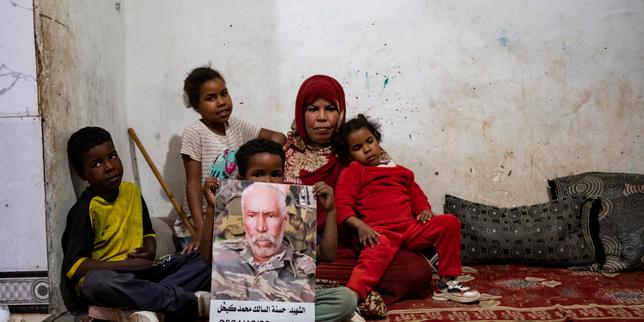
The dust in the Tindouf camps does more than just clog the lungs of the hundred thousand souls trapped there; it obscures a geopolitical stalemate that is rapidly decomposing into something far more volatile. For decades, the narrative surrounding the Sahrawi refugee camps in southwestern Algeria was one of frozen conflict and patient diplomacy. That era ended in November 2020 when the ceasefire between Morocco and the Polisario Front disintegrated at the Guerguerat buffer zone. Today, the "war" is a spectral presence—a series of low-intensity skirmishes and drone strikes that the world largely ignores, while the youth in the camps face a choice between radicalization, migration, or a slow decay in the desert.
The reality of the current conflict is not found in grand territorial gains, but in the psychological exhaustion of a population used as a human shield for regional ambitions. Algeria provides the ground and the weaponry, Morocco provides the "sand wall" and superior technology, and the Sahrawi people provide the tragic imagery required to keep the international aid checks coming. This is no longer a liberation movement in the classical sense. It has become a managed crisis where the status quo serves everyone except the people living in mud-brick houses. Read more on a related subject: this related article.
The Guerguerat Fracture and the Death of the Status Quo
When Moroccan forces moved to clear a blockade at the Guerguerat crossing in late 2020, they didn't just open a road to Mauritania. They collapsed a thirty-year diplomatic architecture. The Polisario Front’s subsequent declaration of a return to armed struggle was intended to force the United Nations back to the negotiating table with a sense of urgency. Instead, the move backfired.
Morocco’s military response was not a full-scale invasion but a calculated deployment of surveillance and precision strike capabilities. The introduction of sophisticated drone technology changed the math of the desert. In previous decades, the Polisario’s land-roving guerrilla tactics could harass Moroccan outposts with relative impunity. Now, any movement east of the Moroccan-built "Berm" is a high-risk gamble against an invisible enemy in the sky. More journalism by USA Today delves into comparable views on the subject.
This technological gap has turned the "war" into a lopsided affair that the Polisario leadership struggles to frame as a victory to their constituents. The communal television sets in Tindouf broadcast reports of "devastating strikes" against Moroccan positions, but the lack of verifiable evidence or territorial shifts tells a different story. It is a war of communiqués rather than conquests.
The Generational Time Bomb in the Camps
Walk through the Smara or Laayoune camps—named after cities their inhabitants haven't seen in generations—and the tension is palpable. The older generation, the "Generation of 1975," is dying out. They were sustained by a revolutionary fervor and the promise that their exile was temporary. The youth, however, are born into a digital world but live in a prehistoric one.
They see the glitz of North African coastal cities on their smartphones while sitting in a sun-scorched wasteland where the most reliable career path is joining the military wing of the Polisario. This creates a dangerous vacuum. When diplomacy fails to offer a timeline and the "war" offers no progress, other forces begin to fill the void. Security analysts have long warned about the permeability of the camps to extremist recruitment from the Sahel. When you have thousands of young men with military training, no jobs, and a growing resentment toward an international community that has forgotten them, you have the raw materials for a regional catastrophe.
The Polisario leadership is aging and increasingly disconnected from this restless demographic. The transition of power within the organization is opaque, and the loyalty of the youth is no longer a given. They are tired of being the permanent guests of the Algerian state, living on dwindling rations while the leaders in Algiers and the Polisario elites debate the finer points of UN resolutions that never seem to change the price of water in Tindouf.
Algeria and Morocco The Great Game of the Maghreb
To understand Tindouf, you have to look 1,000 miles away to the capitals of Algiers and Rabat. The Western Sahara issue is the primary lens through which both nations view their security and regional dominance. For Morocco, the "autonomy plan" is the only deal on the table. They have successfully lobbied major global powers—most notably the United States and Spain—to recognize their sovereignty or at least view their proposal as the most credible path forward.
For Algeria, the Sahrawi cause is a matter of revolutionary principle and, more pragmatically, a way to keep their primary rival bogged down in a permanent security drain. Algiers provides the Polisario with more than just a sanctuary; they provide the diplomatic muscle and the hardware. However, this support comes with strings. The Sahrawis in the camps are often pawns in a larger North African chess match.
The recent severance of diplomatic ties between Algiers and Rabat has only hardened the lines. There is no longer a middle ground. You are either for the "territorial integrity" of Morocco or for the "self-determination" of the Sahrawi people. This binary choice leaves no room for the nuanced, compromise-heavy solutions that are actually required to settle the dispute.
The Aid Industry and the Economy of Exile
There is a cynical truth about the Tindouf camps: they have become an economy unto themselves. International humanitarian aid is the lifeblood of the camps, but it is also a source of significant contention. Reports of aid diversion have surfaced repeatedly over the years, alleging that supplies intended for refugees end up in local markets or are used to fund the Polisario’s administrative and military structures.
This creates a perverse incentive to maintain the refugee status of the population. If the "refugee" label is removed, the funding dries up. The Sahrawis are thus kept in a state of perpetual displacement. Unlike other refugee populations globally, there is very little effort toward local integration or economic self-sufficiency, largely because such moves would undermine the political claim that these people are merely "waiting" to return to their homeland.
Meanwhile, the conditions in the camps are deteriorating. Climate change is making the Sahara even less hospitable, with extreme heatwaves and occasional, devastating flash floods that wipe out fragile shelters. The reliance on imported food has led to high rates of malnutrition and anemia, particularly among women and children. It is a humanitarian crisis kept on a low boil, just enough to justify the aid, but never enough to trigger a massive global intervention.
The Drone Shadow and the End of Conventional Guerilla Warfare
The most significant shift in the last three years is the "Airization" of the conflict. Morocco’s acquisition of Turkish, Israeli, and American drone platforms has effectively neutralized the Polisario’s traditional advantage: knowledge of the terrain and mobility.
The New Rules of Engagement
- Persistent Surveillance: The Berm is no longer just a wall of sand and mines; it is a sensor-fused border that can detect movement dozens of kilometers away.
- Precision Attrition: Morocco can now target high-ranking Polisario commanders with minimal risk to its own personnel. The killing of Addah al-Bendir, the head of the Sahrawi gendarmerie, in 2021 was a watershed moment.
- The No-Go Zone: A vast swath of the territory east of the wall has become a "kill zone" where any unidentified vehicle is liable to be struck. This has crippled the Polisario’s ability to conduct even symbolic raids.
The Polisario has attempted to counter this with older Soviet-era anti-aircraft systems, but the tech gap is widening. This military stalemate is more dangerous than an active war because it provides no resolution while maintaining a high level of threat. It allows the Moroccan side to solidify its "facts on the ground"—investing billions in infrastructure in Dakhla and Laayoune—while the Sahrawis in the camps are left with a military strategy that is increasingly obsolete.
Sovereignty vs Reality
The international community’s approach to the Western Sahara is characterized by a profound "bystander effect." Everyone recognizes the situation is unsustainable, yet no one is willing to spend the political capital to fix it. The UN Mission for the Referendum in Western Sahara (MINURSO) is a misnomer; there hasn't been a serious push for a referendum in decades. Its current role is essentially monitoring a non-existent ceasefire and writing reports that satisfy the bureaucracy of the Security Council.
The "Real Reason" the conflict persists is that the cost of the stalemate is still lower than the cost of a definitive solution for the major players. For Morocco, the cost is the military budget and diplomatic friction. For Algeria, it is the cost of hosting the camps. For the Sahrawis, however, the cost is their future.
The autonomy proposal offered by Rabat—granting the region self-rule under Moroccan sovereignty—is gaining international momentum because it offers a concrete endpoint. The Polisario and Algiers reject it as a violation of international law. But international law is a cold comfort to a thirty-year-old in Tindouf who has never held a passport or had a bank account.
The Radicalization Risk
We have to talk about the "Malization" of the camps. The collapse of order in the Sahel, particularly in neighboring Mali and Niger, has created a thriving black market for weapons, drugs, and human trafficking. The Tindouf camps are not a vacuum. They are connected to these networks by necessity and geography.
When a liberation movement stalls, its soldiers often look for other employers. There have been documented cases of Sahrawi youth appearing in the ranks of various militant groups across the Sahel. This isn't necessarily a matter of ideological conversion; it’s a matter of survival. If the Polisario cannot deliver a state, and the UN cannot deliver a referendum, the desert's "informal economies" will deliver a paycheck.
This is the nightmare scenario for Europe. A destabilized Tindouf would not just be a local tragedy; it would be a gateway for instability to pour into North Africa and eventually across the Mediterranean. The "war in pointillé" (the dotted-line war) is a luxury the region can no longer afford.
Breaking the Cycle of the Desert Mirage
The tragedy of the Sahrawi people is that they have become a professional refugee class, their identity inextricably linked to a struggle that the rest of the world has moved past. The maps in the Tindouf classrooms still show a country that doesn't exist in any functional sense, while the cities on the other side of the wall are being integrated into the global economy.
The path out of this desert requires more than just another UN envoy. It requires a fundamental shift in how the camps are managed. De-linking humanitarian aid from political status is a start. Providing the residents of Tindouf with the right to work and move freely within the region—something the Algerian government has been hesitant to grant—would alleviate the pressure cooker environment.
Ultimately, the ghost war will continue as long as the Polisario leadership and their backers in Algiers believe that time is on their side. But time is the one thing the people in the camps don't have. Every year that passes without a settlement is another year that a new generation is lost to the bitterness of the hamada. The drones will keep flying, the communiqués will keep being issued, and the sand will keep burying the hopes of a population that has been waiting for a tomorrow that never arrives.
The situation demands a brutal honesty that the diplomatic corps is currently unwilling to provide. You cannot feed a population on the memory of a 1970s revolution while the world moves into the mid-2020s. If the stalemate isn't broken by choice, it will eventually be broken by the collapse of the very structures that have kept it frozen for fifty years.
Reach out to your regional policy analysts to demand a transparency audit of the aid pipelines into the Tindouf basin.