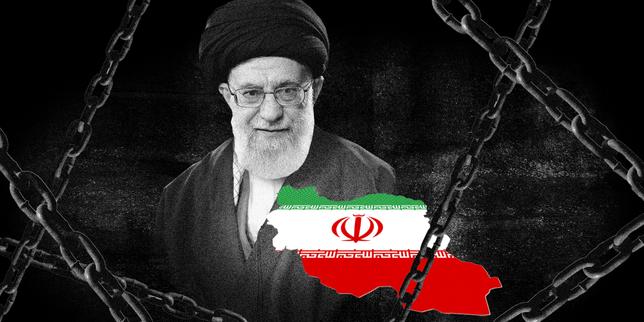
The survival of the Iranian political system relies on a specific structural paradox: the maintenance of republican institutions that are systematically hollowed out to serve a theo-autocratic core. Since assuming the role of Supreme Leader in 1989, Ali Khamenei has transitioned the Iranian state from the charismatic, revolutionary upheaval of the Khomeini era into a rigid, bureaucratized security state. This evolution is not merely a "hardening" of policy but a comprehensive re-engineering of the state's cost-benefit analysis regarding dissent, economic distribution, and institutional loyalty.
The Triad of Institutional Capture
The consolidation of power under Khamenei functions through three primary mechanisms that ensure no single entity—civilian or clerical—can mount a credible challenge to the Office of the Supreme Leader (the Beyt-e Rahbari).
- Vetting as a Filtration System: The Council of Guardians serves as the primary atmospheric control for Iranian politics. By disqualifying candidates who exhibit even moderate deviation from the "Principalist" line, the regime has shifted the Overton window of Iranian discourse. In the 2021 and 2024 cycles, this reached a terminal point where even foundational figures of the Revolution were purged, effectively ending the era of factional pluralism.
- The Parallel Military-Industrial Complex: The Islamic Revolutionary Guard Corps (IRGC) functions as a state within a state. Unlike a traditional military, its loyalty is tethered to the person of the Supreme Leader rather than the constitution. Its control over an estimated 30% to 50% of the Iranian economy—through conglomerates like Khatam al-Anbiya—creates a closed-loop system where the regime can fund its security apparatus independently of the national budget.
- The Shadow Cabinet (The Beyt): Khamenei has expanded the Office of the Supreme Leader into a massive administrative body that bypasses the formal ministries. This office employs thousands of advisors and representatives who are embedded in every provincial government, university, and military branch, ensuring that the Leader’s directives are implemented without the friction of the civilian bureaucracy.
The Mathematical Reality of the Purge
The hardening of the regime is most visible in the narrowing of its elite circle. Historically, the Islamic Republic operated on a "Dual Sovereignty" model, balancing the "divine" legitimacy of the Supreme Leader with the "popular" legitimacy of the Presidency and Parliament. Under Khamenei, the "popular" variable has been systematically devalued.
The logic behind this is a survivalist calculus: as the regime's popularity wanes due to economic mismanagement and social restrictions, the cost of allowing genuine electoral competition exceeds the benefit of the legitimacy that competition provides. Consequently, the regime has opted for "Minority Rule," where it prioritizes the absolute loyalty of a 15-20% core constituency (the Basij and IRGC families) over the broad but shallow support of the general population.
Engineering the "Second Phase" of the Revolution
In 2019, Khamenei released the "Second Phase of the Revolution" manifesto, a strategic blueprint that codified the transition toward a younger, more radicalized generation of technocrats. This document outlines a shift from "Revolutionary Government" to "Revolutionary State," where the goal is no longer just holding power but the total Islamization of all societal functions.
- Technocratic Radicalism: The current administrative class is characterized by individuals who are technically proficient but ideologically unyielding. These are not the "old guard" clerics; they are IRGC-linked professionals who view the state through the lens of asymmetric warfare.
- Information Sovereignty: The development of the National Information Network (NIN) represents the digital component of this hardening. By creating a domestic intranet, the regime has gained the ability to sever the Iranian population from the global internet during periods of unrest without collapsing the digital economy—a tactic successfully deployed during the "Bloody November" protests of 2019.
The Economic Shield: Resistance Economy Logic
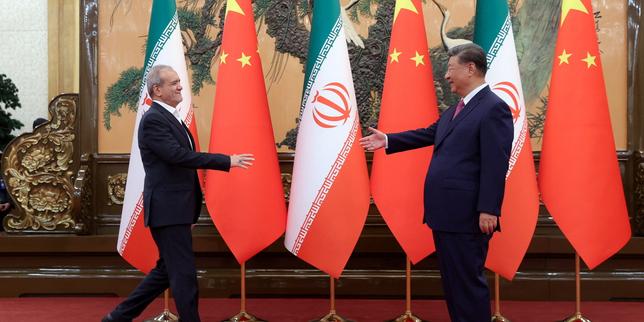
The "Resistance Economy" is the regime’s response to international isolation. It is not a policy of growth, but a policy of resilience. The goal is to make the Iranian state "unsanctionable" by diversifying trade partners toward the "Global East" (China and Russia) and internalizing supply chains.
This economic strategy has a profound domestic political impact. It reinforces the IRGC’s dominance, as only entities with paramilitary backing possess the logistics and "gray market" expertise to bypass international banking restrictions. This creates a feedback loop: the more the regime is sanctioned, the more the civilian private sector atrophies, and the more the IRGC-linked economy expands, further centralizing power in the hands of the hardliners.
Succession Planning as a Forcing Function
The tightening of the regime is inextricably linked to the looming succession. Khamenei, now in his mid-80s, is overseeing the construction of a political environment that will ensure his successor is not a reformer who might dismantle his legacy.
The Assembly of Experts, the body responsible for choosing the next Leader, has been thoroughly purged of moderate influences. The current structural rigidity is designed to prevent a "Gorbachev moment"—a situation where a new leader attempts to reform a brittle system, only to inadvertently trigger its collapse. By narrowing the field of potential candidates to a handful of ultra-loyalists, the regime is attempting to pre-determine the outcome of the succession before it even begins.
The Fragility of Total Control
While the regime appears more cohesive than ever, this cohesion is achieved through the elimination of "pressure valves." In the past, the presence of reformist or centrist factions allowed the population to hope for incremental change within the system. By removing these factions, the regime has simplified the political landscape into a binary: total submission or total opposition.
The strategic risk for the Office of the Supreme Leader is that by closing all avenues for internal reform, it has made the system brittle. The reliance on the IRGC as the sole pillar of support creates a "Praetorian Guard" problem; if the interests of the IRGC leadership ever diverge from those of the Supreme Leader’s office, the Leader has no other institutional weight to counter them.
Strategic Trajectory
The Iranian state has transitioned from a populist-theocratic hybrid to a militarized autocracy. For external observers and internal actors, the operating assumption must be that the regime has abandoned its quest for broad-based domestic legitimacy in favor of high-efficiency repression and economic autarky. The "hardening" is not a temporary phase, but the final form of the Khamenei era—a system designed to survive its creator through the institutionalization of ideological purity and the monopolization of force.
The primary variable to monitor is the cohesion of the IRGC mid-level officers. While the top leadership is ideologically and economically tethered to the current structure, the mid-levels are subject to the same inflationary pressures and social tensions as the general public. Any fracture in this segment would represent the first genuine threat to the consolidated architecture Khamenei has spent three decades building.
Would you like me to analyze the specific economic data regarding IRGC-linked holdings to quantify their impact on the Iranian GDP?