A single spark on a tiny island in the Persian Gulf doesn't usually make the commute in Chicago or the heating bill in London feel any different. We live in a world of buffered distances. We assume the grid is a constant, as reliable as the sunrise. But yesterday, that distance vanished.
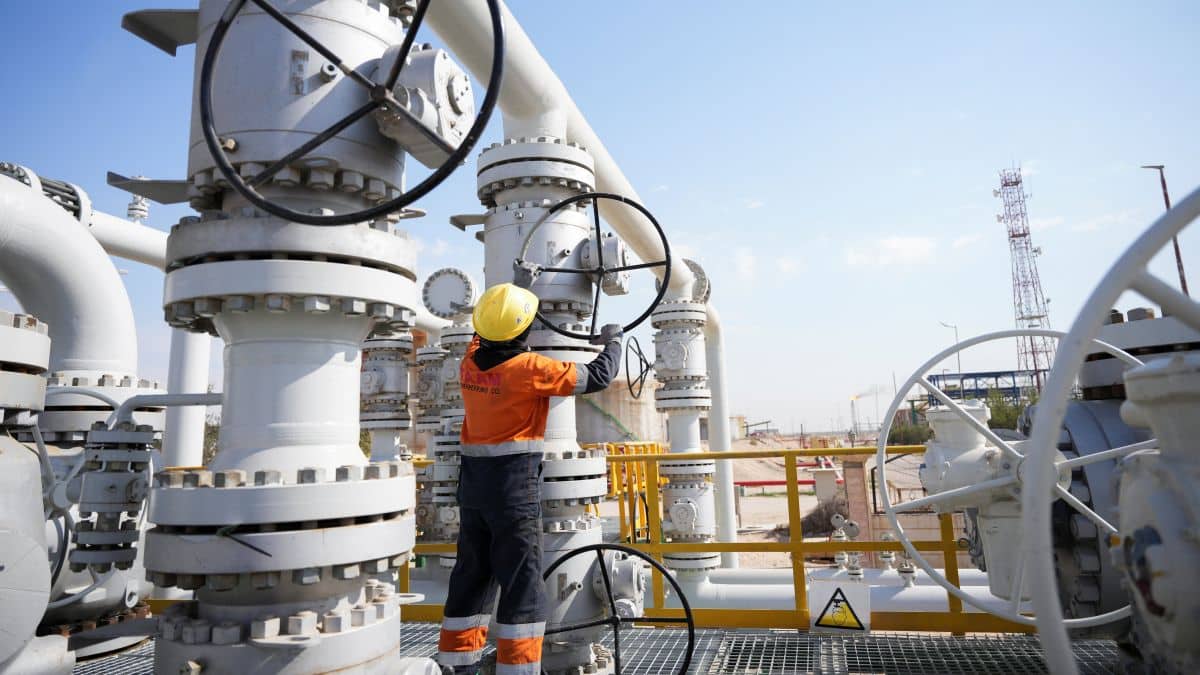
Kharg Island is a scorched thumb of land poking out into the sea. It is not a place for tourists. It is a place of cold steel, massive pipes, and the constant, rhythmic thrum of black gold moving from the earth into the bellies of gargantuan tankers. To the global economy, it is a jugular vein. When American munitions struck the terminal facilities there, they didn't just hit concrete and metal. They hit the invisible thread that holds our modern, electrified lives together.
Consider a man named Elias. He is a hypothetical composite of the thousands of engineers who live in the shadow of those flares. When the sirens began, he wasn't thinking about geopolitics or the abstract concept of "crude futures." He was thinking about the vibration in his chest. The sky didn't just turn red; it folded. The pressure wave from a precision strike doesn't feel like a movie explosion. It is a physical weight that displaces the air in your lungs.
As the fires climbed into the atmosphere, the digital boards in trading floors from Singapore to New York began to bleed. This is where the story leaves the island and enters your pocketbook.
The Math of a Narrow Strait
The world consumes roughly one hundred million barrels of oil every single day. It is the blood in the veins of every delivery truck, every cargo ship carrying your next smartphone, and every plastic component in a hospital ventilator. About a fifth of that supply passes through the Strait of Hormuz. Kharg Island is the primary loading point for Iranian exports, a massive piece of that specific puzzle.
When you remove a piece that large, the remaining pieces don't just sit still. They scream.
In the hours following the strike, Brent crude didn't just climb; it leaped. This isn't just a number on a screen for billionaires to fret over. It is a tax on existence. Within forty-eight hours, the price of a gallon of gasoline at a pump in Ohio or a liter in Berlin begins to creep upward. But the pump is only the visible symptom. The real damage happens in the dark.
Think of the logistics manager at a regional grocery chain. Her margins are already thin. When the cost of diesel for her fleet jumps by twenty percent overnight, she has two choices. She can lose money and go out of business, or she can change the price of a gallon of milk. You aren't just paying for the milk. You are paying for the fuel that moved the cow's feed, the electricity that cooled the vat, and the diesel that drove the carton to your neighborhood.
The Echo of Retaliation
The tragedy of this specific escalation is the predictability of the response. Tehran did not wait for the smoke to clear before issuing a vow of "crushing" retaliation. In the language of modern warfare, this rarely means a symmetrical tank battle. It means the "Tanker War" of the 1980s, reimagined with twenty-first-century drones and sea mines.
Imagine a sea captain navigating the narrow waters of the Gulf. The water looks the same as it did yesterday, but the silence is different. Somewhere beneath the surface or humming in the clouds above, a message is being sent. If Iran decides to choke the Strait of Hormuz in response to the Kharg strike, the global economy won't just slow down. It will hit a wall.
We often think of "The Economy" as a giant, indestructible machine. It's actually more like a high-wire act performed in a windstorm. Everything depends on the expectation of tomorrow being roughly the same as today. When that expectation breaks, panic takes its place.
If the Strait is closed, even partially, we are looking at oil prices that could realistically double. We have seen this script before, but never with a world so deeply interconnected and so fragile from previous shocks. The ghost of 1973 begins to haunt the halls of every central bank.
The Human Cost of High Energy
The stakes are highest for those who have the least to give. In developing nations, energy isn't a luxury or a convenience. It is the difference between a farm being able to pump water or a village having light to study by at night. When global prices spike because of a missile strike halfway across the world, people in sub-Saharan Africa or Southeast Asia don't just "budget better." They go hungry.
This is the hidden gravity of the Kharg Island strike. It creates a ripple effect that gains strength as it travels.
By the time you feel it, it might just look like a slightly higher credit card bill or a more expensive plane ticket for a summer vacation. But for the small business owner trying to keep the lights on, it is a suffocating pressure. For the parent choosing between a full tank of gas to get to work or a full cart of groceries, it is a crisis of the soul.
We are currently witnessing the dismantling of the "just-in-time" world. For decades, we optimized everything for efficiency, assuming the routes would always be open and the terminals would always be standing. We traded resilience for a lower price point. Now, as the fires on Kharg Island burn bright enough to be seen from space, we are being handed the bill for that trade.
The Fragility of the Grid
There is a specific kind of dread that comes with realizing how much of our lives we don't actually control. We flick a switch, and the light comes on. we turn a key, and the engine starts. We assume the complexity of the world is handled by people smarter than us, in rooms we will never enter.
But those rooms are currently filled with people who are just as uncertain as we are.
The strike on Iran’s oil heart is a gamble. The logic, according to the official statements, is to drain the resources of a hostile state and prevent further regional aggression. It is a move played on a chessboard where the pieces are made of flesh and blood. The hope is that the pressure forces a hand. The reality is often that pressure creates an explosion.
If the retaliation comes in the form of cyberattacks on Western infrastructure or the physical disruption of other energy nodes, the "deepening crisis" mentioned in the headlines will become a lived reality for every person reading this. We are no longer spectators to a conflict in the Middle East. We are participants in its consequences.
The tankers are sitting still now, waiting for orders, their hulls reflecting the orange glow of a horizon that shouldn't be that color. In homes thousands of miles away, people are sleeping, unaware that the cost of their tomorrow just changed irrevocably. The world is a much smaller place than we like to admit, and tonight, it feels smaller than ever.
The true weight of a bomb is not measured in megatons. It is measured in the silence of a factory that can no longer afford to run, the empty shelves of a store at the end of a broken supply chain, and the cold stare of a thermostat that won't go any higher. We are all connected by a river of oil, and that river is currently on fire.