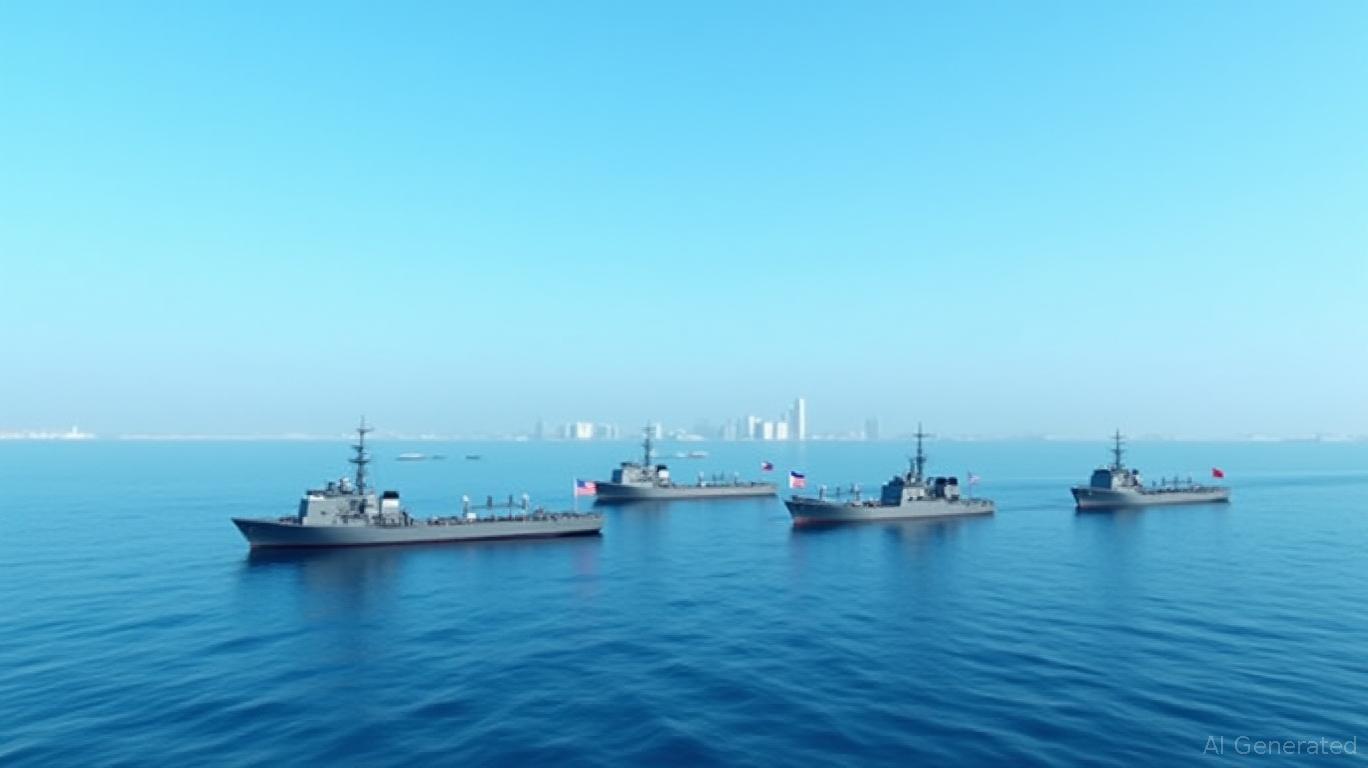
The global oil market is currently pricing in a ghost. While Brent crude spikes on the heels of renewed threats from the Trump administration to intensify strikes against Iranian assets, the real crisis isn't just the potential for fire in the sky. It is the structural fragility of the world’s most important chokepoint. Allied forces are currently meeting in closed-door sessions to map out how to keep the Strait of Hormuz open, but these discussions often ignore a brutal reality. You cannot protect a narrow waterway against a motivated actor using asymmetric tactics with traditional naval doctrine alone.
Donald Trump’s vow to "finish the job" regarding Iran’s nuclear and regional ambitions has injected a specific kind of volatility into the energy sector. We are seeing a shift from managed tension to high-stakes brinkmanship. The immediate result is a surge in oil prices, but the underlying mechanics of this surge reveal a terrifying lack of redundancy in global supply chains. If the Strait closes, even for a week, the economic fallout would dwarf the 1973 oil embargo.
The Chokepoint Math
To understand the gravity of the situation, one must look at the sheer volume of trade passing through this twenty-one-mile-wide strip of water. Roughly 20% of the world’s total petroleum consumption moves through the Strait of Hormuz daily. This includes the majority of crude from Saudi Arabia, the UAE, Kuwait, and Iraq, along with nearly all of Qatar’s Liquefied Natural Gas (LNG).
The math is simple and unforgiving. If 20 million barrels of oil per day are removed from the market, there is no "spare capacity" on earth that can fill the gap. The United States Strategic Petroleum Reserve (SPR), while a significant cushion, is designed for supply disruptions, not a total systemic blockage. Allies are currently debating the deployment of enhanced mine-sweeping capabilities and drone-shielding for tankers, but these are tactical band-aids on a femoral artery wound.
Why the US Military Cannot Guarantee Flow
For decades, the presence of the U.S. Fifth Fleet in Bahrain served as a psychological deterrent. That deterrent is rotting. Modern warfare has shifted toward low-cost, high-impact tools that negate the advantage of a billion-dollar destroyer. Iran does not need to win a naval battle; they only need to make insurance premiums for commercial tankers so high that the shipping industry grounds itself.
The use of unmanned surface vessels (USVs) and "swarm" drone tactics means that a single successful strike on a VLCC (Very Large Crude Carrier) could create an environmental and logistical nightmare that halts traffic indefinitely. Allied navies are training for this, but the defensive cost-curve is unsustainable. Spending a $2 million interceptor missile to take down a $20,000 drone is a losing game of attrition.
The Trump Factor and the Strategy of Maximum Pressure
The return to a "Maximum Pressure" campaign is more than just rhetoric. It is an attempt to decapitate the Iranian economy by targeting the "ghost fleet"—the network of aging tankers that move Iranian crude to China under various flags of convenience. By vowing to step up attacks, the administration is signaling that the era of turning a blind eye to these shadow exports is over.
This creates a cornered-rat scenario. Tehran knows that its only real leverage against a direct military confrontation is its ability to hold the global economy hostage via the Strait. When the Trump administration talks about "surgical strikes" on Iranian infrastructure, they are betting that Iran will not dare to close the waterway for fear of total regime collapse. It is a gamble with the global GDP as the ante.
The Myth of Alternative Pipelines
Policymakers often point to the East-West Pipeline in Saudi Arabia or the ADCOP pipeline in the UAE as "solutions" to a Hormuz closure. This is a dangerous oversimplification. At best, these pipelines can handle about 6 to 7 million barrels per day. That still leaves a deficit of over 13 million barrels per day.
Furthermore, these pipelines terminate at terminals that are themselves within range of regional missile batteries. There is no "safe" route for Persian Gulf oil in a hot war scenario. The infrastructure is too concentrated, too static, and too vulnerable to modern precision-guided munitions.
The Chinese Complication
While the U.S. and its allies discuss security, China sits in an awkward position. China is the primary recipient of the oil that moves through the Strait. Any prolonged disruption would cripple the Chinese manufacturing engine. However, Beijing has also been the primary financial lifeline for Iran.
We are seeing a quiet but frantic diplomatic effort from Beijing to restrain both Washington and Tehran. If the U.S. successfully chokes off Iranian exports, China loses its cheap, "off-the-books" energy source. If Iran closes the Strait in retaliation, China loses everything. This makes the current oil price surge a geopolitical weapon that the U.S. is using not just against Iran, but to squeeze Chinese economic stability.
Insurance Markets Are the True Barometer
If you want to know how close we are to a disaster, don't look at the futures market; look at the War Risk Surcharge in the shipping industry. Currently, underwriters are hiking premiums at a rate that suggests they view a kinetic incident as a "when," not an "if."
When a shipowner has to pay an extra $200,000 per voyage just to enter the Gulf, that cost is passed directly to the consumer. This is a hidden tax on the global economy that exists even without a single shot being fired. The "oil price surge" reported in the headlines is merely the tip of an iceberg made of logistics costs and risk-mitigation capital.
The Failure of Allied Coordination
The current "discussions" between allies are fraught with disagreement. European nations, still reeling from the energy shocks caused by the Russia-Ukraine conflict, are terrified of another price spike. They want de-escalation at any cost. Meanwhile, the U.S. is pushing for a more aggressive maritime coalition to "police" the waters.
The problem is that many allies are hesitant to put their hulls in the water. They remember the "Tanker War" of the 1980s, which required a massive, multi-year commitment just to maintain a semblance of order. In the current political climate, few Western leaders have the stomach for a protracted naval engagement in the Middle East that could last years and cost thousands of lives.
The Reality of Energy Transition Narratives
There is a frequent argument that the "green transition" makes the Strait of Hormuz less relevant. This is a delusion. While EVs are growing in market share, the heavy industry, shipping, and aviation sectors remain tethered to hydrocarbons. Furthermore, the global petrochemical industry—the source of everything from plastics to fertilizers—is utterly dependent on the feedstocks coming out of the Gulf.
A disruption in the Strait is not just about the price of gas at the pump in Ohio; it is about the price of bread in Egypt, the price of shipping containers in Rotterdam, and the stability of the global food supply. The interconnectedness of modern trade means that a local conflict in a twenty-mile stretch of water is a global systemic shock.
Weaponizing the Dollar
The Trump administration's strategy also involves the aggressive use of secondary sanctions. By targeting any bank or entity that facilitates the trade of Iranian oil, they are effectively weaponizing the U.S. dollar. This forces allies into a "with us or against us" position that many are beginning to resent.
This resentment is driving a long-term shift toward non-dollar trade, but that shift is too slow to help in the current crisis. For now, the world is stuck in a loop: the U.S. threatens Iran, Iran threatens the Strait, the price of oil climbs, and the global consumer pays the bill.
The Role of Tactical Miscalculation
In any high-pressure environment, the greatest risk is a mistake. A stray missile, a misunderstood naval maneuver, or a rogue commander can trigger a cascade that no one actually wants. The "discussions" currently taking place are an attempt to build "guardrails" around a potential conflict, but guardrails don't work when the road itself is collapsing.
The surge in oil prices we are seeing now is a warning. It is the market's way of screaming that the current status quo is unsustainable. We have built a global civilization on the assumption that oil will always flow through a narrow, contested gateway, regardless of the political madness surrounding it. That assumption is now being tested by an administration that thrives on unpredictability.
Moving Beyond Rhetoric
The true test for the allies will not be their ability to issue joint statements or conduct naval exercises. It will be their ability to create a genuine alternative to the Hormuz dependency. This would require a massive, multi-decade investment in trans-continental pipelines and a fundamental restructuring of how energy is moved across the planet.
Until then, we are all passengers on a tanker moving through a minefield. The price of oil will continue to swing wildly based on the latest post or speech, but the underlying danger remains constant. The Strait of Hormuz is a Loaded Gun held to the head of the global economy, and right now, many hands are reaching for the trigger.
The immediate action step for any business or nation reliant on these flows is not to wait for "stability" to return. Stability is a relic of a previous geopolitical era. The only rational move is to aggressively diversify supply chains and hedge against a scenario where the Strait of Hormuz becomes a permanent no-go zone. Those waiting for a return to the "old normal" will be the first to go bankrupt when the first torpedo hits.