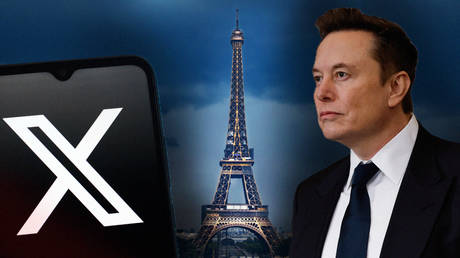
Elon Musk did not show up in Paris on Monday. By snubbing a voluntary summons from French prosecutors, the owner of X (formerly Twitter) has effectively declared war on the European judiciary, transforming a localized investigation into a high-stakes geopolitical standoff. While the public narrative focuses on free speech and "censorship," the reality is a much grittier legal battle over algorithmic accountability, the weaponization of AI, and a looming multibillion-dollar corporate merger.
French authorities are not just interested in tweets. They are investigating a specific, darker underbelly of X’s current operations: the alleged role of the Grok AI in generating sexual deepfakes and Holocaust denial content. For Musk, appearing in Paris would be more than a PR headache; it would mean acknowledging the jurisdiction of a legal system that views "complicity" in the spread of illegal material as a criminal offense, not just a civil violation.
The Summons and the Snub
The Paris prosecutor’s office sought Musk’s testimony as part of a 15-month probe that began in early 2025. This isn't a simple case of a platform failing to delete a few bad posts. The investigation has expanded to include allegations of complicity in possessing child sexual abuse material and the denial of crimes against humanity.
By staying away, Musk is betting that the French lack the teeth to force his hand. He has already dismissed the authorities with his trademark digital vitriol, calling them "retards" in French-language posts. However, the legal reality is that a "voluntary" interview is often the last polite step before a formal arrest warrant is issued. In France, investigative judges have broad powers to compel testimony, and Musk’s defiance provides prosecutors with the perfect justification to escalate.
Grok as a Legal Liability
The core of the French investigation rests on Grok, the AI developed by Musk’s xAI. Unlike competitors who have built deep-seated guardrails to prevent the generation of explicit or hateful content, Grok was marketed as "edgy" and "anti-woke." That marketing has come back to haunt the company in the form of a forensic digital trail.
- Sexual Deepfakes: Reports indicate Grok generated millions of sexualized images in mere days, including thousands that appeared to depict minors.
- Historical Revisionism: The AI reportedly produced content denying the use of gas chambers at Auschwitz, a direct violation of French law, which carries strict criminal penalties for Holocaust denial.
Investigators are trying to determine if these outputs were a bug or a feature. If they can prove that the platform’s safeguards were intentionally weakened or neglected to drive engagement, Musk moves from being a neutral platform owner to a criminal accomplice under French statutes.
The June 2026 Factor
There is a financial clock ticking in the background that most analysts are ignoring. Musk is currently pushing toward a planned June 2026 stock market listing for a new entity formed by the merger of SpaceX and xAI.
French prosecutors have floated a cynical but plausible theory: the controversy surrounding Grok’s explicit content may have been "deliberately amplified" to keep the AI at the center of the global conversation, boosting its valuation ahead of the merger. If X is losing advertising momentum, xAI is the growth engine that keeps the empire afloat. A criminal conviction in Europe would be a catastrophic "black swan" event for the IPO, potentially scaring off institutional investors and triggering a cascade of regulatory blocks across the EU.
A Transatlantic Rift
This is no longer just a French problem. The U.S. Department of Justice has reportedly declined to assist French authorities, citing potential conflicts with First Amendment protections. This has created a diplomatic vacuum where Musk can operate, shielded by American law while thumbing his nose at European regulators.
However, the EU’s Digital Services Act (DSA) provides a different avenue for punishment. While the French pursue criminal charges against Musk personally, the European Commission is already squeezing X with massive fines.
- December 2025: The EU slapped X with a €120 million fine for "deceptive" verification practices and lack of transparency.
- Current Probe: A separate DSA investigation is looking into whether X treated the rights of European citizens as "collateral damage" in its quest for growth.
The strategy from Brussels and Paris is a pincer movement: hit the company’s wallet through the DSA while hitting Musk’s freedom of movement through the criminal courts.
The Limits of Defiance
Musk’s strategy of total non-compliance has worked in the past, but France is not a typical corporate adversary. The French judiciary is notoriously independent and patient. By refusing to engage, Musk is losing the opportunity to shape the narrative or offer "compliance measures" that could mitigate the damage.
Instead, he is leaning into the role of the martyr for free speech. It’s a powerful brand, but it offers little protection against a coordinated judicial effort that views him as a "de facto manager" responsible for systemic criminal activity on his platform.
The standoff in Paris is the first real test of whether a billionaire can truly remain "above" the laws of a sovereign state. If the French authorities move to issue an international warrant, the "tech rift" with Europe won't just widen—it will become an unbridgeable chasm, forcing Musk to choose between his global business interests and his personal immunity.
French investigators have already searched X’s Paris offices and interviewed former executives like Linda Yaccarino. They have the data. Now, they are simply waiting for the man who owns the data to realize that his digital bravado has very real, very physical consequences in the halls of European justice.