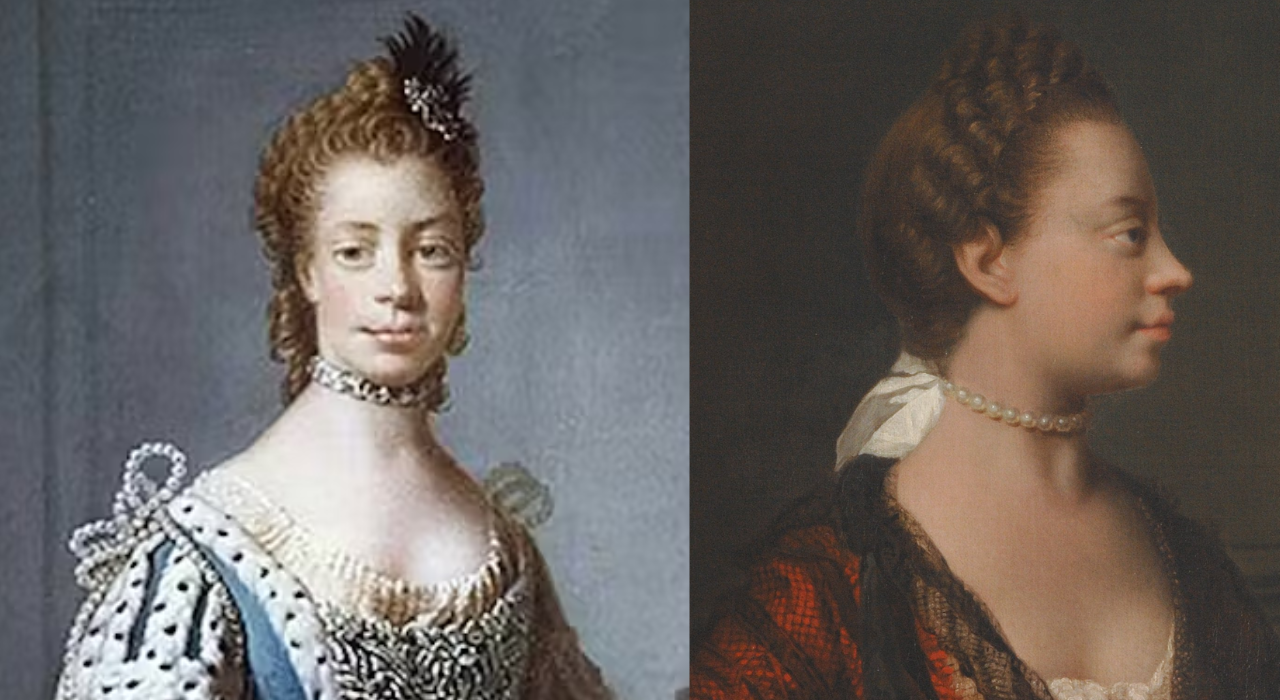
The debate regarding Queen Charlotte’s racial identity is not a matter of subjective interpretation but a conflict between two distinct analytical frameworks: genealogical trace-evidence and the social construction of 18th-century European nobility. To evaluate the claim that Britain’s consort from 1761 to 1818 was a woman of color, one must move beyond the stylized depictions in modern media like Bridgerton and instead deconstruct the three primary variables that drive this hypothesis: the "De Sousa" genealogical lineage, the contemporary physiognomic accounts, and the systemic filters of royal portraiture.
The Genealogic Anchor: The De Sousa Lineage
The foundational argument for Queen Charlotte’s African ancestry rests on a specific genealogical link occurring approximately 500 years prior to her birth. Historian Mario de Valdes y Cocom identified a connection between Charlotte and Madragana Ben Aloandro, a woman who lived in the 13th century.
The structural logic of this claim follows a cascading descent model:
- The Origin Point: Madragana Ben Aloandro was the mistress of King Alfonso III of Portugal.
- The Ethnic Classification: Valdes y Cocom posits that Madragana was a "Moor," a term that in a medieval Iberian context could denote North African Berbers, Arab Muslims, or sub-Saharan Africans.
- The Transmission Path: The lineage passed through the De Sousa family, a prominent Portuguese noble house, eventually merging with the House of Mecklenburg-Strelitz.
From a statistical probability standpoint, the impact of a single ancestor fifteen generations removed is negligible. In a standard genetic inheritance model, an individual carries approximately 1/32,768th of the DNA from an ancestor at that generational distance. Therefore, even if Madragana was definitively of sub-Saharan African descent, the "biological" presence of that heritage in Queen Charlotte would be functionally invisible without the intervention of endogamy—the practice of marrying within a specific social or ethnic group. Since the Mecklenburg-Strelitz line married extensively into other European Germanic and Central European houses, the dilution of that specific genetic marker is a mathematical certainty.
The Physiognomic Record: Subjective Observation vs. Artistic Convention
The second pillar of the "Woman of Color" hypothesis relies on the written accounts of Charlotte’s contemporaries. These descriptions often deviated from the standard adulation afforded to royalty, using coded or explicit language to describe her features.
Sir Walter Scott described her as "ill-colored," while the royal physician Baron Stockmar wrote that she had a "true mulatto face." These observations create a data discrepancy when compared to the visual record provided by court painters. To resolve this discrepancy, we must analyze the "Portraiture Filter." In the 18th century, royal portraiture functioned as a political tool rather than a biometric record. Painters were commissioned to emphasize "European" ideals of beauty: pale skin, thin lips, and narrow noses.
The works of Allan Ramsay, however, are often cited as the most "accurate" because of his known anti-slavery sentiments and his tendency toward realism. His 1762 coronation portrait of Charlotte depicts her with features that some art historians argue are more representative of African heritage than those found in the works of her other contemporary, Benjamin West.
The divergence in these accounts suggests a conflict between:
- The Royal Brand: The idealized, bleached-out image required for international diplomacy.
- The Biological Reality: The physical traits observed by those in her immediate proximity.
- The Social Taxonomy: How 18th-century observers categorized "otherness" when a person did not meet the exact aesthetic standards of the Germanic elite.
The Social Construction of Blackness in the 18th Century
Applying 21st-century racial definitions to the 1700s creates an analytical bottleneck. In the Georgian era, "Blackness" was often tied to legal status and proximity to the slave trade rather than a strict biological percentage.
If Charlotte had visible African ancestry, her position at the apex of the British Empire would have created a systemic paradox. The British monarchy was the primary beneficiary of the Royal African Company. The recognition of a Queen Consort with African heritage would have destabilized the racial hierarchies used to justify the transatlantic slave trade.
The "Silence of the Archives" serves as a critical data point here. While political enemies of the crown often used any available leverage to discredit the monarchy, Charlotte was rarely attacked on the basis of her race in contemporary political pamphlets. The insults directed at her were typically focused on her perceived "homeliness" or her "frugality." The absence of racialized political satire suggests that either her African features were too subtle to be weaponized or that the social category of "Black" was so diametrically opposed to the category of "Queen" that the two could not be cognitively reconciled by the public at the time.
The "Bridgerton" Effect: Media as Historiographical Disruptor
The Netflix series Bridgerton does not claim historical accuracy, yet it has fundamentally altered the public's perception of the historical Queen Charlotte. This creates a "Feedback Loop of Perception" where the dramatized version of history becomes the primary reference point for the general population.
The show utilizes a "What If" framework: What if the King’s marriage to a woman of color had been the catalyst for a "Great Experiment" in racial integration? While narratively compelling, this obscures the actual historical mechanism. Historically, Charlotte’s role was not to disrupt the racial status quo but to provide a stable, Protestant succession for the House of Hanover.
The media's insistence on her identity as a "woman of color" serves a contemporary social function—representation—but it complicates the historical record by prioritizing identity politics over genealogical evidence. The danger in this shift is the erasure of the nuance of 18th-century racial dynamics in favor of a binary "Black or White" logic that did not exist in the same form during Charlotte's reign.
Quantifying the Probability
To reach a definitive conclusion, one must weigh the evidence across four sectors of analysis:
- Genetic Persistence: Low. The 15-generation gap makes significant phenotypic expression highly improbable without repeated reinforcement from similar genetic pools.
- Contemporary Witness Testimony: Moderate to High. The consistency of descriptions mentioning "mulatto" features by those in her inner circle cannot be dismissed as mere aesthetic critique.
- Artistic Evidence: Inconclusive. The variability between Ramsay and West suggests that painters manipulated the subject’s features to align with the client’s preferences.
- Historical Context: Low. The lack of racialized opposition in a period of intense political vitriol suggests that she was not viewed as "Black" by the standards of the time.
Strategic Historical Positioning
The most logically sound position is to view Queen Charlotte as a figure of "ambiguous heritage" rather than a definitive racial pioneer. Labeling her as "Black" in the modern sense is an anachronistic projection. However, acknowledging her as a woman who likely possessed African ancestry—however distant—allows for a more sophisticated understanding of the fluidity of the European aristocracy.
The strategic play for historians and analysts is to move the conversation away from "Was she or wasn't she?" and toward an investigation of why her appearance was noted as "other" by her peers. This shifts the focus from biological essentialism to the study of social perception and the mechanics of power.
The evidence suggests that Charlotte was a product of the European "melting pot" of minor nobility, where centuries of strategic marriages occasionally introduced lineages from outside the Rhine-centered norm. Her "Blackness" was not an identity she lived, but a biological trace that modern society has chosen to amplify to satisfy a demand for historical inclusivity. To treat her as a modern racial icon is to ignore the actual constraints and realities of the Georgian court.
Investigate the specific diplomatic correspondence between the court of Mecklenburg-Strelitz and the British emissaries sent to evaluate Charlotte before the marriage. These documents contain the "raw data" of her physical assessment before she was subjected to the filters of the British court’s propaganda machine.