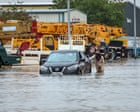
The media loves a good "biblical" flood narrative in the Middle East. Every time a thunderstorm rolls over Riyadh or a drainage system in Dubai hits its limit, the headlines pivot to the same tired script: "unprecedented" weather, "extreme" shifts, and the inevitable, misguided whispers about cloud seeding gone wrong.
They are wrong.
The shock and awe surrounding thunderstorms in the UAE and Saudi Arabia isn't a reflection of a changing climate—it’s a reflection of a collective failure to understand basic arid-land hydrology and the sheer arrogance of modern urban planning. We treat rain in the desert as an anomaly when it is, in fact, a structural necessity that we have spent decades trying to pave over.
The Arid Myth of "Dryness"
The "lazy consensus" suggests that the desert is a place defined by a permanent state of drought, and therefore, any significant rainfall is an existential threat. This is a fundamental misunderstanding of the hyper-arid ecosystem. The desert is not "dry" in the sense of a lack of water; it is a landscape defined by its specific hydrological pulse.
In a temperate climate, you get a slow, steady trickle. In the desert, you get everything at once. This is the Pulse.
When we see the UAE or Saudi Arabia "drenched," we are watching the system function as it has for millennia. The problem isn't the rain. The problem is that we’ve built cities that assume the rain will never come, then act surprised when the water follows its ancient, natural pathways. We have replaced the natural drainage of the wadi—the dry riverbeds—with concrete, then wonder why the streets are rivers.
The Cloud Seeding Boogeyman
Let’s address the elephant in the room: the National Center of Meteorology (NCM) in the UAE and the Saudi Cloud Seeding Program.
Every time there’s a thunderstorm, the conspiracy theorists emerge from the digital woodwork. "They seeded too much! They’ve broken the sky!"
It’s a seductive idea because it gives us a villain to blame. It’s also scientifically illiterate.
Cloud seeding is not some god-like control over the atmosphere. It is a marginal nudge. It involves injecting salt flares or silver iodide into convective clouds to encourage the formation of larger droplets. At its absolute best, most peer-reviewed studies (see the WMO’s position on weather modification) suggest a 10% to 15% increase in precipitation from a specific, already existing cloud system.
Cloud seeding did not create the massive thunderstorms that recently drenched Riyadh. The thermodynamics of the Arabian Peninsula did.
The moisture comes from the Arabian Sea and the Red Sea, fueled by high temperatures that create massive convection. If you think a few salt flares can manufacture a multi-state thunderstorm system, you are overestimating human technology and underestimating the sheer energy of $10^{15}$ joules of solar radiation hitting the sand.
The Cost of Paving the Pulse
I’ve watched developers in Riyadh and Dubai dump billions into "smart city" features—fiber optics, autonomous pods, AI-driven traffic lights—while completely ignoring the most basic smart feature of any city: a functional sewer.
The "biblical" flooding we see isn't a weather problem. It’s a civil engineering crisis.
We have spent fifty years building "Western" cities in an "Eastern" climate. We use European drainage standards for a region where the rainfall intensity (the amount of rain per hour) can be ten times higher than in London or Paris.
- The Error: Designing for the "average" annual rainfall.
- The Reality: The "average" in the desert is a useless metric. You don't get 100mm of rain spread over 100 days; you get 100mm in 45 minutes.
If your drainage pipes are designed for a steady drizzle, they will fail every single time the desert decides to pulse. This isn't a failure of the sky; it’s a failure of the drawing board.
The Counter-Intuitive Truth: We Need More Floods
Here is the take that will get me kicked out of most planning meetings: the UAE and Saudi Arabia don't need "better drainage." They need better retention.
The current strategy is to get the water out of the city as fast as possible. We pump it into the sea or into massive underground cisterns where it sits and does nothing. This is a catastrophic waste of a precious resource.
In a hyper-arid region, every drop of rain is a strategic asset. Instead of fighting the flood, we should be inviting it in.
Imagine a scenario where the "flooded" streets of Dubai were actually designed as permeable sponges. Instead of asphalt, we use porous materials. Instead of curbing off the parks, we drop the elevation of green spaces by three feet, turning every park into a temporary lake during a storm.
This isn't just about preventing puddles. This is about groundwater recharge. The Saudi Vision 2030 and the UAE’s sustainability goals are centered on water security. Yet, we let trillions of gallons of "extreme" rainwater evaporate or flush into the salt-heavy sea because we are too afraid of a wet street.
Stop Asking if the Climate is Breaking
"Is this the new normal?"
This is the most common question I get. It’s the wrong question.
The "normal" was always a lie. We based our idea of "normal" on a tiny window of time—the last 40 years of rapid urbanization—during which we were lucky enough to avoid a massive hydrological event.
The Arabian Peninsula has always had these storms. The difference is that 50 years ago, there was nothing for the water to hit but sand. Now, there’s a Lamborghini in the way.
The climate isn't breaking; your infrastructure is simply being exposed.
We need to stop treating thunderstorms as "news" and start treating them as a predictable, high-intensity part of the desert's operational cycle. If you live in a place where the sun burns at 50°C for half the year, you have to expect that when it finally cools down, the atmospheric snap is going to be violent.
The Actionable Order: The Sponge City Shift
If I were advising the municipal leaders in Jeddah or Abu Dhabi tomorrow, the advice would be brutal and expensive:
- De-Pave the Centers: Rip up the non-essential concrete in high-risk zones.
- Wadi Restoration: Stop building luxury villas in the path of historical dry riverbeds. The water remembers where it used to flow, even if your GPS doesn't.
- Mandatory On-Site Retention: Every new skyscraper or mall should be required by law to capture and store 100% of the rain that falls on its footprint.
The "drenched" desert is only a crisis because we are trying to force the Middle East to behave like a temperate zone. It isn't. It’s a high-energy, high-volatility environment that rewards those who adapt and punishes those who build on the hubris of "dryness."
Quit blaming the clouds. Fix the ground.