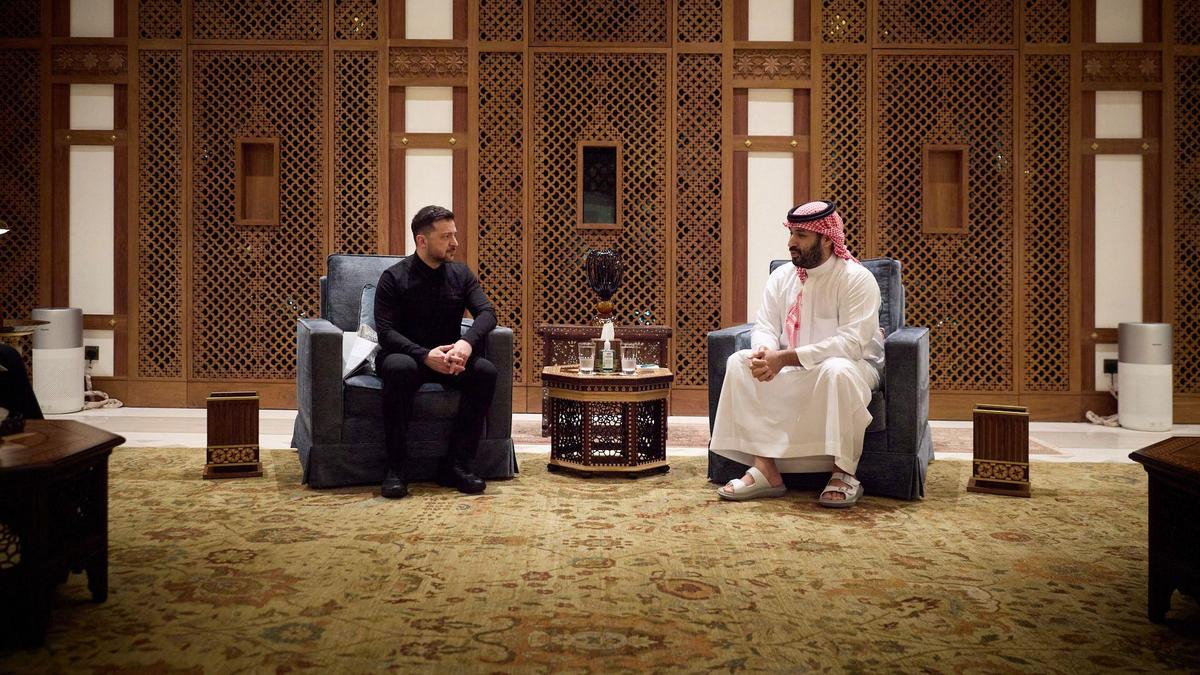
Volodymyr Zelenskyy’s recent arrival in the United Arab Emirates signals a desperate, necessary shift in the arithmetic of the war. While the cameras capture the formal handshakes in Abu Dhabi, the true substance of this visit lies in the backrooms where global finance meets cold-blooded energy policy. Ukraine is no longer just asking for shells and air defense systems from its traditional Western allies. It is now hunting for the capital and diplomatic leverage required to sustain a long-term war of attrition. The UAE represents a unique intersection of Russian money, Western interests, and unaligned ambition.
The calculus is simple. Kyiv knows that the political winds in Washington and Brussels are fickle. By engaging with President Sheikh Mohamed bin Zayed Al Nahyan, Zelenskyy is attempting to bypass the gridlock of the Global North. He is looking for a broker that can speak to both the Kremlin and the White House without the baggage of Cold War ideology. This isn't just about security talks. It is about the survival of the Ukrainian state as a viable economic entity.
The Gray Market Bridge
The UAE has spent the last few years perfecting its role as the world’s most influential middleman. While the West has tightened its sanctions on Moscow, Dubai and Abu Dhabi have remained open for business. This creates a paradox that Zelenskyy must now navigate. He is sitting down with a leadership that provides a safe haven for the very Russian oligarchs who fund the war against his country.
This is not a diplomatic oversight. It is a calculated move. Zelenskyy knows that the UAE is one of the few places on the planet where he can exert pressure on Russian financial flows through a third party. If Abu Dhabi can be convinced that its long-term stability depends on a more stable Europe, the flow of capital back into the Russian war machine might finally see some resistance.
The Emiratis are masters of the hedging game. They have maintained a strategic partnership with the United States while simultaneously expanding their trade with Russia and China. This position gives them a level of influence that many European capitals can only envy. For Ukraine, the UAE is a backdoor to the Kremlin, a channel for prisoner swaps, and a potential source of the massive investment required for future reconstruction.
The Energy Leverage
The war in Ukraine has fundamentally altered the global energy map. The European Union’s pivot away from Russian gas has made Gulf oil and gas more valuable than at any point since the 1970s. This gives the UAE immense leverage. When Zelenskyy talks about "security," he is also talking about energy security.
Ukraine’s energy infrastructure has been a primary target for Russian strikes. Rebuilding a decentralized, resilient power grid is a task that requires billions of dollars and specialized engineering. The Emirati sovereign wealth funds are among the few entities with the capital and the appetite for high-risk, high-reward projects of this scale. This isn't charity. It is an investment in the post-war order.
The Architecture of Neutrality
The West often views the UAE’s "neutrality" through a lens of suspicion. It is easy to see it as a lack of moral clarity. However, from the perspective of the Gulf, this neutrality is a strategic necessity. The Emiratis are building a post-oil economy that requires absolute connectivity to every major global market. They cannot afford to choose sides in a way that shuts them out of either the East or the West.
Zelenskyy’s visit is a recognition of this new reality. He is not there to demand that the UAE join the sanctions regime. He knows that is a non-starter. Instead, he is there to offer an alternative path. By positioning Ukraine as a future agricultural and technological hub for the Middle East, he is making a business case for Ukrainian sovereignty.
This is where the investigative eye must look beyond the official communiqués. The real story is the potential for "triangular trade" involving Ukrainian grain, Emirati logistics, and Middle Eastern investment. Ukraine was once the breadbasket of the Soviet Union. Now, it needs to be the breadbasket of the world. The UAE, with its world-class ports and logistics networks, is the perfect partner for this ambition.
The Weaponization of Diplomacy
Zelenskyy is a performer, but he is also a pragmatic politician who has learned the hard way that rhetoric doesn't win wars. Capital does. The UAE has become a primary hub for the global arms trade, hosting massive defense exhibitions that attract everyone from American aerospace giants to Russian state-owned contractors.
There is a quiet, ongoing discussion about the role of Emirati-manufactured technology in the conflict. While the UAE is unlikely to send tanks to Kyiv, their expertise in drone technology and electronic warfare is world-renowned. Even a subtle shift in their export policies or a more rigorous enforcement of dual-use technology sanctions could have a material impact on the battlefield.
The Emirati leadership is also deeply concerned about the regional fallout of a prolonged conflict. The instability in the Black Sea has direct implications for food security in the Middle East and North Africa. By stabilizing Ukraine, the UAE is protecting its own neighborhood from the ripples of a global hunger crisis. This is the argument Zelenskyy is making behind closed doors. It is a play on self-interest, the most reliable currency in international relations.
The Oligarch Factor
One cannot discuss the UAE and Ukraine without mentioning the Russian presence in Dubai. The city has become a hub for Russians fleeing the draft and for those moving their wealth out of reach of Western banks. This creates a unique opportunity for intelligence and leverage.
The Ukrainian government has been meticulously tracking these financial flows. Zelenskyy’s team is likely presenting evidence of how certain entities are bypassing sanctions through Emirati channels. The goal is not necessarily to shut these channels down entirely—which would be impossible—but to make them more transparent and more costly for Moscow to use.
The Reconstruction Gamble
The cost of rebuilding Ukraine is currently estimated to be in the hundreds of billions of dollars. This is a sum that no single Western nation can provide on its own. The entry of Gulf capital into this space would be a massive boost for Kyiv’s long-term prospects.
For the UAE, participating in the reconstruction of Ukraine is a way to solidify its role as a global power. It allows them to demonstrate their capacity for large-scale development projects and to gain a foothold in the European market. It is a high-stakes gamble, but the Emiratis have never been afraid of the long game.
This visit is about more than just "security talks." It is a fundamental reconfiguration of the Ukrainian war effort. Zelenskyy is moving beyond the traditional alliances of the 20th century and into the messy, multi-polar world of the 21st. He is engaging with the brokers of the new world order on their own terms.
The success of this mission will not be measured in the immediate headlines. It will be seen in the flow of grain through the Bosporus, the arrival of specialized equipment on the Ukrainian power grid, and the quiet tightening of financial oversight in the skyscrapers of Dubai. The war for Ukraine is being fought in the trenches of the Donbas, but its outcome is being negotiated in the air-conditioned boardrooms of the Gulf.
The survival of the Ukrainian state now depends on its ability to integrate itself into the global economy in ways that make it indispensable to neutral powers like the UAE. This is the hard truth of modern conflict. Morality is a useful tool for mobilization, but interest is what sustains a nation through the long, dark years of a war without a clear end in sight.
Kyiv is learning that in a world of shifting alliances, the most important friend is the one who can talk to your enemy while holding your bank account.
The next step in this diplomatic offensive will be the formalization of investment treaties that tie Emirati capital to Ukrainian soil. Watch the movement of the sovereign wealth funds. They are the true indicators of where the power lies.