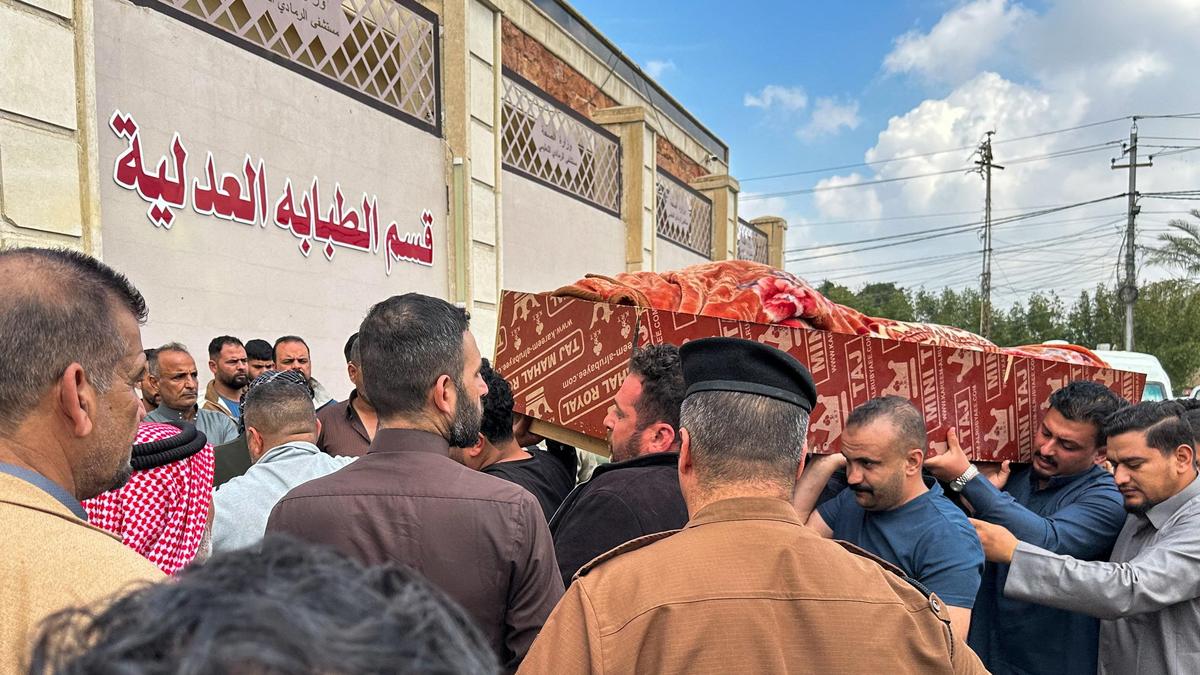
The recent airstrike in western Anbar, resulting in seven Iraqi soldier fatalities and thirteen wounded, represents a systemic failure of the deconfliction protocols essential to counter-insurgency operations. Beyond the immediate tactical loss, this event exposes a critical bottleneck in the Command, Control, Communications, Computers, Intelligence, Surveillance, and Reconnaissance (C4ISR) architecture currently managing the Iraqi border regions. To understand why these "blue-on-blue" or "friendly fire" incidents occur, one must look past the surface-level reporting of "mistakes" and instead analyze the structural decay of the operational environment, the latency in target verification, and the fragmentation of the local security apparatus.
The Triad of Deconfliction Failure
Friendly fire incidents in high-intensity gray zones are rarely the result of a single mechanical error. They are the output of a three-staged breakdown in the operational loop.
1. Spatial Misalignment
In the vast, undulating desert of western Anbar, the absence of recognizable geographic markers forces a heavy reliance on Global Positioning System (GPS) data and Blue Force Tracking (BFT) systems. When ground units maneuver outside of their pre-filed "dirty boxes"—designated areas of operation—or when their transponders suffer from signal degradation due to electronic interference or terrain masking, they effectively become "ghosts" in the eyes of the air controller. If an Iraqi unit moves into a sector previously identified as an insurgent transit corridor without real-time data synchronization, the risk of misidentification reaches a statistical certainty.
2. Temporal Latency
The window between a Joint Terminal Attack Controller (JTAC) identifying a target and the delivery of ordnance is the "kill chain." In western Anbar, this chain is often lengthened by multi-layered authorization processes involving both local Iraqi commands and international coalition oversight. When the intelligence used to justify a strike is even thirty minutes old, the ground reality can shift entirely. A group of soldiers establishing a temporary checkpoint or a defensive perimeter can be mistaken for an insurgent cell preparing an ambush if the surveillance asset (UAV) has not maintained a continuous "unblinking eye" on the target’s evolution.
3. Verification Asymmetry
There is an inherent friction between the speed required for an effective airstrike and the thoroughness required for positive identification (PID). In the Anbar incident, the failure to verify the identity of the target through a secondary visual or electronic handshake indicates that the "Rules of Engagement" (ROE) were either bypassed due to perceived urgency or were insufficiently robust to account for the presence of mobile Iraqi units in non-traditional sectors.
The Cost Function of Operational Fragmentation
The security landscape in western Anbar is not a monolith; it is a patchwork of the Iraqi Army, Federal Police, and various paramilitary groups under the Popular Mobilization Forces (PMF) umbrella. This fragmentation creates a massive "tax" on operational efficiency.
- Interoperability Deficits: Different units often operate on disparate radio frequencies and use incompatible encryption standards. This prevents a pilot from making direct contact with the ground unit they are orbiting.
- Information Silos: Intelligence gathered by one branch of the Iraqi security forces is not always shared horizontally with other units in the same sector. This lack of transparency means an air asset may be cleared to fire by a regional command that is literally unaware that their own soldiers have moved into the impact zone.
- Cognitive Loading: Pilots and remote operators are often managing multiple sensor feeds simultaneously. In a high-stress environment where insurgent "hit-and-run" tactics are common, the cognitive bias toward seeing a threat (confirmation bias) can override the protocols meant to ensure target validity.
The Anatomy of an Errant Strike
When ordnance is released under a "wrong target" scenario, the failure can be traced through the following technical phases:
Phase I: The Detection Bias
An Intelligence, Surveillance, and Reconnaissance (ISR) platform identifies movement in a prohibited zone. Because the zone is classified as "hostile," the baseline assumption of the analyst shifts from neutral to suspicious.
Phase II: The Correlation Gap
The air operations center queries the ground command for friendly presence. Due to the aforementioned communication silos, the ground command provides an outdated or incomplete map of their troop locations. The absence of a "no-fire" overlay on the digital battle map is interpreted as a "clear to engage" signal.
Phase III: The Kinetic Execution
The weapon system—likely a precision-guided munition (PGM)—is deployed. While the PGM hits its intended coordinates with high accuracy, the underlying intelligence was flawed. The high lethality of modern munitions means that even a minor coordination error results in catastrophic casualties, as evidenced by the twenty total casualties in this Anbar event.
Geopolitical Repercussions and Strategic Erosion
The fallout of such an incident extends far beyond the immediate tactical loss of twenty personnel. It triggers a cascade of strategic vulnerabilities that insurgents are quick to exploit.
Erosion of Trust in Central Command
Every instance of friendly fire weakens the bond between the rank-and-file soldier and the high command. When soldiers feel that their own air support is a threat, they become more risk-averse, less likely to conduct deep-desert patrols, and more prone to staying within fortified bases. This cedes the initiative to insurgent groups who thrive in the "un-patrolled" spaces of the Anbar desert.
Political Leveraging
External actors and domestic political factions often use these tragedies to argue for the removal of foreign air support or to demand a restructuring of the military hierarchy that favors their specific interests. This politicization of a tactical failure further complicates the chain of command, making future deconfliction even more difficult.
Recruitment and Propaganda
Insurgent groups utilize high-definition imagery and reports of these strikes to paint the central government as incompetent or as "puppets" who cannot protect their own men. This narrative is particularly effective in the tribal regions of western Anbar, where local loyalties are often tied to the perceived strength and reliability of the security forces.
The Technical Fix: Implementing Hard-Site Deconfliction
To prevent a recurrence, the Iraqi Ministry of Defense must move away from verbal deconfliction and toward automated, hardware-integrated systems.
- Mandatory Universal Transponders: Every vehicle and platoon-sized element operating in Anbar must be equipped with an encrypted, frequency-hopping transponder that is integrated directly into the air-tasking order (ATO) software. Any target that does not emit a "friendly" signal should still require a triple-verified visual PID before engagement.
- The "Human-in-the-Loop" Redundancy: An airborne forward air controller (FAC-A) should be mandated for any strike within 10 kilometers of known friendly outposts. This provides a literal eye in the sky that can orbit the target and look for subtle signs of friendly presence—such as specific vehicle markings or uniform patterns—that a high-altitude drone might miss.
- Real-Time Data Fusion: Establishing a unified "Common Operational Picture" (COP) where every branch of the security forces is required to update their position every 15 minutes. Failure to update the COP should result in an immediate "hold fire" on that entire sector.
Strategic Forecast
The Anbar airstrike is a symptom of a military transition that has outpaced its technical infrastructure. As the Iraqi security forces take more responsibility for border security, the friction between their traditional ground maneuvers and modern, high-speed air operations will continue to generate heat. Without a radical overhaul of the cross-branch communication protocols and the implementation of automated "no-strike" triggers, the desert of western Anbar will remain a high-risk zone for the very soldiers tasked with defending it.
The immediate move for the Iraqi General Staff is the suspension of all non-emergency kinetic air operations in the Anbar sector until a full audit of the "sensor-to-shooter" timeline is completed. This audit must identify exactly where the data packet regarding the soldiers' position was lost—whether it was never sent, never received, or simply ignored in the heat of the engagement. Until the "digital handshake" between the ground and the air is perfected, the cost of air superiority will continue to be paid in friendly blood.
Establish a joint-service "Deconfliction Cell" physically located within the Anbar Operations Command, where representatives from every active unit—including paramilitary and border guards—must sit in the same room as the air controllers to provide a manual, physical verification of every strike coordinate in real-time.