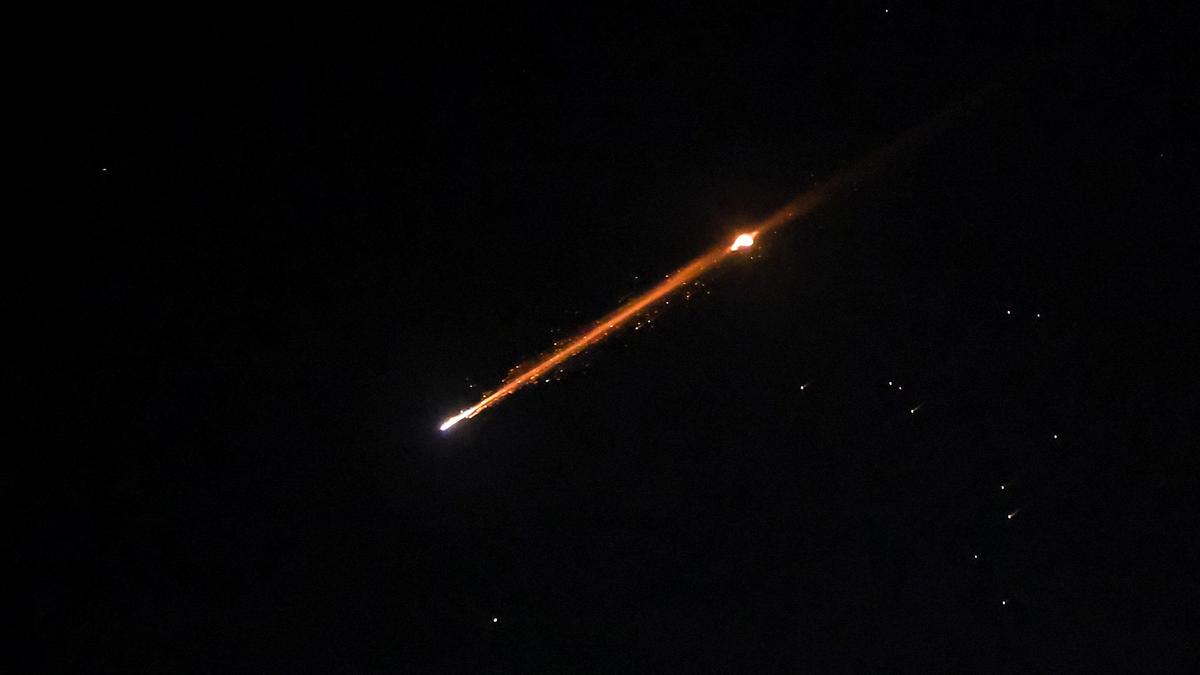
The recent diplomatic signaling at the United Nations by Gulf Cooperation Council (GCC) member states regarding Iranian kinetic actions reflects a shift from tactical concern to a fundamental reassessment of "existential risk." While media narratives often focus on the spectacle of missile intercepts, the underlying crisis is one of structural vulnerability in high-density, high-value economic zones. For states like the United Arab Emirates and Saudi Arabia, the threat is not merely the destruction of property but the catastrophic breakdown of the "Security-Investment Correlation"—the invisible foundation that allows a desert geography to function as a global financial and logistical hub.
The Triad of Sovereign Vulnerability
The existential threat described by Gulf diplomats is best understood through three distinct vectors of systemic failure. Each vector represents a point where traditional defense mechanisms are bypassed by modern asymmetric warfare.
1. The Proximity-Payload Paradox
Gulf states operate within a geography defined by "zero-depth defense." The distance between Iranian launch sites and critical GCC infrastructure—desalination plants, refineries, and urban centers—is often less than 200 kilometers. This creates a compressed OODA loop (Observe, Orient, Decide, Act). When flight times are measured in seconds rather than minutes, the probability of a "lethal leak" through even the most advanced Integrated Air and Missile Defense (IAMD) systems approaches 100% over a sustained engagement period.
2. The Economic Attrition Ratio
There is a profound mathematical imbalance in the cost of engagement.
- The Offensive Unit Cost: Shahed-type loitering munitions or basic ballistic missiles can be produced for $20,000 to $100,000.
- The Defensive Unit Cost: A single Patriot PAC-3 interceptor costs approximately $4 million.
In a prolonged conflict, an adversary can achieve economic victory without ever hitting a primary target by simply forcing the defender to exhaust their inventory of multi-million dollar interceptors against "low-fidelity" targets. The existential threat is, therefore, a projected state of fiscal and kinetic bankruptcy.
3. The Infrastructure Centralization Risk
Unlike the United States or China, which possess vast internal geographies to distribute risk, GCC economies are concentrated in "Gigaproject" nodes. A single successful strike on a facility like the Ras Tanura refinery or the Jebel Ali Port does not just cause localized damage; it creates a systemic choke point for the entire national GDP. The "existential" label refers to this lack of redundancy.
Deconstructing the Iranian Kinetic Doctrine
The Iranian strategy utilizes a "layered saturation" model designed to overwhelm digital and physical defense architectures. By deploying a heterogeneous mix of slow-moving drones, low-altitude cruise missiles, and high-velocity ballistic missiles simultaneously, the attacker creates a computational bottleneck for defensive radars.
The primary objective of these strikes is seldom total destruction. Instead, they function as "Signal Interference Operations." By proving that a "impenetrable" shield can be pierced, the attacker degrades the sovereign credit rating and the "Safe Haven" status of the target nation. Once international insurance markets and multi-national corporations perceive the risk as unmanageable, the economic model of the Gulf—which relies on the frictionless flow of capital and expatriate talent—begins to de-leverage.
The Technical Limits of Current Missile Defense
Standard IAMD systems are built on the assumption of high-value intercept. They are optimized for Cold War-era scenarios involving a limited number of sophisticated nuclear or conventional warheads. They are fundamentally ill-equipped for the "Mass-at-Scale" drone swarms currently being deployed in regional proxies.
Several bottlenecks prevent a purely technological solution:
- Sensor Saturation: Radars have a finite capacity for track-processing. When the number of incoming objects exceeds the processor’s ability to categorize and prioritize, the system defaults to "Fail-Safe" modes or becomes paralyzed.
- Magazine Depth: No matter how many batteries a state purchases, the "re-load" time and total interceptor stock are finite. In a high-intensity 72-hour window, a Gulf state could theoretically run out of ready-to-fire interceptors, leaving the entire national infrastructure exposed to a second-wave "cleaning" strike.
- Multi-Vector Pressure: Attacks originating from Yemen, Iraq, and across the Gulf simultaneously force a 360-degree defensive posture, thinning out resources that were previously oriented toward a single perceived threat direction.
The Shift Toward "Total Defense" Diplomacy
The appeal to the United Nations signifies a transition from military reliance to "Legal and Normative Deterrence." Since the physical cost of defense is becoming unsustainable, Gulf states are attempting to raise the "Political Cost" of Iranian aggression.
This strategy hinges on redefining Iranian strikes not as bilateral skirmishes, but as "Assaults on Global Energy Security." By framing the threat in terms of Brent Crude volatility and the stability of the Suez-to-Indo-Pacific trade routes, the GCC aims to force the permanent members of the Security Council into a position of active enforcement. However, this relies on a level of international consensus that is currently fragmented by the competing interests of the US, Russia, and China.
Strategic Framework for Sovereign Resilience
To move beyond the current state of vulnerability, GCC states must pivot from "Hard Interception" to a model of "Elastic Defense." This involves three structural shifts:
- Distributed Infrastructure: Future development must move away from centralized mega-hubs. Secondary and tertiary nodes for water desalination and power generation must be established to ensure that no single kinetic event can trigger a national blackout or water crisis.
- Directed Energy Implementation: To solve the "Economic Attrition Ratio," investment must shift toward high-energy lasers and microwave counter-UAS systems. These technologies offer a "near-zero" cost per shot, neutralizing the financial advantage of cheap drone swarms.
- Regional Intelligence Integration: The "Middle East Air Defense" (MEAD) concept—sharing sensor data across borders—is the only way to solve the Proximity-Payload Paradox. By seeing a launch from deep within Iranian territory through a neighbor's radar, a state gains the precious minutes required to optimize its defensive response.
The current trajectory suggests that the "existential threat" will persist as long as the cost of offense remains an order of magnitude lower than the cost of defense. The strategic play for Gulf leadership is to aggressively pursue "Asymmetric Defense"—utilizing electronic warfare, cyber-kinetic countermeasures, and regional data-sharing to make the cost of Iranian strikes high enough to deter their use as a standard tool of statecraft. The window for this transition is narrowing as drone technology becomes more autonomous and harder to jam. Success will be measured not by how many missiles are shot down, but by how many are never launched because the tactical objective has been rendered unachievable.