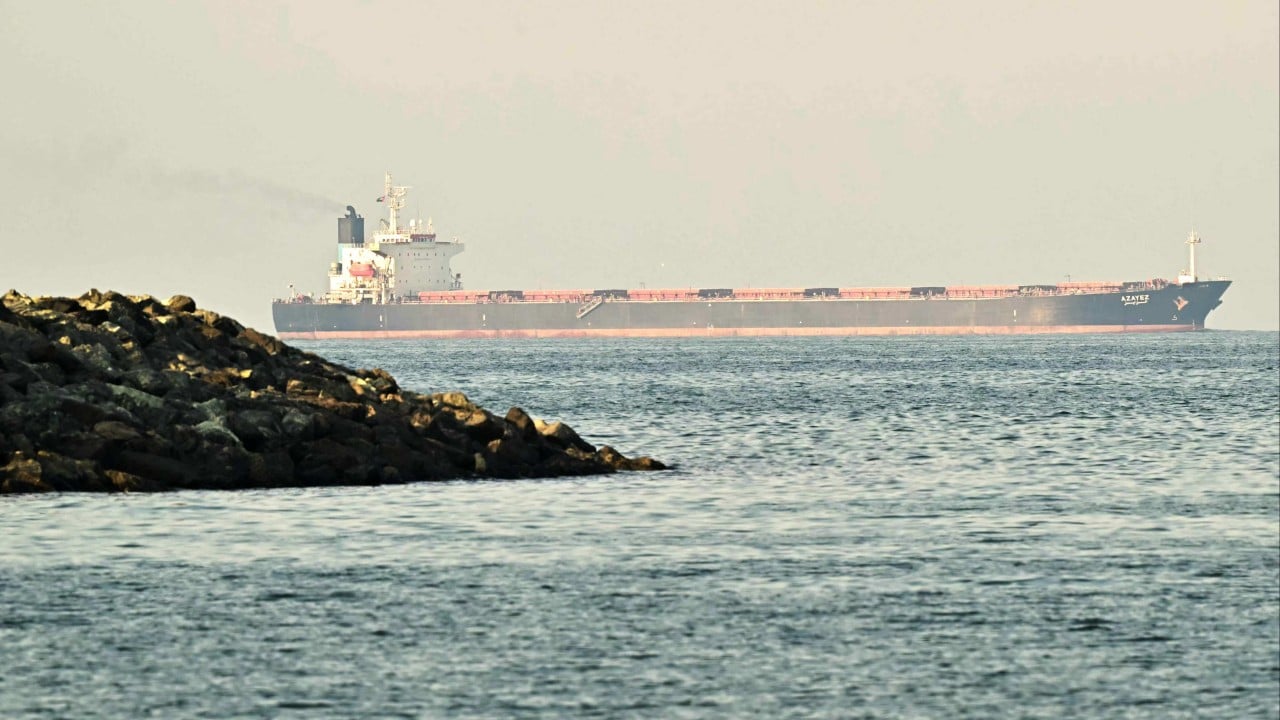
The headlines are predictable. They scream about "Russian drone strikes" and "Panama-flagged vessels" as if we are witnessing a simple act of maritime bullying. The narrative is tidy: a rogue state hits a neutral merchant ship, and the world gasps at the violation of international law.
It is a fairy tale.
If you believe a "Panama-flagged" ship in the Black Sea is actually Panamanian, you’ve been buying the cheap seat tickets to a high-stakes shell game. That vessel is a floating piece of legal fiction. The strike on a grain ship in a Ukrainian port isn't just "collateral damage" or a "war crime" in the traditional sense. It is the violent collision of two realities: the 19th-century concept of national borders and the 21st-century reality of decentralized, flags-of-convenience logistics.
The Myth of the Neutral Vessel
Mainstream reporting focuses on the flag. Panama. Liberia. The Marshall Islands. These are the "open registries" that dominate the high seas. They provide a thin veneer of sovereignty to ship owners who want to dodge taxes, bypass labor laws, and—most importantly during wartime—pretend they aren't part of the conflict.
When a drone hits a Panama-flagged ship, the media treats it as an attack on a neutral party. This is a fundamental misunderstanding of how global trade functions. In reality, these ships are the logistical backbone of a side. In the Black Sea, they are the vital organs of the Ukrainian economy. Calling them "neutral" is like calling a private military contractor a "tourist" because they’re wearing a Hawaiian shirt.
Russia knows this. The insurance markets know this. Only the general public remains confused.
The "lazy consensus" suggests that hitting these ships is a tactical error by Russia because it risks international condemnation. Wrong. It is a calculated economic strangulation that works precisely because the "international community" is paralyzed by the very legal loopholes it created. If a ship is flagged in Panama but owned by a Greek firm and carrying grain for Egypt via a Ukrainian port, who exactly is going to war over it? Nobody. That’s the point.
Risk Is Not A Bug It Is The Feature
I’ve watched shipping lanes tighten and insurance premiums skyrocket in conflict zones from the Persian Gulf to the Red Sea. The industry doesn't fear the strike; it prices it.
When the media reports on "rising costs of food," they blame the drone. That’s half the story. The other half is the London insurance market. Companies like Lloyd’s of London are the true arbiters of where ships go. A drone strike isn't just a physical explosion; it’s a data point that adjusts the War Risk surcharge.
How the Math Actually Works
Consider the cost of a single voyage. You have:
- Hulls and Machinery (H&M): The cost of the ship itself.
- Protection and Indemnity (P&I): The liability.
- War Risk Premium: The "gambler’s fee" for entering the Black Sea.
Every time a drone hits a hull, that War Risk Premium jumps. Eventually, the cost of insurance outweighs the profit of the grain. You don't need to sink every ship to win a blockade; you just need to make the math impossible for the owner. Russia isn't trying to destroy the Ukrainian fleet—Ukraine barely has one. They are trying to bankrupt the logistical appetite of the private sector.
The Drone Is The New Destroyer
We need to stop talking about drones as "cheap alternatives" to missiles. They are the ultimate tool for asymmetric maritime denial.
A traditional naval blockade requires a fleet of destroyers and cruisers. Those are big, expensive targets. They are also an overt act of war that invites a direct response. A swarm of $20,000 Shahed-style drones, however, provides plausible deniability and constant pressure for a fraction of the cost.
The Technical Reality of Port Vulnerability
Ports are static. Modern logistics depends on "Just-In-Time" efficiency. Drones disrupt this by targeting the "loading window." If a ship is damaged while docked, it doesn't just stop that one shipment; it clogs the berth. It turns a high-efficiency terminal into a salvage yard.
The competitor articles talk about "structural damage." They should be talking about "operational paralysis."
In my experience, a ship doesn't have to sink to be "lost." If it requires a dry dock for six months in a region where no dry docks are operating, it is effectively removed from the global supply chain. The drone strike is a surgical strike on the insurance policy, not just the steel.
Why International Law Is A Paper Shield
People ask: "Why doesn't the UN do something?" or "Isn't this a violation of the Law of the Sea?"
The United Nations Convention on the Law of the Sea (UNCLOS) was designed for a world where ships belonged to nations and navies protected their own. It was not built for a world where a shell company in Cyprus owns a ship managed by a firm in Singapore, flagged in Panama, and crewed by sailors from the Philippines.
Russia leverages this fragmentation. When they hit a ship, they aren't attacking a nation-state; they are attacking a commercial interest. The "flag state" (Panama) has zero incentive or capability to project power in the Black Sea to defend that vessel. Panama sells the flag for revenue; they don't provide a navy.
This is the dirty secret of globalism: we’ve traded security for lower operating costs. Now, the bill is coming due.
The Illusion of the Grain Initiative
The various "grain deals" we’ve seen are often portrayed as humanitarian triumphs. They were actually temporary truces between grain cartels and military interests. The moment the strategic value of the truce dropped below the value of the disruption, the drones started flying again.
If you want to understand why these attacks continue, stop looking at the "humanitarian corridor" maps and start looking at the wheat futures in Chicago. War is a market participant.
The Actionable Truth for the Industry
If you are involved in maritime logistics or global trade, the lesson here isn't to "wait for peace." Peace in the Black Sea is a nostalgic concept. The new reality is Hardened Logistics.
- Diversification is Dead: You cannot simply "diversify" your way out of a kinetic conflict zone. You either have the stomach for the War Risk premium, or you exit the market.
- Flag Integrity Matters: We are moving toward a world where "Flags of Convenience" become "Flags of Liability." In a polarized world, a ship without a real naval protector is just a target.
- Automation of Defense: Expect to see merchant vessels equipped with private, autonomous C-RAM (Counter Rocket, Artillery, and Mortar) systems. If the state won't protect the ship, the owner will have to—or the insurance companies will demand it.
The End of the Invisible Sea
For decades, the shipping industry operated in the shadows. It was the invisible engine of the world. That era ended with the first drone strike on a grain carrier.
The Black Sea is currently a laboratory. What happens there—the use of cheap drones to nullify expensive maritime insurance and bypass international law—will be exported. The Persian Gulf is next. The South China Sea is watching.
The strike on a Panama-flagged ship isn't an isolated incident of "Russian aggression." It is the blueprint for the future of trade disruption. We are witnessing the death of the neutral merchant. In the next decade, every ship will be a participant in a war, whether the captain likes it or not.
Stop looking for the "resolution" to this conflict. Start adapting to a world where the sea is no longer a safe common, but a contested grid where the only law that matters is the one you can enforce with a point-defense system.
The "ghost" of global shipping has been forced into the light, and it's bleeding.