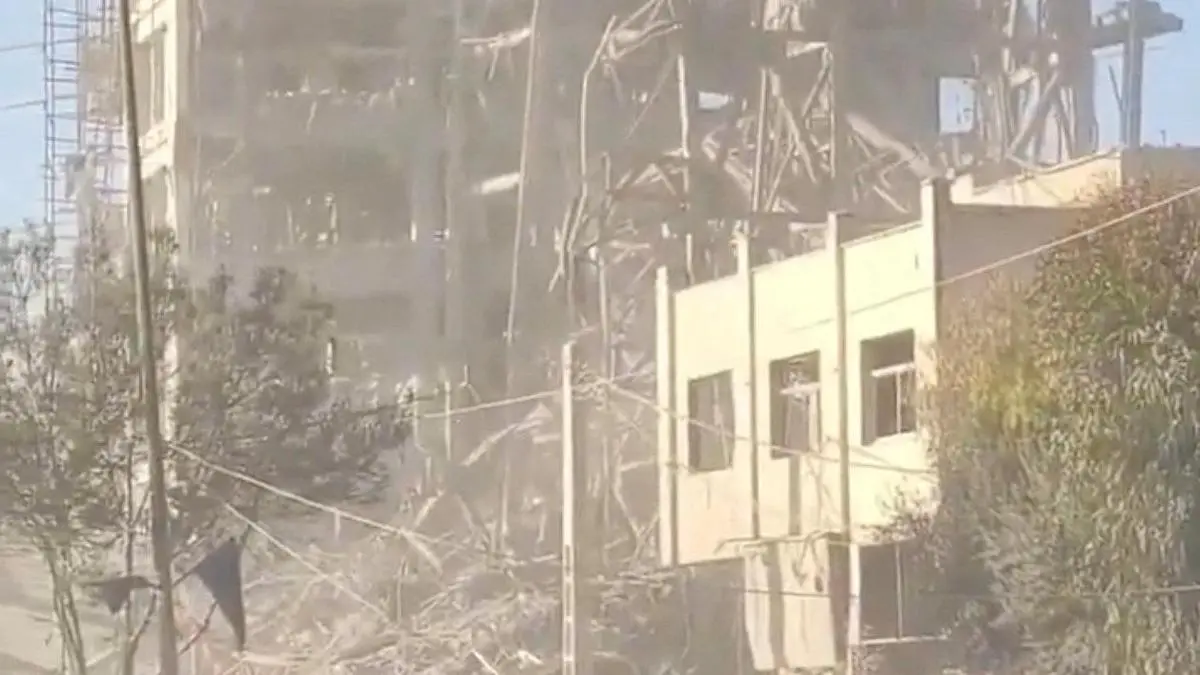
The warning from Tehran arrived not through backchannels, but via a blunt ultimatum on social media and state broadcasts. If the United States follows through on its threat to "obliterate" Iran’s domestic power grid, the Islamic Revolutionary Guard Corps (IRGC) will systematically dismantle the electrical and desalination infrastructure of every regional neighbor hosting an American military presence. This is no longer a localized border skirmish or a proxy war fought in the shadows. It has evolved into a high-stakes energy hostage crisis where the lights in Riyadh, Abu Dhabi, and Manama are being used as leverage to protect the turbines in Tehran.
For three weeks, the region has balanced on a knife’s edge. Following a joint U.S.-Israeli offensive on February 28, 2026, known as Operation Epic Fury, Iran has effectively shuttered the Strait of Hormuz. The move has choked 20% of the world’s liquefied natural gas trade and sent oil prices into a vertical climb. In response, President Donald Trump issued a 48-hour deadline: open the waterway or watch Iran’s largest power plants disappear. Tehran’s counter-threat shifts the target from the battlefield to the civilian lifeblood of the Middle East, turning every substation and water plant into a front line.
The Architecture of Asymmetric Retaliation
Iran’s strategy relies on a simple, brutal calculation. While the U.S. possesses superior kinetic firepower, the regional infrastructure supporting its bases is remarkably fragile. U.S. installations like Al-Udeid in Qatar or Camp Arifjan in Kuwait do not exist in a vacuum. They draw from the same overtaxed national grids as the local populations. By targeting the "host" infrastructure, Iran achieves two objectives: it degrades the operational capacity of U.S. forces and simultaneously triggers a massive humanitarian and political crisis for American allies.
The IRGC statement was specific. They aren’t just looking at transformers; they are targeting information technology systems and desalination facilities. In the Gulf, water is electricity. Without the massive energy inputs required for desalination, the desert cities of the UAE and Bahrain would run dry in days. This is "irreversible destruction" by design. Unlike a bridge that can be bypassed, a destroyed desalination plant represents a multi-year engineering project to replace.
Cyber Probing and the Invisible Front
While the world watches for missile launches, the actual "reconnaissance" is happening in the digital layer. Industry analysts have tracked a surge in activity from Iranian-aligned groups like Handala Hack and OilRig. These actors aren't just defacing websites; they are actively seeking access to Industrial Control Systems (ICS).
- Credential Harvesting: Recent campaigns have targeted regional energy employees using AI-enhanced phishing.
- Wiper Malware: The discovery of wiper variants in regional logistics networks suggests that the "off switch" may already be planted.
- CCTV Compromise: Reports indicate that state-linked actors have attempted to hijack CCTV systems across Gulf states to provide real-time battle damage assessment for potential missile strikes.
The asymmetry is staggering. The U.S. and Israel have already demonstrated the ability to plunge Iran into a near-total internet blackout, yet Iranian cells are increasingly operating with tactical autonomy. Even if Tehran is dark, "sleeper" cyber units in third-party countries can still pull the trigger on pre-positioned exploits.
The Diego Garcia Escalation
The credibility of Iran's threat was bolstered by the recent firing of long-range ballistic missiles at Diego Garcia. Targeting a U.S.-British base 2,500 miles away proves that the IRGC's reach extends far beyond the immediate Persian Gulf. If they can touch a remote island in the Indian Ocean, a power plant in the eastern province of Saudi Arabia is a trivial target.
The U.S. military finds itself in a strategic trap. To "obliterate" Iran’s power grid as promised would satisfy the demand for a decisive response, but it would almost certainly initiate the "cascading failure" of the regional energy market. The International Energy Agency (IEA) has already compared the current volatility to the 1973 oil shocks. A systematic attack on Gulf power plants would make those historical crises look like a minor market correction.
The Failure of Regional Deterrence
This crisis exposes a fundamental flaw in the regional security architecture. For decades, Gulf nations have invested billions in advanced missile defense systems like the Patriot and THAAD. These systems are excellent at intercepting high-altitude threats, but they are less effective against the "low and slow" drone swarms and localized sabotage that Iran favors for infrastructure targeting.
Furthermore, the integration of regional grids—intended to provide stability—now acts as a conductor for contagion. A significant failure in one node of the GCC Interconnection Authority's grid can create frequency imbalances that trip plants across borders. Iran understands this connectivity better than most. They aren't just planning to hit a building; they are planning to "crash" a system.
The Deadline and the Fallout
As the 48-hour clock winds down, the focus remains on the Strait of Hormuz, but the real danger lies in the substations. If the U.S. strikes, the retaliation won't be a mirrored military engagement. It will be an attempt to make the Middle East unlivable for both the U.S. military and the civilian populations that host them.
There is no "clean exit" from this scenario. If Iran loses its power, it has nothing left to lose by taking the rest of the region’s energy down with it. The result would be a total reconfiguration of the global economy, as the world’s primary energy export hub transitions from a production center to a dark zone.
Monitor the regional SCADA (Supervisory Control and Data Acquisition) traffic. The first signs of the next phase won't be an explosion; it will be a series of "unexplained" frequency drops across the Gulf grid.