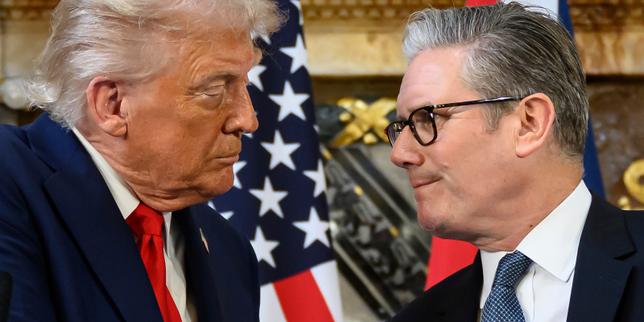
The "Special Relationship" is no longer a diplomatic anchor; it is a liability. For decades, British Prime Ministers have flown to Washington to play the role of the wise Greek to the American Roman, whispering restraint into the ears of emperors. That era died this week. As Donald Trump publicly mocks Keir Starmer as "not Winston Churchill" and fumes over the use of airbases for his widening war with Iran, the facade of a unique, shared destiny has finally crumbled. The UK is discovering that being a "staunch ally" in the age of America First does not buy loyalty; it only sets the opening price for a protection racket.
The Chagos Betrayal and the Diego Garcia Trap
The immediate friction stems from the Chagos Islands. When the UK government moved to return sovereignty of the archipelago to Mauritius, they believed they had secured the future of the strategic Diego Garcia airbase with a 99-year lease. Trump sees it differently. He has branded the move an "act of great stupidity," viewing any concession of territory as a sign of terminal weakness.
The crisis escalated when Starmer initially hesitated to allow US bombers to launch offensive strikes against Iran from British soil, citing international law and a lack of a clear exit strategy. Though Starmer eventually caved—invoking the "best way to eliminate the urgent threat"—the damage was done. In the Oval Office, standing next to a silent German Chancellor, Trump made it clear that the UK’s "uncooperative" behavior has placed it in the crosshairs. This is not a spat over protocol; it is a fundamental disagreement on what an alliance actually is. To Washington, the UK is a platform; to London, it is a partner. That distinction is costing the British dearly.
Trade as a Weapon of Coercion
While the headlines focus on the war in the Middle East, the real carnage is occurring in the Treasury. The Economic Prosperity Deal (EPD), signed with much fanfare in 2025, is currently being dismantled piece by piece. Trump’s faith in tariffs as a universal solvent for the US deficit remains unshaken, even after the US Supreme Court recently struck down his use of the International Emergency Economic Powers Act (IEEPA).
The administration has simply pivoted. By invoking Section 122 and Section 232 national security justifications, the White House has maintained a 10% "temporary" tariff on most UK goods. The British automotive sector, once promised a 100,000-vehicle quota at lower rates, now faces a precarious future.
The cost of this "special" bond is becoming visible in the everyday lives of British citizens.
- Pharmaceuticals: To avoid even harsher penalties, the UK caved to US demands on drug pricing, a move that will likely inflate the NHS bill by hundreds of millions of pounds.
- Agriculture: The UK has agreed to import 1.4 billion liters of US bioethanol and massive quotas of hormone-treated beef, abandoning long-standing food safety standards to appease a transactional president.
- Technology: The much-touted tech deal was suspended in late 2025 after the UK refused to scrap its Digital Services Tax, which hits American silicon giants.
The Nuclear Umbilical Cord
The most dangerous aspect of this breakdown is the UK’s total dependence on American hardware for its independent nuclear deterrent. The Vanguard and upcoming Dreadnought-class submarines carry Trident II D5 missiles. These are not British; they are leased from a shared pool and serviced in Kings Bay, Georgia.
For the first time since the 1960s, serious questions are being asked in Whitehall about whether that lease is conditional on total political alignment. If the US presidency views the UK as "unreliable" or "weak," the technical support required to keep those missiles functional becomes a bargaining chip. This isn't theoretical. Trump's inner circle has already hinted that security guarantees are for those who "pay their way" and follow the lead without question. Britain, currently spending 2.5% of GDP on defense and aiming for 3.5%, is finding that the math of the "protection racket" always favors the house.
The Pivot to a Broken Europe
Starmer’s response has been a desperate "reset" with the European Union. He is attempting to build a security and defense pact with Brussels to hedge against American volatility. But this, too, is a minefield.
If the UK aligns its agricultural standards with the EU to facilitate trade, it triggers immediate "reciprocal" tariffs from Trump for "discriminating" against American farmers. Britain is caught in a pincer movement between a protectionist superpower and a rigid regulatory bloc. The strategy of being a "bridge" between the two has failed because the bridge is being shelled from both sides.
A Legacy of Dependency
The hard truth that nobody in Downing Street wants to admit is that the UK has spent the last decade making itself more vulnerable. Brexit severed the European ties, while a series of Prime Ministers doubled down on the "Special Relationship" as a safety net. Now, that net has been pulled away.
The UK is no longer the indispensable ally; it is a mid-sized power with an overstretched military and an economy sensitive to every whim of a social media post from the Oval Office. The shared intelligence, the joint bases, and the nuclear cooperation—the "pillars" of the relationship—now look more like tethers.
There is no "fixing" this with a state visit or a letter from the King. The power dynamic has shifted too far. The US is moving toward a balance-of-power strategy that prioritizes the Indo-Pacific and views the Euro-Atlantic as a secondary theater that must manage its own problems. Britain is being told to grow up and pay up, or get out of the way.
The next time a British politician uses the phrase "Special Relationship," they won't be talking about a bond of blood and history. They will be talking about a survival strategy for a nation that has run out of easy options.