The steel walls of a container ship are roughly an inch thick. When you are standing on the bridge of a 400-meter vessel, staring out at the hazy, shimmering horizon of the Strait of Hormuz, that steel feels like paper.
To the global economy, this stretch of water is a statistic—a line on a spreadsheet indicating that 20% of the world’s liquid petroleum passes through a gap just 33 kilometers wide at its narrowest point. But to the sailors on the deck, it is a gauntlet. It is the place where the abstract tensions of Tehran, Washington, and Jerusalem manifest as gray hulls of fast-attack craft and the low hum of loitering munitions.
When the news reports "tensions in the Gulf," we think about gas prices. We should be thinking about the silence of a radar room when an unidentified drone begins to shadow a vessel.
The Invisible Artery
Imagine a massive, beating heart located in the Middle East. Every day, it pumps millions of barrels of oil and cubic feet of liquefied natural gas through a single, narrow artery. If you pinch that artery, the limbs of the global body—the factories in Shenzhen, the heating systems in Berlin, the trucking fleets in Kansas—begin to go numb.
The Strait of Hormuz is not just a geographical feature. It is a psychological trigger. Because the shipping lanes are so compressed, vessels have almost no room to maneuver. They are forced into "traffic separation schemes" that bring them within a stone's throw of Iranian territorial waters.
For a captain, this is a nightmare of physics and diplomacy. You are piloting a ship that takes three miles to come to a full stop, navigating a channel where the geopolitical temperature can boil over in seconds. One wrong turn, one misunderstood radio transmission, and a commercial transit becomes an international incident.
The Human Cost of the Gray Zone
We often speak of "war" as a binary state—either the guns are firing or they are silent. The reality in the Strait is "Gray Zone" warfare. It is a state of permanent, vibrating anxiety.
Consider a hypothetical third mate named Elias. He isn't a soldier. He’s a merchant mariner from the Philippines who sends 80% of his paycheck home to Manila. He didn’t sign up to be a pawn in a proxy war. Yet, as his tanker enters the Strait, he is told to put on a flak jacket. He sees the "Welcome to the Islamic Republic" signs on the islands of Abu Musa or Greater Tunb, and he knows that underneath the water, there are mines that don't care about his family's dreams.
When Iran seizes a ship, like the MSC Aries, it isn't just a blow to a shipping conglomerate. It is a traumatic event for two dozen humans who are suddenly hooded, interrogated, and held as high-stakes bargaining chips. The "war in Iran" isn't a distant explosion; it's the sound of a heavy boot hitting a metal deck while the world watches on a grainy satellite feed.
The Ghost Ships and the AIS Dark Patch
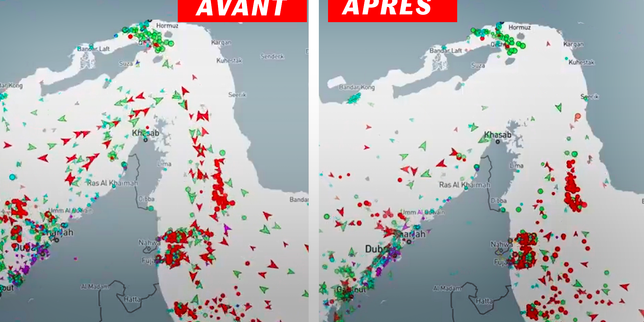
How does a war affect global traffic? It makes it go dark.
To understand the scale of the disruption, you have to understand AIS—the Automatic Identification System. It is the digital "shout" every ship emits to tell the world its position, speed, and heading. It is the foundation of maritime safety.
But when the threat of seizure or missile strikes looms, the Strait becomes a sea of ghosts. Ships turn off their transponders to avoid being tracked by shore-based batteries or hostile drones. They deviate from standard routes, burning more fuel and wasting precious time.
This "dark" sailing creates a chaotic environment. It increases the risk of collisions in one of the most crowded waterways on Earth. More importantly, it creates a data vacuum. Commodities traders, who rely on real-time flow data, begin to panic. Uncertainty is the most expensive commodity in the world. When we don't know where the oil is, we price it as if it has already disappeared.
The Domino Effect on Your Doorstep
It is easy to feel insulated from a naval skirmish six thousand miles away. That insulation is an illusion.
The maritime industry operates on a razor-thin margin of "just-in-time" delivery. The Strait of Hormuz is the primary exit for the energy that powers the tankers that carry the components for your smartphone. When insurance premiums for Gulf transits spike—sometimes by 1,000% in a single week—those costs don't evaporate. They are baked into the price of a gallon of milk, a plane ticket, and a plastic toy.
But the stakes are higher than inflation. We are witnessing the breakdown of the "freedom of navigation," a principle that has underpinned global prosperity since 1945. If a single nation can decide who gets to pass through an international strait, the ocean ceases to be a global common. It becomes a series of toll booths owned by the most aggressive actor.
The Technology of Fear
The weapons have changed. In the 1980s "Tanker War," it took a full-sized destroyer or a fighter jet to threaten a ship. Today, it takes a $20,000 drone.
This democratization of destruction means that the "front line" is everywhere. Iran’s use of swarming tactics—dozens of small, fast boats buzzing a massive tanker—is designed to overwhelm the senses. It is a psychological tactic as much as a military one. It tells the West: You may have the aircraft carriers, but we have the keys to your gas station, and we aren't afraid to break them in the lock.
This is why the images of the Strait are so haunting. They show the world's most sophisticated logistics machines being humbled by the oldest human impulse: the desire to control a narrow pass.
The Weight of the Horizon
There is a specific kind of exhaustion that comes from sailing through a chokepoint. It’s the constant scanning of the horizon for a shape that shouldn’t be there. It’s the way the crew falls silent as the ship passes the Iranian coast.
We look at the maps and see lines of trade. We see the "Guerre en Iran" as a headline to be scrolled past. But for those on the water, the Strait is a place where the air feels heavy, where the water is a deep, unforgiving blue, and where the distance between a normal Tuesday and a global catastrophe is measured in a few hundred yards of saltwater.
The world’s economy isn't built on gold or data. It is built on the courage of people willing to sail through the shadows of giants.
The next time you turn on a light, remember the silence of the bridge in the middle of the night, three miles off the coast of Bandar Abbas, where the only thing louder than the engines is the heartbeat of a sailor wondering if today is the day the artery finally closes.