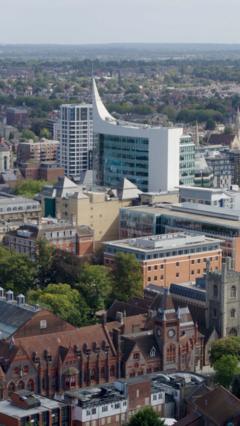
The skyline of Reading suggests a town in the middle of a golden era. Cranes hang over the horizon, glass-fronted apartments creep toward the clouds near the station, and the arrival of the Elizabeth Line has cemented its status as the western anchor of the London commute. However, beneath the polished surface of these regeneration projects lies a systemic failure. Reading is currently trapped in a pincer movement between soaring private rents and a stagnant social housing supply that creates a hollowed-out middle class. This is not just a shortage of bricks and mortar; it is a fundamental breakdown of the town’s economic engine.
The Myth of Proximity
For years, the narrative around Reading was simple. Build enough luxury apartments near the station, and the wealth from London would trickle down to the local economy. Developers jumped at the chance. They converted old office blocks under permitted development rights, creating "luxury" studios that often bypassed the usual requirements for space and light. These units were marketed to young professionals who work in Paddington or the tech hubs of Green Park.
The problem is that this strategy ignores the people who actually keep the town running. Nurses at the Royal Berkshire Hospital, teachers, and bus drivers cannot afford the £1,500-a-month price tag for a one-bedroom flat. When the workforce responsible for essential services is priced out, the town begins to lose its functionality. We see this in the high vacancy rates of local businesses and the increasing difficulty schools face when recruiting. The proximity to London has become a curse for those who do not earn a London wage but must pay London prices for a roof over their heads.
The Permitted Development Trap
One of the most significant yet underreported drivers of the current crisis is the rise of permitted development. This policy allows developers to convert commercial buildings into residential units without full planning permission. On paper, it sounds like a sensible way to repurpose empty offices. In practice, it has stripped the local council of its power to demand affordable housing contributions.
Usually, when a developer builds a large block of flats, they are required to ensure a percentage—often 30%—is designated as affordable housing. By using permitted development, many projects in Reading have avoided this obligation entirely. This has led to a surge in high-cost, small-footprint housing that does nothing to alleviate the pressure on the thousands of families currently on the housing register. The result is a town center filled with transient renters while families are pushed further into the suburbs or out of the borough altogether.
The Social Housing Deficit
Reading Borough Council is in a difficult position. While they have made strides in building their own council homes, the scale of the need is staggering. There are over 3,000 households on the waiting list. The math simply does not add up. If the council builds 100 homes a year but 500 more people fall into housing need due to private sector evictions or domestic changes, the gap never closes.
The "Right to Buy" scheme continues to haunt the local balance sheet. For every new social home built, another is often sold off at a discount, frequently ending up in the hands of private landlords who then rent it back to the council at three times the cost to house homeless families in temporary accommodation. It is a circular waste of public money that benefits nobody but the property speculators.
Infrastructure at the Breaking Point
Housing does not exist in a vacuum. Every new high-rise adds pressure to a Victorian sewage system, a congested road network, and oversubscribed GP surgeries. The development at the former Royal Mail site and the massive transformations around the IDR (Inner Distribution Road) are adding thousands of residents to a small geographic footprint.
Critics of the current pace of development point to the "canyon effect" being created in the town center. Narrow streets lined with towering blocks trap pollution and block sunlight, making the urban environment less liveable. More importantly, the infrastructure has not kept pace with the density. If you add 5,000 residents to a quarter-mile radius without adding a single new primary school or dental practice, the quality of life for everyone in that radius drops.
The Empty Promise of Build to Rent
A new trend has emerged in the Reading market: Build to Rent (BTR). These are massive developments owned by institutional investors—think pension funds and insurance giants—where every unit is for rent, never for sale. Proponents argue that BTR offers better security of tenure and professional management.
The reality is more complex. While BTR might provide a better experience than a rogue private landlord, it keeps the "generation rent" cycle spinning. By pricing these units at the top of the market, institutional landlords set a high floor for rents across the entire town. When a corporate landlord knows they can get £1,800 for a two-bed, every other landlord in the area raises their price to match. This corporate entry into the housing market has turned homes into a pure asset class, prioritized for yield rather than human habitation.
Land Banking and the Planning Bottleneck
Look at the derelict sites scattered around the edges of the town center. These are often owned by developers who have secured planning permission but refuse to start digging. They are waiting. They wait for property values to rise further, or for interest rates to drop, or for the political climate to shift. This is land banking.
While the council can grant permission, they have very few tools to force a developer to actually build. This creates a false sense of progress. The headlines shout about "3,000 new homes approved," but five years later, the site is still a gravel lot behind a rusted fence. This delay artificially restricts supply, keeping prices high and keeping the power firmly in the hands of the developers.
The Temporary Accommodation Scandal
The most harrowing part of the Reading housing story is the rise of the "hidden homeless." These are not people sleeping on the streets, but families living in "temporary" accommodation for months or even years. The council is forced to spend millions of pounds every year on B&Bs and private hostels because there is nowhere else for these people to go.
Living in a single room with children, without a proper kitchen or space to play, has a devastating impact on health and education. This is the human cost of the housing crisis. The money spent on these emergency measures could build hundreds of permanent homes, but the immediate crisis is so severe that the budget is swallowed up by the daily cost of survival.
The South East Economic Paradox
Reading is often cited as one of the best places to do business in the UK. Its proximity to Heathrow, its high concentration of tech companies, and its excellent rail links make it an economic powerhouse. Yet, this very success is what makes it unliveable for many.
There is a point where the cost of living outweighs the benefits of the high-paying jobs. If a software engineer earning £60,000 can’t afford to buy a modest house within a 30-minute commute, they will eventually look elsewhere—to Bristol, Manchester, or even abroad. Reading risks becoming a "dormitory town" for those who have already made it, while becoming a "departure lounge" for the talent it needs to sustain its future.
Redefining the Urban Core
For Reading to survive its own success, the approach to development must change. The focus on high-density, high-cost units in the center has reached a saturation point. There needs to be a shift toward medium-density, family-oriented housing that allows people to put down roots. This means moving away from the "luxury studio" model and toward three-bedroom houses with gardens and community spaces.
This requires a radical rethink of how land is used. It might mean looking at underutilized industrial estates or pushing for more aggressive "brownfield first" policies that include strict requirements for social infrastructure. It also requires the central government to give local authorities the power to freeze rents or implement "use it or lose it" policies on planning permissions.
The Road Ahead
The housing situation in Reading is a microcosm of the wider UK crisis, but amplified by its role as a regional economic hub. The current trajectory—more high-rises, more high rents, and more families in temporary accommodation—is unsustainable. It creates a town that is wealthy on paper but poor in social cohesion.
Solving this doesn't require more glossy brochures or "vision statements" from developers. It requires the hard, unglamorous work of building social housing at scale and reclaiming the planning process for the benefit of the residents, not the shareholders. Without a course correction, the cranes over Reading will continue to build a town that its own people cannot afford to inhabit. The market has had its chance to fix the problem, and it has failed. Now, the priority must shift from protecting profit margins to ensuring that a roof over one's head is a right, not a luxury reserved for the highest bidder.