The white paint on the armored personnel carrier is peeling, blistered by a Mediterranean sun that feels less like a vacation and more like a slow-cooker. Underneath that paint lies the weight of 1978. It is a ghost year. A year of panic, of borders breached, and of a hastily scribbled resolution in New York that birthed the United Nations Interim Force in Lebanon (UNIFIL). The word "interim" was meant to denote a temporary measure, a quick fix for a sudden bleed.
Forty-eight years later, the "interim" has become a permanent state of precariousness.
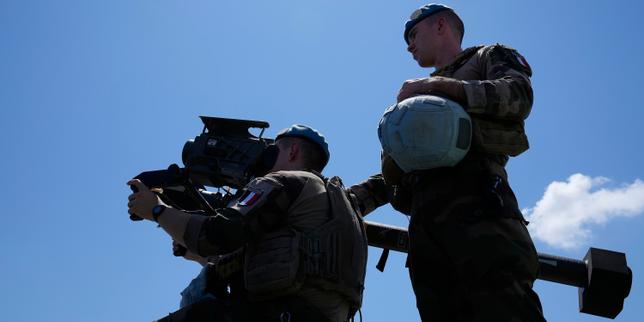
To understand why 10,000 soldiers from dozens of nations are currently sitting in the crosshairs of a conflict they are forbidden to fight, you have to look past the maps. Stop looking at the Blue Line as a digital boundary on a screen. Instead, picture a young soldier from Ireland or Indonesia standing on a dusty ridge near Naqoura. He wears the blue beret, a target-colored piece of felt that signifies he is there to keep a peace that neither side seems particularly interested in keeping right now. He is an observer in a theater where the actors have stopped following the script.
The Paper Shield
The legal bedrock of this mission is Resolution 1701. In the halls of diplomacy, it sounds like a masterpiece of compromise. It dictates that the area between the Blue Line—the withdrawal line between Lebanon and Israel—and the Litani River should be free of any armed personnel, assets, and weapons other than those of the Lebanese government and UNIFIL.
But paper is a poor shield against steel.
Hypothetically, imagine a UNIFIL patrol rounding a bend in a lush, terraced valley. They spot a group of men moving equipment into a shed. Under the mandate, the peacekeepers cannot simply burst in. They are guests. They operate in coordination with the Lebanese Armed Forces (LAF). If the LAF isn't there, or if the "private property" sign is wielded like a weapon, the blue helmets must often turn away. Their eyes are wide open, but their hands are tied behind their backs with the silken cords of international law.
This is the narrow margin of maneuver. It is a space so tight it barely allows for breathing. Over nearly five decades, the mission has shifted from a buffer to a witness, and finally, to a tripwire. If they leave, the last shred of international legitimacy in the region vanishes. If they stay, they risk becoming collateral damage in a war of drones and precision missiles.
A History of Broken Windows
The story of UNIFIL is not a straight line; it is a series of fractures. In 1982, they watched as Israeli tanks rolled past their positions toward Beirut. The peacekeepers were, by design, unable to stop a full-scale invasion. They became humanitarian workers in a combat zone, distributing flour and medicine while the world around them burned.
Then came 2006. Another war, another expansion of the mandate. The force grew. The technology improved. Yet, the underlying tension remained unaddressed. The presence of Hezbollah’s infrastructure south of the Litani grew not in spite of UNIFIL, but often in the shadows cast by the mission’s own limitations.
Peacekeeping requires the consent of the parties. When that consent is replaced by "strategic tolerance," the peacekeeper becomes a pawn. Israel argues that the UN has failed to disarm the south. Lebanon argues that Israel violates its airspace and sovereignty daily. Both are right. Both use the UN’s presence as a convenient grievance while relying on that same presence to prevent a total, apocalyptic escalation. It is a symbiotic relationship of mutual frustration.
The Human Cost of Neutrality
There is a psychological toll to being a professional bystander.
Consider the "Peacekeeper’s Paradox." These men and women are trained soldiers. They know how to fire a weapon, how to seize an objective, and how to win a fight. Yet, their success is measured by their restraint. They sit in bunkers while rockets scream overhead. They watch through high-powered binoculars as villages they have visited for years are emptied of their inhabitants.
The locals have a complicated relationship with the blue helmets. In times of relative calm, the UN is an economic engine. They rent houses, buy local produce, and fix roads. They are the "uncles" from abroad who bring stability. But when the shells start falling, that affection curdles into a bitter question: What are you actually doing here if you can’t protect us?
It is a question that haunts the barracks at night.
The mandate was never designed for "peace enforcement." It was designed for "peacekeeping." The difference is the width of a human life. Enforcement means taking a side to stop an aggressor. Keeping means standing in the middle and hoping your presence makes the shooters hesitate. But in 2024 and 2025, hesitation is in short supply.
The Shrinking Horizon
The current escalation has pushed the mission into a corner, both literally and figuratively. UN positions have been hit. Walls have been toppled by bulldozers. Cameras have been shot out. This isn't accidental. It is a message. The message is that the "interim" era is ending. The margin of maneuver has shrunk from a narrow path to a tightrope.
One might ask why they don't just leave.
If the 10,000 leave, the buffer is gone. The Blue Line becomes a vacuum, and nature—especially the nature of Middle Eastern geopolitics—abhors a vacuum. Without the white trucks and the blue flags, there is no one left to pick up the "deconflicting" phone. There is no one to facilitate the recovery of bodies or the repair of essential water lines under fire. They are the last nervous system of a region in shock.
The reality is that UNIFIL is a mirror. It reflects the collective will of the international community. When the mission looks weak, it is because the world’s powers are divided. When the mission is ignored, it is because diplomacy has been sidelined by the visceral urge for a military solution.
We often speak of "failed missions" as if they are machines that broke down. UNIFIL isn't a machine. It is a collection of humans from Ghana, Italy, Nepal, and Spain, caught in a geography of ancient grudges and modern munitions. They are there because we don't have a better idea. They are there because the alternative—a direct, unmonitored clash between two of the most heavily armed entities in the Mediterranean—is too terrifying for the UN Security Council to contemplate.
The sun sets over the hills of Southern Lebanon, casting long, distorted shadows across the valley. A patrol returns to base, the dust of the border coating their uniforms. They have seen nothing and everything. They have monitored the silence and recorded the explosions. Tomorrow, they will go out and do it again, not because they believe they can stop the war, but because they are the only ones left who are even trying to define what peace looks like.
They stand in the gap, not with the power of the sword, but with the fragile, stubborn authority of a blue flag that refuses to be lowered. It is a lonely, dangerous, and perhaps impossible task. But as the horizon glows with the artificial light of distant flares, you realize that the narrow margin they occupy is the only space where hope hasn't yet been completely extinguished.