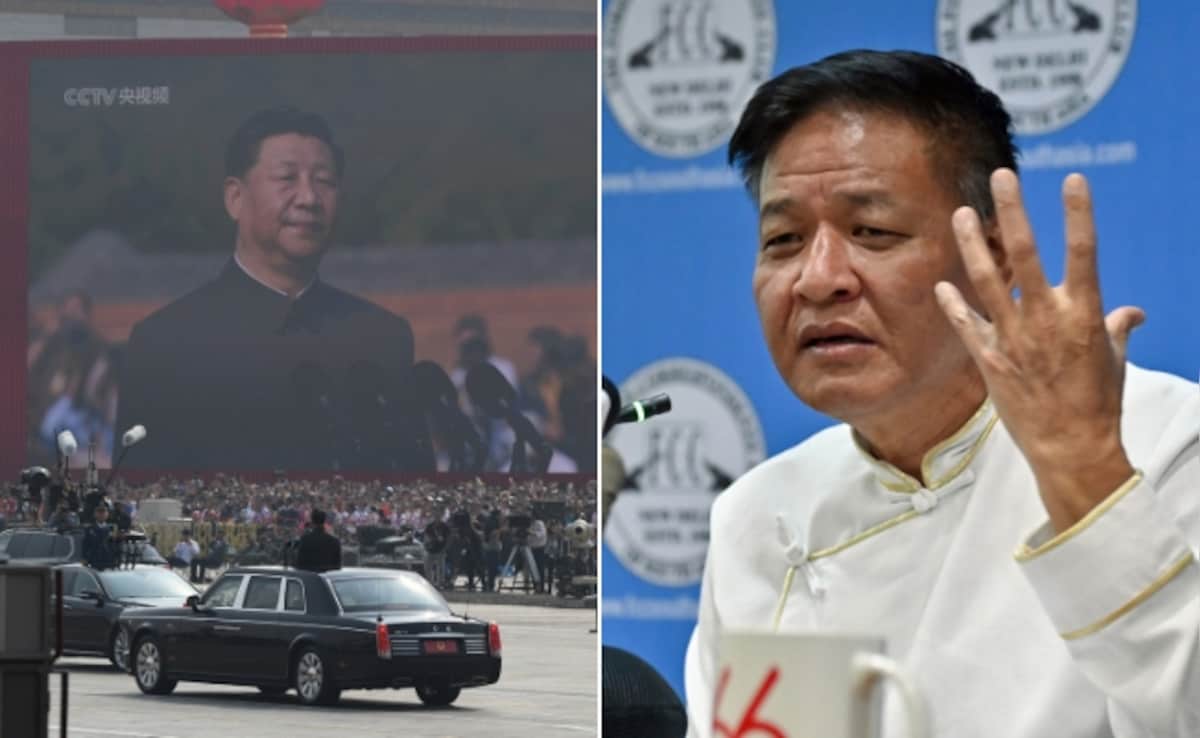
Xi Jinping isn't just "cleaning house." He's tearing the house down and rebuilding it from the studs. When Sikyong Penpa Tsering, the leader of the Tibetan government-in-exile, recently flagged that Xi has removed over 110 military generals, he wasn't just quoting a statistic. He was describing a seismic shift in how the world's largest military operates.
If you're wondering why this matters to you, look at the map. A military in the middle of a massive internal "power struggle" is either too paralyzed to fight or so desperate for internal unity that it might provoke an external conflict to save face. Tsering’s insights suggest we’re seeing a mix of both.
The Numbers Behind the Purge
To understand the scale, you have to look at the history of the People's Liberation Army (PLA). In traditional militaries, losing 110 generals would happen over a decade of natural retirement or a catastrophic world war. In Xi’s China, it happened through the stroke of a pen and "discipline inspections."
The purge hit a fever pitch recently with the downfall of heavyweights like Zhang Youxia and Liu Zhenli. These weren't just mid-level bureaucrats. Zhang was a Vice Chairman of the Central Military Commission (CMC), effectively the highest-ranking uniformed officer in the country. When guys at that level disappear from public view, the message is clear: nobody is safe.
The "why" is usually scrubbed behind the label of "corruption." While graft is definitely real—we're talking about massive kickbacks in the Rocket Force and equipment procurement—it's often a convenient cover for political loyalty tests.
Why the Rocket Force Was the Primary Target
The most telling part of this struggle involves the PLA Rocket Force. This is the branch responsible for China's nuclear arsenal and the "carrier killer" missiles designed to keep the US Navy at bay.
- Equipment Failure: Reports have surfaced about missiles filled with water instead of fuel and silo lids that don't function correctly.
- Leaked Secrets: There’s persistent chatter that high-ranking officers were "leaking" technical specs to foreign intelligence.
- Operational Readiness: Xi wants the PLA combat-ready by 2027. He realized that the "paper tiger" problem was real—commanders were lying about their capabilities to satisfy the Party.
If the missiles don't fly, Xi's leverage over Taiwan vanishes. That’s why he's willing to decapitate his own military leadership even if it causes short-term chaos. He'd rather have a smaller, loyal, and functional force than a massive one led by men he can't trust.
The Tibetan Perspective on Beijing’s Insecurity
Penpa Tsering’s recent comments highlight something most Western analysts miss: the connection between internal military purges and the "slow death" of occupied regions like Tibet.
Tsering argues that the more Xi purges his generals, the more "insecure" the regime becomes. An insecure Beijing is a dangerous Beijing. To distract from the fact that the military is in a state of "power struggle," the CCP doubles down on:
- Sinicization: Forcing Tibetan children into colonial-style boarding schools to strip away their identity.
- Border Aggression: Using the PLA to poke at the Indian border in the Himalayas to test troop loyalty and nationalistic fervor.
It’s a classic move. When you can’t trust your generals at home, you send them to the frontier where their only job is to follow orders or face the consequences.
Is the PLA Actually Ready for War
This is the billion-dollar question. Common sense says that if you fire your best commanders, your army gets weaker. In the short term, that's absolutely true. The PLA is currently suffering from "organizational paralysis." New officers are so terrified of making a mistake that they won't take initiative.
However, don't mistake this for permanent weakness. Xi is trying to solve the "Soviet Problem"—a military that is essentially its own political party. By removing 110 generals, he’s ensuring that the military’s only loyalty is to him personally, not to their own business interests or regional factions.
What to Watch Next
If you're tracking this, stop looking for "official" announcements. They rarely come. Instead, watch these signs:
- Promotion Patterns: Are the new generals "technocrats" with real combat experience, or "political commissars" who just know how to parrot Xi Jinping Thought?
- Equipment Trials: Watch for sudden, high-profile missile tests. These are often used to prove that the "corruption" issues in the Rocket Force have been "fixed."
- Diplomatic Tone: When the CCP feels weak internally, they usually get louder externally. Expect more aggressive rhetoric regarding the South China Sea and Taiwan as a smokescreen.
The "power struggle" Tsering flags isn't over. As long as Xi feels he hasn't achieved "absolute leadership," the revolving door of generals will keep spinning. For the rest of the world, this means dealing with a Chinese military that is increasingly unpredictable and entirely beholden to the whims of one man.
Inside the purge of China's top generals
This video provides critical context from the Tibetan leader himself regarding the systematic "slow death" of regional autonomy and how it mirrors the ruthless consolidation of power within the PLA.
http://googleusercontent.com/youtube_content/1