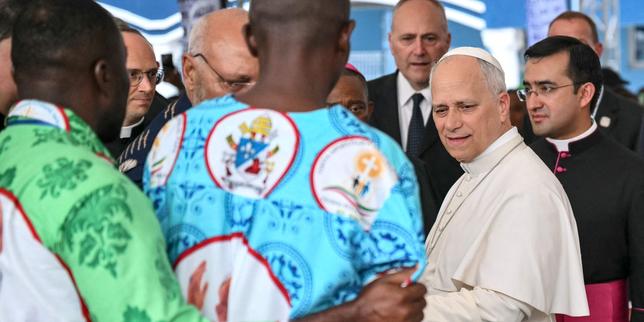
The humidity in Malabo doesn't just sit on your skin; it weightlessly crushes you. It smells of the Atlantic salt, roasting plantains, and the faint, metallic tang of the oil that has made a handful of men here unimaginably wealthy while the rest of the country waits for a miracle. On this Tuesday, the miracle arrived in a different form. He wore white. He spoke of things that cannot be traded on the commodities market.
Pope Leo XIV stepped off the plane into the thick Equatorial Guinean heat, a frail silhouette against the backdrop of a nation that has become a shimmering paradox of the twenty-first century. This wasn't a standard diplomatic stop. It was a collision between the oldest institution of the West and one of the most closed, controversial regimes on the African continent.
The Silence of the Island
To understand why a few words about "justice" matter here, you have to understand the silence. In the cafes along the Avenida de la Independencia, people talk in whispers if they talk at all. The country has one of the highest GDPs per capita in Africa, thanks to its massive offshore oil reserves, yet the average person living in the shadow of the glass-and-steel government buildings often struggles to access clean water.
Consider a man we might call Mateo. He is a hypothetical fisherman, but his reality is shared by thousands. Mateo watches the tankers crawl across the horizon like slow, fat beetles. He knows that every gallon of crude they carry represents a school his children won't attend or a clinic that lacks basic Ibuprofen. When the Pope speaks, Mateo isn't looking for a theological lecture. He is looking for a witness.
The Pope’s arrival was greeted with the kind of pomp only a petro-state can muster. There were flags, polished Mercedes-Benzes, and a military guard that stood so still they looked like statues. But as Leo XIV sat across from the leadership in the presidential palace, the atmosphere shifted. The air grew thin.
When Law Becomes a Ghost
The Pope did not lead with a sword, but with a mirror. His address focused on the concept of Derecho—the right, the law, the very backbone of a functioning society. He spoke about the "droit" (right) and "justice" not as abstract concepts found in dusty textbooks, but as the bread and salt of a dignity-filled life.
In Equatorial Guinea, the law has often been whatever the ruling elite says it is. Power has been concentrated in the same hands for decades. When the Pope mentioned that "true progress is measured by the protection of the smallest," the room went quiet. It was a direct challenge to the "trickle-down" mythology that has defined the nation's economic policy.
Money is loud. It builds highways that lead nowhere and hotels that remain empty. Justice, however, is quiet. It is the steady hand of a judge who cannot be bought. It is the transparency of a ledger that shows where the oil billions actually go. Leo XIV wasn't just talking to the bishops; he was talking to the men in the tailored suits who hold the keys to the treasury.
The Invisible Stakes of a Holy Visit
Some critics argued that the Pope’s visit offered a veneer of legitimacy to a regime frequently cited for human rights abuses. They saw the photos of the Pontiff shaking hands with the leadership and felt a sting of betrayal. But look closer at the body language. Look at the text of the homilies delivered in the dusty outskirts where the "oil wealth" is a rumor, not a reality.
The stakes are higher than a mere photo op. For the local Church, the Pope’s presence is a shield. It allows local priests and activists to speak a little louder tomorrow than they did yesterday. If the leader of 1.3 billion Catholics says that justice is a divine mandate, it becomes much harder for a local official to dismiss a demand for fair wages as "Western interference."
The tension in the air was palpable during the outdoor Mass. Thousands gathered, a sea of vibrant fabrics and expectant faces. They didn't come to see a politician. They came to see someone who acknowledges that their poverty in a land of plenty is not a misfortune, but an injustice.
A Geography of Inequality
If you drive an hour out of the capital, the paved roads give way to the reality of the jungle and the village. The contrast is a physical ache. You see children playing in the dirt next to signs advertising luxury telecommunications services they will never use.
This is the "right" the Pope alluded to—the right to participate in the bounty of one's own land. He used the metaphor of a family table. A father who eats a feast while his children starve in the kitchen is not a provider; he is a tyrant. The imagery was simple, devastating, and impossible to misunderstand.
The Pope’s voice, thinned by age but sharpened by intent, carried across the plaza. He didn't use the jargon of the United Nations or the cold metrics of the IMF. He spoke of the "social mortgage" that comes with wealth. The idea is simple: if you have much, you owe the community a debt that can only be paid in the currency of fairness.
The Echo in the Atlantic
As the sun began to set, casting long, bruised-purple shadows over the Bight of Biafra, the visit drew to a close. The tankers were still there on the water. The oil was still flowing. The statuesque guards were still at their posts. On the surface, nothing had changed.
But the silence had been punctured.
The people who stood in the sun for hours to hear a frail man talk about "justice" didn't leave with bags of grain or envelopes of cash. They left with something far more dangerous to an autocracy: the realization that their hunger for a better life is recognized by the world. They were told that the law is supposed to belong to them, not just to the men who write it.
The Pope’s plane eventually taxied down the runway, lifting off and disappearing into the haze above the ocean. Below, the lights of the capital flickered on, powered by the resources that have defined the nation's destiny. In the small houses on the edge of the city, the whispers felt a little bit more like a conversation.
The oil will eventually run dry. The tankers will eventually stop coming. But the idea that a human being has an inherent right to justice, regardless of the thickness of their wallet or the strength of their political connections, is a fire that, once lit, is notoriously difficult to put out.
Leo XIV didn't bring a revolution in his luggage. He brought a question that Equatorial Guinea will have to answer long after his white cassock has faded from the horizon: What is a nation if it is not just?
The salt air remained. The humidity remained. But for one afternoon, the silence was broken.