The sea does not announce its intentions. In the Indonesian archipelago, where the water is less a boundary and more a highway, the transition from a routine commute to a struggle for breath happens in the space between two heartbeats. One moment, the engine of a passenger boat is a rhythmic, comforting hum against the backdrop of the night. The next, there is only the sound of rushing water and the frantic, jagged pitch of human terror.
This is the reality currently unfolding off the coast of Sulawesi. A wooden hull, laden with dreams, groceries, and families, is gone. In its place, twenty-seven souls have vanished into the dark, leaving behind a void that rescue teams are now desperately trying to fill before the tides claim what remains.
The Anatomy of a Midnight Sinking
Indonesian maritime travel is not a luxury. It is the blood in the veins of an island nation. People board these vessels like we might board a city bus, carrying baskets of produce or sleeping children. The KM Ladang Pertiwi 02, the boat at the center of the current crisis, was never intended to be a headline. It was a bridge between the Pangkep Regency and the smaller, isolated islands that dot the Makassar Strait.
When it went down, it did so without the fanfare of a distress signal. No radio call pierced the static of the local frequency. No flare lit up the horizon to guide the way for passing tankers. The vessel simply stopped existing on the surface.
Consider the physics of a sinking boat in these waters. The Celebes and Java seas are deceptively warm, yet the ocean is a heat thief. Once submerged, the human body begins a quiet, internal war. Even in 28°C water, the core temperature of a person treading water for ten, fifteen, twenty hours begins to slide. Panic accelerates the process. Every splash, every frantic kick, burns the very fuel the body needs to stay conscious.
The official count tells us 27 people are missing. But numbers are sanitized versions of a much uglier truth. Those 27 represent 27 separate stories of a hand slipping from a hand, of a mother realizing the bundle she was holding is no longer there, or of a father watching the light of the surface recede as he is pulled down by the weight of a waterlogged hull.
The Race Against the Clock and the Current
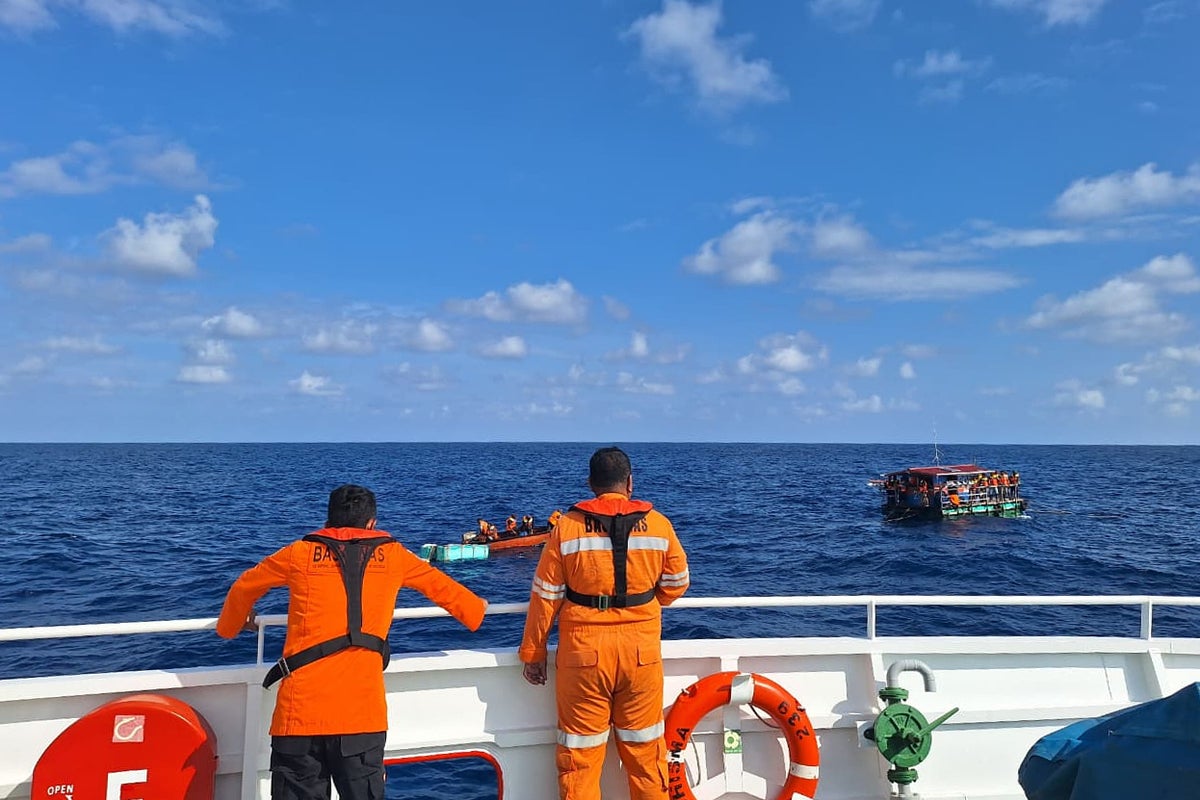
Rescue operations in Indonesia are a masterclass in controlled chaos. The National Search and Rescue Agency (Basarnas) does not have the luxury of a calm, predictable environment. They are fighting the Pangkep currents, which move with the force of a river but the unpredictability of a storm.
Every hour that passes is not just a unit of time; it is a geographic expansion. A person floating in a life vest—if they were lucky enough to find one—can be carried five miles in a single afternoon by the prevailing winds and currents. By the time the sun rises on the second day, the search area has doubled. By the third day, it has quadrupled. The ocean becomes a hayfield, and the survivors are the needles.
The search teams utilize a grid system, a mathematical attempt to impose order on a chaotic liquid landscape. They calculate the drift of a human-sized object based on the $V_c$ (current velocity) and $V_w$ (wind velocity). They map out probability zones. Yet, when you are in a small boat looking at a grey-blue horizon that stretches to the edge of the world, the math feels tragically small.
The Invisible Stakes of Island Life
Why do these boats sink? The answer is rarely a single, catastrophic event. It is a slow accumulation of small, overlooked risks.
Indonesia has a population of over 275 million people spread across more than 17,000 islands. The infrastructure required to move those people safely is staggering. In many regions, the demand for transport far outstrips the availability of modern, steel-hulled vessels. This leads to the "wooden boat economy."
These boats are often overloaded. A manifest might say 40 people, but when the boat pulls away from the rickety wooden pier, there are 60. Plus three motorbikes. Plus a ton of bagged rice. Plus the heavy, unseen burden of a boat that hasn't seen a dry dock in five years.
Safety regulations exist, but the enforcement is a ghost. In the remote reaches of South Sulawesi, the harbor master is often a neighbor, and the captain is a cousin. A "just this once" mentality becomes the standard operating procedure. This is the hidden cost of connectivity in the archipelago. We trade the safety of a regulated ferry for the immediate necessity of getting home.
The Psychology of the Survivor
To understand what those 27 people are facing, you have to look at those who have already been pulled from the water. Seventeen people were rescued early on by local tugboats and fishing vessels. They weren't found by high-tech sonar or satellite imagery; they were found by the sharp eyes of sailors who know what a human head looks like when it's just a speck against a whitecap.
The survivors talk about the silence. After the initial screaming stops, after the boat has gurgled its final breath and the bubbles have cleared, there is a silence that is almost physical. It is just the sound of the wind and the slap of the water against your chin.
There is a specific kind of mental grit required to survive thirty hours at sea. You have to bargain with yourself. Just make it to the next sunrise. Just hold on until that cloud passes. You become hyper-aware of your own biology. The salt burns your eyes. Your tongue swells from dehydration. The skin on your hands begins to prune and then peel, a process called maceration, where the water literally begins to dissolve the outer layers of your protection.
A Geography of Grief
In the villages of Pangkep, the air is thick with more than just humidity. It is the weight of waiting. In these communities, a missing person is not just a statistic; they are the local schoolteacher, the man who fixed the outboard motors, the girl who was coming home from university for the holidays.
The search teams are now deploying helicopters and larger naval vessels, a desperate escalation in the hunt. They are looking for debris, for an oil slick, for the bright orange of a life jacket that might signify a life still clinging to the edge of the world.
But as the sun dips below the horizon again, the window of survivability begins to creak shut. The searchers know this. The families standing on the shore, staring at the empty blue line of the Makassar Strait, know this too.
The ocean is an indifferent witness. It does not care about the 27 stories it has swallowed. It does not care about the political fallout or the lack of safety inspections. It only knows the rhythm of the tide and the pull of the deep.
On the map, Sulawesi is a sprawling K-shaped island, a beautiful and complex piece of geography. To the rescue teams, it is currently the center of a tragedy defined by the cruelest of variables: time. Every minute that a rescue boat spends refueling, every second a spotter blinks, the ocean takes another step toward making the temporary disappearance of those 27 souls permanent.
The search continues because to stop is to admit that the water has won. And in a nation built on the sea, that is a surrender no one is willing to sign. Not yet.
The sun sets, painting the Makassar Strait in hues of bruised purple and gold, beautiful and terrifying, while somewhere out there, the silence is still waiting to be broken by a shout for help.