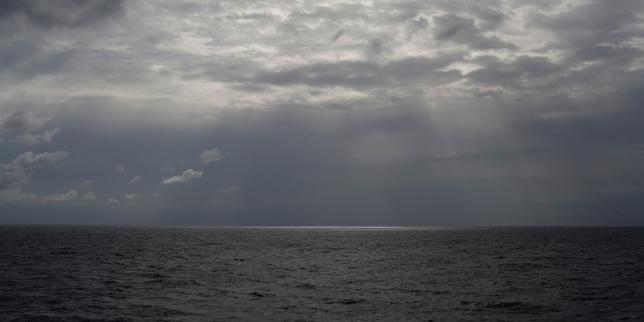
The Mediterranean is not a sea. Not anymore. To those who stand on the shores of Tripoli or Sfax, looking north toward a horizon that promises everything and guarantees nothing, it is a blue-walled waiting room. It is a liquid border. For more than seventy souls this week, it became a grave.
Silence is the loudest thing about a shipwreck. We often think of these tragedies as chaotic, noisy events filled with shouting and the crashing of waves. But once the wooden hull groans its final breath and the engine cuts out for the last time, the sound that remains is the rhythmic, indifferent lap of salt water against nothingness. It is the sound of a story ending mid-sentence.
Seventy-one people. The number is precise, yet it feels hollow. It includes those confirmed dead and those "missing," a word that acts as a polite euphemism for bodies the tide hasn't yet surrendered. This wasn't a freak accident. It wasn't an unpredictable act of God. It was the predictable result of a math equation where the variables are desperation, a failing rubber boat, and a world that has learned to look away.
The Geography of a Dream
Think of a young man. We will call him Omar. He is not a statistic; he is a collection of memories, a specific way of laughing, and a phone tucked into a waterproof bag that contains photos of a mother he promised to call once he hit dry land. Omar isn't fleeing for "economic advantage" in the way a CEO might move to a tax haven. He is moving because the air back home has become unbreathable, thick with the smoke of conflict or the dry dust of a farm that hasn't seen rain in three years.
He pays a man a year's wages for a seat on a vessel that no sane person would use to cross a lake, let alone an ocean. The smugglers call them boats. In reality, they are inflatable coffins. They are overloaded until the gunwales sit only inches above the water line.
One wave. That is all it takes.
When the boat capsized off the coast of Tunisia, the water was likely cold enough to steal the breath from your lungs in seconds. The Mediterranean in early spring is a deception. It looks sparkling under the sun, but at depth, it is a crushing, frigid weight. Imagine the panic. The person next to you, whose shoulder you leaned against for ten hours of shivering darkness, is suddenly gone. The bag with your documents, your money, and your photos sinks. You are left with nothing but the salt in your throat and the terrifying realization that the horizon is much further away than it looked from the beach.
The Invisible Stakes of the Search
Rescue operations are often framed as a matter of logistics. How many cutters? How many helicopters? What is the radius of the search grid? But the real tension lies in the clock. After the initial distress call—if one is even made—the window of survival shrinks with every tick of a watch.
The Tunisian National Guard and local fishermen are usually the first responders. These fishermen aren't soldiers or trained medics. They are ordinary men who went out to pull in nets and instead pulled in children. There is a psychological toll to this that rarely makes the evening news. To be a fisherman in these waters now is to live in a constant state of dread, wondering if your next haul will be the one that haunts your sleep for the rest of your life.
Seventy-one.
If seventy-one people died in a plane crash over the Alps, the world would stop. There would be black boxes, international investigations, and weeks of wall-to-wall coverage. When seventy-one people drown in the Mediterranean, it is a headline for four hours. Then, the digital cycle refreshes. We have become habituated to the horror. We have built a mental callus over our empathy, convinced that this is simply the way of the world.
But it isn't.
The Logic of the Void
The tragedy of the Mediterranean is that it is a man-made disaster. The policies governing these waters are as rigid as the borders they protect. There is a persistent, circular argument that saving lives at sea creates a "pull factor"—that if we stop people from drowning, more will try to cross.
Consider the flaw in that logic. No one gets into a disintegrating rubber boat with their toddler because they heard there might be a rescue ship nearby. They get into that boat because the life they are leaving is already a form of drowning. You do not jump into a burning house because you think the fire department is efficient; you jump out of a burning house because the flames are at your back.
The "pull factor" is a ghost. The "push factor"—war, climate collapse, and total systemic failure—is the reality. By scaling back search and rescue missions, we haven't stopped the boats. We have only ensured that when the boats fail, no one is there to hear the splash.
The Faces in the Foam
The reports tell us that the victims came from various parts of sub-Saharan Africa and the Middle East. These are regions we often discuss in the abstract, as if they are board game territories rather than places where people buy bread, go to school, and fall in love.
When a boat goes down, we lose more than just lives. We lose the potential of those lives. We lose the doctors, the mechanics, the poets, and the fathers. We lose the threads of families that will now spend years waiting for a phone call that will never come. There is a specific kind of agony in the "missing" status. It is a purgatory of grief. Without a body to bury, the mourning cannot begin. The mother back in a village thousands of miles away stays in a state of permanent, vibrating hope, jumping every time the wind knocks against the door.
This is the hidden cost of our current global posture. We aren't just losing people; we are losing our collective humanity. Every time we scan a headline about a shipwreck and move on to the sports scores, the callus grows a little thicker.
The Ocean Does Not Forget
The Mediterranean is a graveyard of history. It holds the wrecks of Roman galleys, Phoenician traders, and WWII warships. But these modern wrecks are different. They are made of plastic, cheap wood, and the discarded dreams of the 21st century.
The sea is a neutral observer. It does not care about passports or visas. It does not recognize the difference between a tourist on a cruise ship and a refugee on a raft. It simply follows the laws of physics. If a boat is too heavy and the waves are too high, the boat sinks.
What remains after the search lights are turned off and the news crews pack up is the salt. It stays on the skin of the survivors. It crusts over the clothes pulled from the water. It lingers in the air of the coastal towns where the bodies are brought ashore in white bags.
We talk about "managing migration" as if it is a spreadsheet problem. We debate quotas and border fences. But the reality is much simpler and much more brutal. It is a woman holding her breath underwater. It is a man reaching for a hand that isn't there. It is seventy-one lives that ended in the dark, surrounded by the very thing they hoped would carry them to safety.
The water is still now. The ripples from the sinking have long since smoothed over. The Mediterranean looks exactly as it did a week ago—blue, vast, and beautiful. But beneath that surface, the weight of what we have allowed to happen continues to sink, deeper and deeper, into the silt of our shared history.
Somewhere, a phone in a waterproof bag is still vibrating with a text message that will never be read.