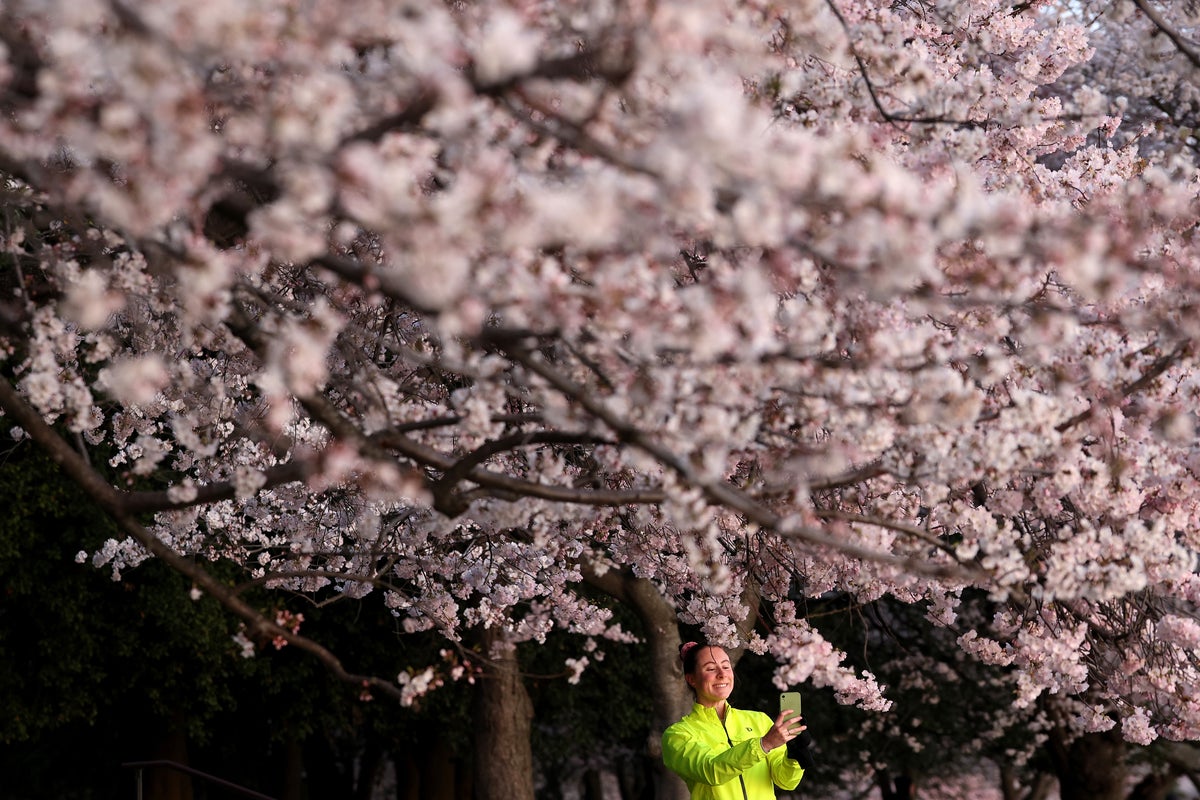
Peak bloom for the Prunus × yedoensis (Yoshino cherry) in Washington, D.C., represents a highly unstable biological equilibrium defined by the intersection of thermal accumulation and atmospheric volatility. While casual observers view the bloom as a singular event, it is more accurately defined as a fragile transition phase within a complex phenological cycle. The window for maximum floral density—defined by the National Park Service as the point when 70% of the blossoms are open—is rarely a static state. Instead, it is a high-decay event where the rate of petal abscission often outpaces the rate of late-stage budding within 72 to 120 hours of onset.
Understanding the mechanics of this phenomenon requires deconstructing the specific environmental variables that dictate the speed of the bloom's progression and its inevitable collapse.
The Growing Degree Day Framework
The timing of the peak bloom is not a matter of calendar dates but a function of heat integration. Botanists use Growing Degree Days (GDD) to measure the accumulation of thermal energy. For the Yoshino trees, the biological clock accelerates once temperatures consistently exceed a base threshold of 5°C (41°F).
The journey to peak bloom follows a rigid six-stage progression:
- Green Bud: The first visible sign of activity after dormancy.
- Florets Visible: The initial separation of the bud scales.
- Extension of Florets: The pedicels begin to lengthen.
- Peduncle Elongation: The stage just prior to the first white appearing.
- Puffy White: The final stage before anthesis (opening).
- Peak Bloom: The 70% threshold.
The primary driver of the "it won’t last long" reality is the compression of these stages. When a cold late February is followed by an aggressive heat spike in March, the trees enter a "forced bloom" state. This rapid transition often results in a physically weaker cellular structure in the petals, making them significantly more susceptible to environmental stressors.
The Three Pillars of Floral Decay
Once peak bloom is achieved, the countdown to "green out"—the emergence of leaves that signals the end of the floral display—is dictated by three primary variables.
1. Kinetic Stress (Mechanical Forcing)
The Yoshino petal is aerodynamically designed to catch wind, but its attachment point (the receptacle) weakens immediately following pollination or peak hydration. High-velocity wind events, common in the mid-Atlantic during early spring, act as a mechanical harvesting force. A sustained wind of 15-20 mph can strip a tree of 40% of its floral mass in a single afternoon. This is not a gradual decline; it is a threshold-based event where the structural integrity of the bloom fails simultaneously across the grove.
2. Precipitation and Petal Weight
Rainfall presents a dual threat: physical impact and weight loading. Water absorption increases the mass of the delicate petals, causing them to droop and lose the "cloud-like" aesthetic. More critically, heavy rain physically dislodges the petals from the pedicel. If a peak bloom coincides with a heavy frontal system, the duration of the peak can be cut from the historical average of 7-10 days down to a mere 48 hours.
3. The Thermal Ceiling
While heat triggers the bloom, excessive heat terminates it. Temperatures exceeding 24°C (75°F) accelerate the tree’s metabolic rate, pushing it rapidly into the next phase of its life cycle: leaf production. As the tree shifts its hormonal resources from reproduction (flowers) to photosynthesis (leaves), the blossoms are naturally shed. This biological handoff is irreversible.
The Economic and Logistical Bottleneck
The ephemeral nature of the bloom creates a high-density logistical challenge for the District of Columbia. Because the peak bloom window is a moving target—often only accurately predictable within a 10-day margin—it creates a "compression of demand."
The infrastructure around the Tidal Basin is not designed for the simultaneous arrival of approximately 1.5 million visitors within a five-day window. This creates several systemic failures:
- Transport Saturation: The Smithsonian and L'Enfant Plaza Metro stations operate at 150% of nominal capacity, leading to platform crowding and "bus bridging" requirements.
- Pedestrian Erosion: The sheer volume of foot traffic causes soil compaction around the roots of the Yoshino trees. Compaction limits oxygen and water infiltration, which induces long-term stress on the trees and makes them even more vulnerable to the "short bloom" cycles of future years.
- Microclimate Alteration: The "urban heat island" effect in D.C. can cause the Tidal Basin trees to bloom several days ahead of cherry trees in the surrounding suburbs, complicating regional tourism planning.
Phenological Shifting and the New Normal
Data from the last century suggests a clear trend toward earlier and more volatile peak blooms. Historically, the average peak bloom date was April 4. In recent decades, that mean has shifted toward the last week of March.
The danger of an earlier bloom is the "false spring" trap. If the GDD accumulation triggers a bloom in mid-March, the probability of the trees hitting a late-season frost increases exponentially. At -2°C (28°F), the floral tissue suffers cryogenic damage. The water within the petal cells freezes, ruptures the cell walls, and causes the blossoms to turn brown and shrivel before they even reach full expansion. This effectively "kills" the peak bloom, transforming a billion-dollar tourism asset into a landscape of biological debris overnight.
Strategic Observation Matrix
For stakeholders and visitors, navigating this volatility requires moving away from "hope-based" planning and toward a data-informed approach.
- The 48-Hour Pivot: Do not commit to travel until the "Puffy White" stage is officially announced. The transition from Puffy White to Peak Bloom is the only consistent variable in the cycle, usually occurring within 2 to 5 days.
- The Wind Threshold: Monitor the National Weather Service for "Small Craft Advisories" on the Potomac. If a wind event exceeds 20 knots, the "Peak Bloom" status will likely be downgraded to "Post-Peak" within 6 hours.
- Diurnal Advantage: Thermal expansion of the blossoms is highest in the mid-afternoon. However, photographic clarity and lower mechanical stress on the trees occur between 06:00 and 08:00. This is the only window where the "peak" can be experienced without the interference of high-density crowd dynamics.
The Tidal Basin ecosystem is currently facing a secondary threat: sea-level rise and the failure of the sea wall. Constant saltwater inundation at high tide is stressing the root systems of roughly 150 trees (most notably "Stumpy," which has become a symbol of this decay). This saltwater stress causes "early senescence"—a condition where the tree drops its flowers and leaves prematurely as a survival mechanism.
To maximize the value of the current bloom, one must treat the event as a decaying asset. The moment 70% openness is achieved, the environmental "cost" of maintaining that state begins to rise. The strategic play is to front-load all observation and data collection within the first 24 hours of the NPS announcement. Waiting for the weekend or for "perfect weather" is a high-risk gamble that ignores the fundamental atmospheric physics of the mid-Atlantic spring. Move early, monitor the wind vectors, and acknowledge that in a warming climate, the "Peak" is no longer a season, but a fleeting biological glitch.
Direct your attention toward the trees on the northwestern edge of the Basin; they are slightly more shielded from the prevailing winds and typically retain their petals 12-18 hours longer than the exposed southern clusters.