The recent price adjustment for Virgin Galactic’s suborbital flight seats to $750,000 represents a pivot from early-adoption hype to a rigorous, margin-focused industrialization phase. This 66% increase from the previous $450,000 price point is not a reflection of arbitrary luxury inflation, but a calculated response to the high fixed costs of aerospace maintenance and the limited throughput of the current VSS Unity and upcoming Delta Class fleets. To understand the viability of Virgin Galactic, one must deconstruct the physics of the flight profile, the operational bottlenecks of reusable spacecraft, and the precarious supply-demand curve of the ultra-high-net-worth (UHNW) demographic.
The Triad of Suborbital Value Extraction
Virgin Galactic’s business model rests on three non-negotiable pillars: flight frequency, payload capacity, and turnaround efficiency. Unlike orbital providers such as SpaceX, which derive revenue from massive government contracts and satellite deployments, Virgin Galactic is a pure-play experience provider. Its success depends on treating space as a repeatable logistic loop rather than a singular event.
1. Energy Management and the Suborbital Profile
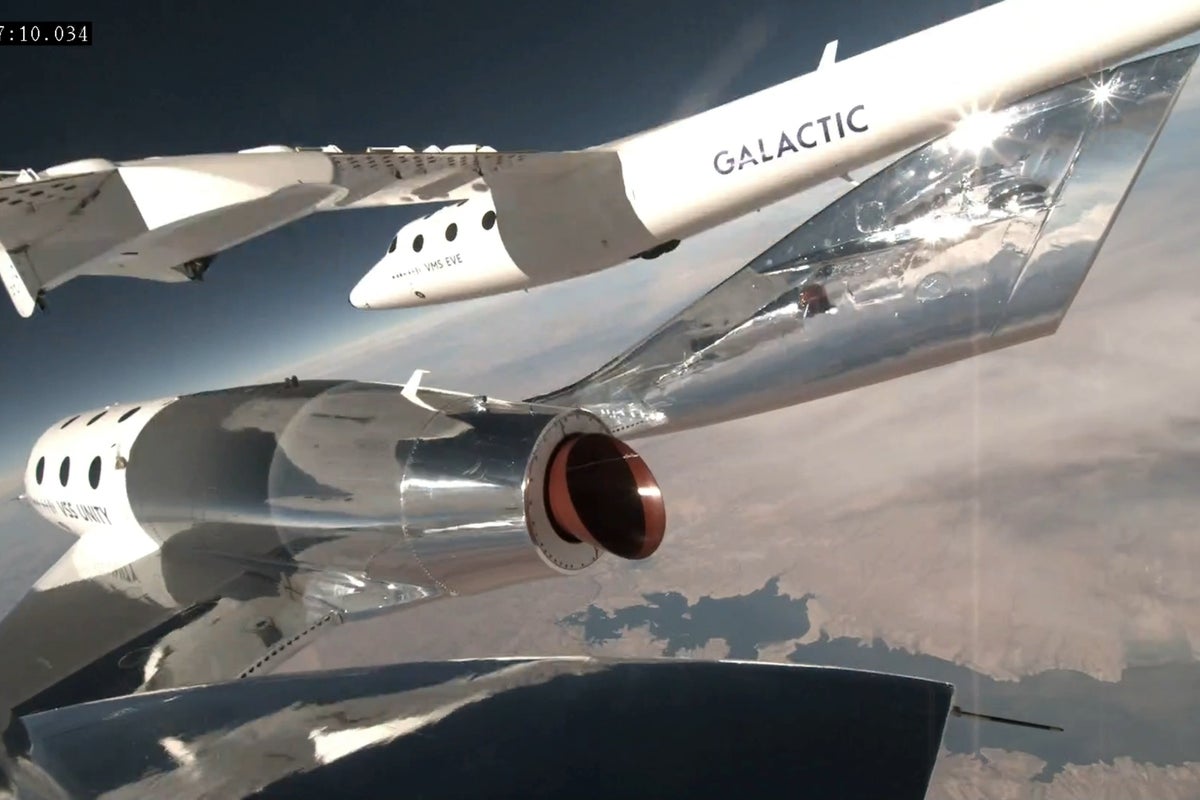
The flight sequence begins with a dual-stage ascent. A carrier aircraft, VMS Eve, transports the SpaceShipTwo vehicle to an altitude of approximately 45,000 feet. This "air-launch" strategy bypasses the densest part of the atmosphere, significantly reducing the fuel-to-mass ratio required for the rocket motor ignition.
Once released, the spacecraft ignites its hybrid rocket motor, accelerating to Mach 3. The objective is not orbital velocity (which requires $7.8 \text{ km/s}$), but a vertical climb to the Kármán line or its approximate boundary. The value proposition for the customer is centered on three specific minutes of microgravity and the "Overview Effect"—the cognitive shift reported by astronauts viewing Earth against the blackness of space. At $750,000 per seat, the cost of this experience translates to roughly $4,166 per second of weightlessness.
2. Fleet Scalability and the Delta Class Transition
The current VSS Unity vehicle is a proof-of-concept asset with a significant limitation: a slow turnaround time. It requires extensive inspections and manual refurbishment between flights. Virgin Galactic’s path to profitability is entirely dependent on the "Delta Class" ships. These are designed for:
- High-Frequency Sorties: A target of two flights per week per vehicle.
- Modular Maintenance: Replacing bespoke hand-crafted components with standardized aerospace parts.
- Increased Seating: Moving from four to six seats per flight to maximize the revenue per "turn."
3. The TAM Liquidity Constraint
The Total Addressable Market (TAM) for space tourism is often overestimated by ignoring the "friction of readiness." While there are over 60,000 individuals globally with a net worth exceeding $100 million, the subset willing to undergo G-force training, sign complex liability waivers, and physically travel to Spaceport America in New Mexico is significantly smaller. By raising the price to $750,000, Virgin Galactic is testing the price elasticity of the "top of the funnel" to compensate for the fact that they cannot yet fly thousands of people per year.
The Cost Function of Reusable Spaceflight
The aerospace industry is historically a graveyard for companies that fail to account for "invisible" operational expenditures (OpEx). Virgin Galactic’s $750,000 ticket price must cover more than just the hybrid fuel grain and nitrous oxide oxidizer.
The Maintenance Debt
Every flight cycle subjects the airframe to extreme thermal expansion and contraction. The transition from the cold of the upper atmosphere to the friction-induced heat of re-entry creates structural fatigue. Unlike a commercial Boeing 737, which can fly 10 hours a day for decades, a suborbital spacecraft has a much shorter "fatigue life." A portion of every $750,000 ticket is essentially a sinking fund for the eventual replacement of the entire vehicle.
The Specialized Labor Bottleneck
The ground crew required for a Virgin Galactic flight includes specialized propulsion engineers, avionics technicians, and meteorologists. These are not general laborers; they are high-cost human capital. When flight frequency is low (e.g., once a month), the "cost per seat" is burdened by the standing salaries of this entire team. Profitability only occurs when the crew's labor is amortized across multiple flights per week.
Strategic Risk and the Safety-Margin Tradeoff
In the aerospace sector, a single catastrophic failure is a terminal business event. Virgin Galactic operates under a "liquidated risk" framework. This means the company must balance the pressure to increase flight frequency with the absolute necessity of a zero-failure rate.
- The Feathering System Reliability: The SpaceShipTwo design uses a unique "feathering" mechanism where the tail booms rotate 65 degrees to create high drag for re-entry. This system removes the need for complex heat shields or computer-controlled thrusters during the descent. However, it introduces a single point of failure: if the feather locks or deploys prematurely (as seen in the 2014 test flight accident), the vehicle breaks up.
- Regulatory Volatility: The FAA currently operates under a "learning period" for commercial human spaceflight, which limits the agency's power to dictate specific safety designs to allow for innovation. If this period expires or is revoked due to an accident, Virgin Galactic could face a "grounding order" that lasts years, evaporating its cash reserves.
Competitor Mapping: Blue Origin vs. Virgin Galactic
The $750,000 price point puts Virgin Galactic in direct competition with Jeff Bezos’s Blue Origin, though the technical approaches differ fundamentally.
- Launch Method: Blue Origin uses a vertical takeoff, vertical landing (VTVL) rocket (New Shepard). Virgin uses an air-launch horizontal landing system.
- Flight Duration: New Shepard is a shorter, more intense 10-minute burst. SpaceShipTwo offers a longer "mission" feel because of the carrier aircraft ascent and the glide back to the runway.
- Payload Synergy: Blue Origin’s New Shepard is a derivative of its larger orbital ambitions. Virgin Galactic is more specialized, though it is increasingly looking at "human-tended research" where scientists pay for seats to conduct experiments in microgravity. This B2B revenue stream is often more stable than the capricious luxury tourism market.
The Economic Equilibrium of the New Price Point
The increase to $750,000 suggests that Virgin Galactic has identified a "backlog reality." They have a list of roughly 800 "Future Astronauts" who paid lower legacy prices. To satisfy investors and fund the Delta Class development, new cash infusions must come at a higher premium.
This creates a two-tier revenue structure:
- Legacy Liability: Fulfilling the $200k–$450k tickets, which likely run at a gross loss when considering R&D amortization.
- New Growth Capital: The $750,000 tickets, which represent the actual market value of the service in a supply-constrained environment.
The success of this pricing strategy relies on the "Veblen Effect"—where the high price itself increases the desirability of the service among the elite, signaling that space is still an exclusive frontier rather than a mass-market commodity.
Inventory Management in 4D
Virgin Galactic is no longer just an engineering firm; it is an inventory management firm where the inventory is "time in the launch window." Weather patterns in New Mexico, solar activity, and FAA air traffic control (ATC) clearances create a limited number of viable launch days per year.
The $750,000 price is the "clearing price" for this limited inventory. If Virgin Galactic can successfully transition to the Delta Class by 2026, the strategy will shift from high-margin/low-volume to a mid-margin/high-volume model. Until that transition is complete, the company remains in a "capital bridge" phase, using the high ticket prices of the few to fund the infrastructure of the many.
The strategic play for Virgin Galactic is to aggressively decouple from the "tourism" label and pivot toward "high-frequency suborbital logistics." By positioning their flights as a platform for rapid microgravity research and elite astronaut training for emerging national space programs, they can diversify their revenue away from the volatility of individual UHNW discretionary spending. The $750,000 price tag serves as the filter to ensure that only the most committed—and least price-sensitive—occupy the limited seats available during this critical scaling window.