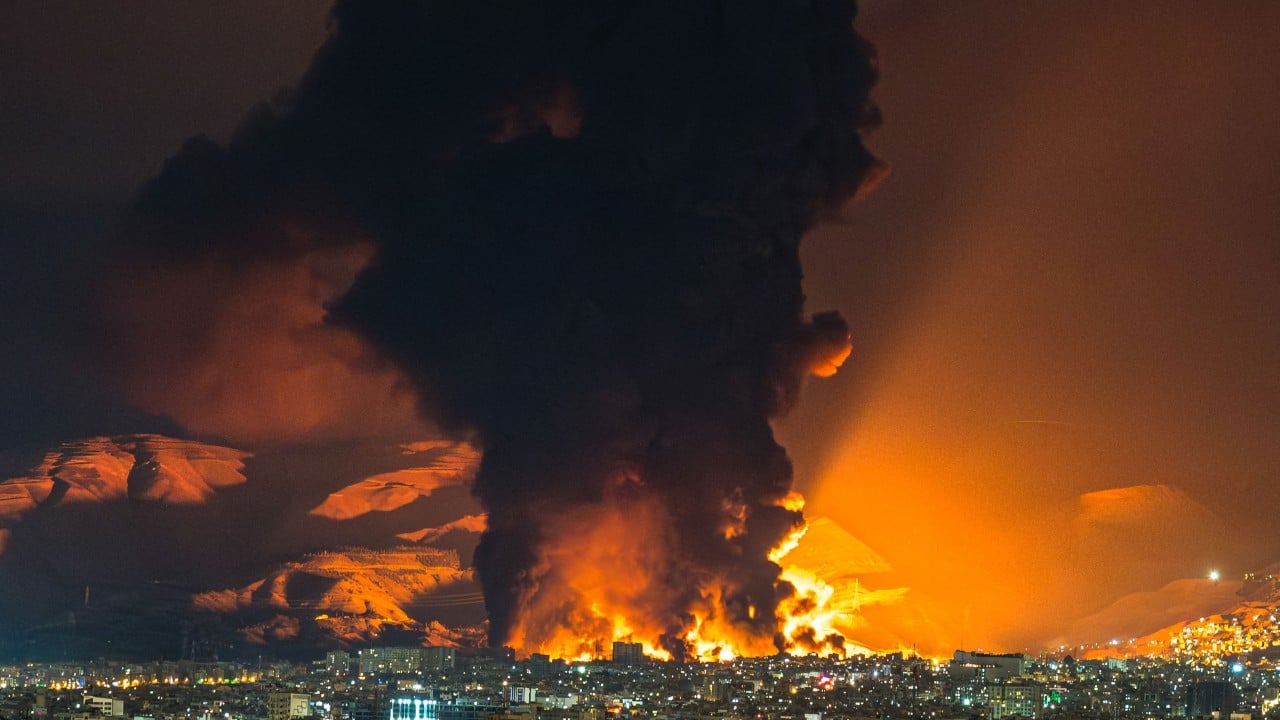
Traditional war makes sense to us. One army crosses a border, the other army fights back, and eventually, someone signs a piece of paper in a tent or a palace. We like that. It’s clean. But if you’re looking for that kind of ending in a conflict with Iran, you’re going to be waiting forever. Victory in an asymmetric war with the Islamic Republic doesn’t look like a flag over a captured capital. It looks like a long, exhausting, and often invisible stalemate where the goal isn't to win, but to not lose.
Most analysts get this wrong because they think in terms of "leverage" or "surgical strikes." They assume that if you hit enough high-value targets, the regime collapses or changes its behavior. That’s a fantasy. Iran has spent four decades building a system specifically designed to survive that exact scenario. When we talk about asymmetric warfare, we aren't just talking about cheap drones and sea mines. We’re talking about a psychological and political framework where the weaker power defines the terms of success. For a closer look into this area, we suggest: this related article.
Why the conventional definition of winning is dead
In a standard conflict, you measure progress by territory taken or hardware destroyed. In an asymmetric fight with Iran, those metrics are mostly useless. Iran doesn't need to control the Mediterranean or the Persian Gulf in a physical sense. They just need to make it too expensive, too risky, or too politically damaging for anyone else to stay there.
Think about the Strait of Hormuz. Roughly 20% of the world’s petroleum liquids pass through that narrow chokepoint. Iran doesn't need a massive navy to "win" there. They just need a few hundred fast-attack boats, some aging sea mines, and a handful of shore-based missiles. If they can hike global oil prices by 30% in a week, they’ve achieved a strategic victory without ever winning a single naval engagement. For them, victory is the absence of a stable status quo for their enemies. To get more information on this topic, detailed reporting can also be found at Reuters.
We often forget that the Iranian leadership views survival itself as the ultimate win. Since the 1979 Revolution, the regime has faced internal uprisings, a brutal eight-year war with Iraq, and decades of soul-crushing sanctions. They’re still here. To them, every day the system persists despite Western pressure is a "victory." If you’re fighting an opponent who measures success by their own continued existence, your "mission accomplished" banner is never going to fly.
The proxy network is a shield not a sword
You can't talk about Iran without talking about the "Axis of Resistance." This is the network of groups like Hezbollah in Lebanon, various militias in Iraq, and the Houthis in Yemen. Western planners often treat these groups as mere puppets. That’s a mistake. They’re more like a distributed operating system.
If a conflict scales up, Iran doesn't have to fire a single missile from its own soil to hurt its opponents. They can outsource the violence. This creates a massive problem for "victory" because it dilutes the target. If Hezbollah fires rockets, do you retaliate against Beirut or Tehran? If you hit Tehran, you risk a total regional war that nobody actually wants. If you hit Beirut, Iran’s core infrastructure remains untouched.
This creates a buffer zone of chaos. Victory for Iran in this context is maintaining the ability to strike from anywhere while maintaining "plausible deniability." It’s a genius move, honestly. It forces the more powerful side to fight a ghost that has no central nervous system to crush.
The high cost of the silver bullet theory
A lot of people think a massive cyberattack or a strike on nuclear facilities would end the threat. It’s a tempting thought. "Just take out the program and the problem goes away." But history shows us that technical fixes for political problems rarely stick.
When the Stuxnet virus crippled Iranian centrifuges years ago, it didn't stop the program. It just taught Iran they needed better cyber defenses and more decentralized facilities. They learned. They adapted. Today, Iran is a major cyber power in its own right, capable of hitting infrastructure in the West or the Middle East.
If a kinetic strike happens today, the Iranian response wouldn't be a symmetrical return fire. It would be a "thousand cuts" strategy. Small-scale attacks on shipping, cyber hits on regional banks, and stepped-up militia activity. You can’t "win" against a thousand cuts with a few big bombs. You just end up bleeding out while looking for something solid to hit.
Redefining success in a grey zone world
So, if we can't get a surrender ceremony, what does a "win" actually look like? It’s not a single moment. It’s a process of containment that feels a lot like losing to people used to quick results.
- Deterrence through resilience: Success is when Iran decides an action is too costly because the target is too hard to break, not because they fear a counter-strike.
- Decoupling proxies: Breaking the link between Tehran and its partners by addressing local grievances in places like Baghdad or Sana'a.
- Internal stagnation: Letting the regime’s own economic mismanagement and social restrictions do the work.
The hardest part for Western leaders is admitting that "victory" might just be a quieter version of the current tension. It’s boring. It doesn't look good on the news. It requires constant, grinding diplomacy and incremental military positioning.
What most people get wrong about Iranian intent
There’s a common belief that Iran is an irrational actor driven by pure ideology. While ideology plays a part, their foreign policy is deeply pragmatic. They know they can't win a head-to-head war with a superpower. Their entire military doctrine is built on that realization.
They use "strategic patience." They’re willing to wait out four-year or eight-year political cycles in Washington. They know that Western publics eventually get tired of "forever wars" and regional entanglements. Iran isn't going anywhere. Their geography is their greatest asset. You can’t "defeat" a country of 85 million people sitting on some of the most important real estate on the planet through military force alone.
The reality of the long game
If you’re waiting for a clear-cut ending, you’re looking at the wrong map. The "war" is already happening, and it’s being fought in bank servers, in the holds of commercial tankers, and in the halls of local governments across the Middle East.
Winning means keeping the global economy moving and preventing a nuclear breakout without starting a fire that burns the whole region down. It’s a tightrope walk. Anyone promising a simpler version of victory is selling you something.
Stop looking for a knockout blow. In asymmetric warfare, the person who stays in the ring the longest is the one who wins, even if they’re covered in bruises. The goal isn't to destroy the opponent; it's to outlast their will to keep swinging. That requires a level of patience that doesn't fit into a campaign slogan or a 24-hour news cycle. It's time to accept that the only way to "win" is to manage the conflict so effectively that it eventually becomes irrelevant. That’s the real victory, and it’s the hardest one to achieve.