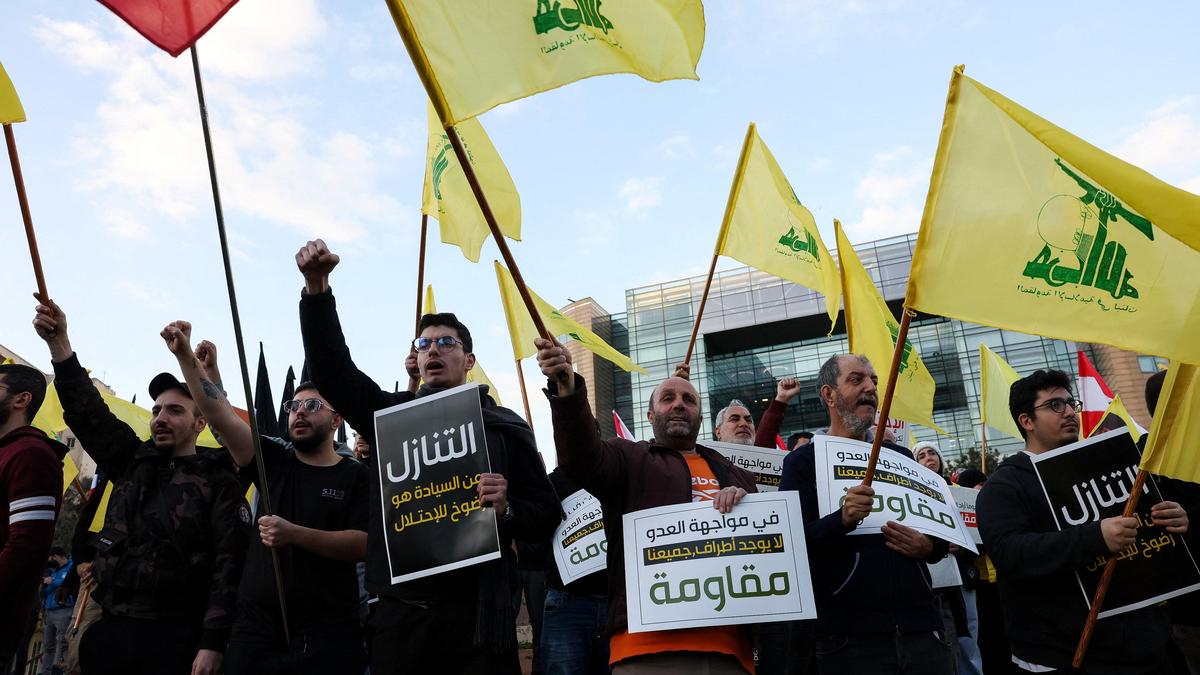
The American foreign policy establishment is currently obsessed with a fantasy. They believe that if they apply enough pressure, or offer the right carrot, Bashar al-Assad will suddenly turn on Hezbollah. It is a fundamental misunderstanding of Middle Eastern power dynamics that borders on the delusional.
The narrative suggests Damascus is "hesitant" or "wavering" under U.S. encouragement. This isn't hesitation. It is a cold, calculated survival strategy that Washington refuses to decode. You don't amputate the limb that is currently holding your entire torso upright.
The Myth of the Independent Syrian State
The primary flaw in the "encourage Syrian action" argument is the assumption that Syria exists as a fully sovereign, independent actor capable of making a clean break from its paramilitary partners. It doesn't.
Since 2011, the Syrian Arab Army (SAA) has been hollowed out. I have tracked the movements of the 4th Armored Division and the Tiger Forces for a decade; these units do not operate in a vacuum. They are deeply integrated with Hezbollah’s logistics, intelligence, and tactical command.
To ask Assad to "take action" against Hezbollah is to ask him to dismantle his own security architecture.
Hezbollah isn't just a guest in Syria. They are the floorboards. When the rebels were at the gates of Damascus in 2013, it wasn't a U.S. diplomatic overture that saved the regime. It was Hezbollah's intervention in Qusair. Assad knows this. He also knows that the moment he moves against the "Party of God," his eastern flank collapses, his supply lines to Iran vanish, and his internal protection against a coup evaporates.
The Fallacy of the Strategic Pivot
Diplomats love the word "pivot." They think every leader is just one good deal away from changing their entire geopolitical identity. This is the "Lazy Consensus" of the D.C. beltway.
- The Leverage Gap: What is the U.S. actually offering? Sanctions relief? The Caesar Act is a blunt instrument that has already done its maximum damage. Assad has learned to live in the wreckage.
- The Security Guarantee: If Assad kicks out Hezbollah, who protects him from the inevitable resurgence of extremist cells in the Badia? The U.S. isn't going to send the 82nd Airborne to guard the presidential palace in Damascus.
- The Iranian Shadow: Hezbollah is Iran's primary forward-deployed asset. Breaking with Hezbollah means breaking with Tehran. In a world where Russia is distracted by Ukraine, Iran is the only benefactor Assad has left who is willing to put boots on the ground to keep him in power.
Washington’s "encouragement" is a request for Assad to commit geopolitical suicide in exchange for a pat on the back and a potential seat at a table he’s already been kicked off of.
Understanding the Logistics of Co-Dependence
Let’s look at the math of the resistance axis. We are talking about a land bridge that stretches from Tehran through Baghdad to Damascus and Beirut.
$$Total Resistance Capacity = (Iranian Funding) + (Hezbollah Manpower) + (Syrian Geography)$$
If you remove the Syrian geography or the Hezbollah manpower, the entire equation zeroes out. Assad isn't a "hesitant" partner; he is a captive one.
The integration isn't just military; it’s economic. Hezbollah runs massive smuggling operations and shadow economies that keep the Syrian elite's pockets lined while the official economy is in a coma. To "take action" against these networks would trigger an internal revolt from the very Alawite base that keeps Assad in power.
The Real Reason for the "Quiet"
When sources say Damascus is "hesitant," what they are actually seeing is a tactical pause. Assad is a master of the "long wait." He will listen to U.S. intermediaries, he will nod, he will imply that he’s frustrated with his allies, and then he will do absolutely nothing.
He uses the possibility of a break with Hezbollah as a shield to prevent further Western escalation. It’s a stalling tactic, not a policy shift. If he were actually moving against them, we would see movement in the 15th Special Forces Division or shifts in the command structure of the intelligence directorates. We see none of that. We see deeper cooperation in the south near the Golan Heights.
Why the Status Quo is the Only Move
The Western intelligence community often asks: "How can we incentivize a Syrian-Hezbollah split?"
The question is flawed. You are asking for a chemical reaction that lacks a catalyst.
- Geopolitics is not a business transaction. You cannot "buy" a regime's survival instinct away.
- Assad views the West as fundamentally unreliable. He saw what happened to Gaddafi after he cooperated on nuclear disarmament. He saw the "red line" in 2013 evaporate. He trusts the people who stayed in the trenches with him when the world wanted him gone.
If the U.S. wants to actually impact Hezbollah's influence in Syria, it needs to stop asking the person who benefits from that influence to remove it. You don't ask the landlord to kick out the tenant who is paying the mortgage and providing the security.
The Brutal Reality of "Stability"
The hard truth that nobody in the State Department wants to admit is that a Syria without Hezbollah is, in the short term, a Syria in total chaos.
Without the Hezbollah-controlled corridors and the Iranian-backed militias, the SAA cannot hold the territory it has reclaimed. The resulting vacuum would be filled by a mix of Turkish-backed proxies, remnant ISIS cells, and localized warlords.
Assad knows that his "hesitation" is actually his greatest strength. By remaining in this gray zone—nominally in charge but functionally dependent—he makes himself indispensable to both sides. He tells the West, "I'm the only one who can eventually check Iran," while telling Iran, "I'm your only gateway to the Mediterranean."
Stop Looking for a Split That Isn't Coming
The obsession with driving a wedge between Damascus and Hezbollah is a waste of diplomatic capital. It is based on a 1990s view of the Middle East where Syria was a regional power broker. That Syria is dead. The current Syria is a hollowed-out shell that serves as a platform for regional actors.
Instead of "encouraging action" that will never happen, the focus should be on the technicalities of the border.
- Monitor the transfer of precision-guided munitions (PGMs).
- Target the financial hubs in Dubai and Beirut that facilitate the trade.
- Stop pretending that a polite conversation in an embassy is going to change thirty years of blood-oath alliance.
Assad isn't hesitant. He's bored of the West's inability to read the room.
He will continue to take the meetings, continue to leak "frustration" to the press, and continue to allow Hezbollah to use Damascus International Airport as a logistics hub. He is playing a different game than Washington. Washington is playing for a "win-win" settlement. Assad is playing for Tuesday. And so far, he’s winning.
Accept the reality: The Syrian-Hezbollah axis is not a marriage of convenience; it is a fusion of survival. You cannot talk someone out of their own skin.
Stop asking the fox to guard the henhouse and then acting surprised when he invites his friends over for dinner.