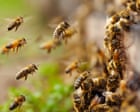
A low, heavy vibration hummed through the floorboards of the back porch. It was only mid-March. The morning air still carried the sharp, metallic bite of winter, and the oak trees in the yard were nothing but bare, gray skeletons. By all accounts of the calendar, the world should have been quiet.
Then came the shadow.
It did not fall from a cloud. It rolled across the grass like an undulating, living carpet, accompanied by a sound that felt less like an insect buzz and more like the distant roar of a stadium crowd. High in the branches of a dormant maple, twenty thousand honeybees fused into a swirling, desperate knot the size of a watermelon.
To anyone walking by, it looked like a plague. To a beekeeper, it looked like a miracle arriving at the absolute wrong time.
Every spring, a strange and beautiful madness grips a healthy bee colony. The hive becomes too crowded, bursting at the seams with new life. In response, the old queen takes a massive gamble. She abdicates her throne, fills the bellies of half her workforce with honey, and pours out into the open sky in a phenomenon known as a swarm. They are homeless, vulnerable, and searching for a new kingdom. It is the ultimate act of biological rebirth.
But across North America, this grand rebirth is happening in the dark.
The Biological Clock Has Lost Its Gears
Bees are creatures of exquisite geometry and flawless timing. For millennia, their internal clocks have been hardwired to the internal clocks of the botanical world. They wake up when the flowers open. They multiply when the pollen flows. It is a contract signed by evolution, executed with the precision of a Swiss watch.
Lately, the watch is missing its teeth.
When an unseasonably warm blast of air sweeps across the continent in February, the hive does not check the calendar. The queen simply feels the ambient temperature rise inside the wooden walls of her home. She assumes the world outside is greening. She begins laying thousands of eggs a day, kickstarting the colony’s growth weeks ahead of schedule.
By the time March arrives, the hive is overflowing. The bees do what nature commands them to do: they split, and they fly.
But when a hypothetical swarm lands on a branch in Illinois or Ontario in the early weeks of March, they confront a stark reality. The air temperature might be balmy for forty-eight hours, but the ground is still locked in frost. There are no dandelions. There are no apple blossoms. The maples have not even thought about budding.
The swarm is a thousands-strong army with rations for only a few days. They huddle together, burning through their stored honey just to keep the queen warm at the center of the cluster. If a cold snap returns—and it almost always does—the cluster freezes. The ground beneath the tree becomes littered with tiny, golden bodies that woke up to a promise the earth could not keep.
The Chaos on the Ground
For the people who spend their lives managing these creatures, this seasonal shift is transforming a predictable craft into a chaotic game of triage.
Consider the typical routine of a backyard apiarist. Historically, the equipment is cleaned in January, frames are built in February, and the first major hive inspections begin in late April. That timeline has been completely shattered. Beekeepers are now receiving panicked phone calls from neighbors before they have even scrubbed the winter grime off their veils.
"There is a monster hanging from my mailbox," a voice will stutter over the phone.
When the call comes in March, the local bee removal networks scramble. It is a race against the weather forecast. If a beekeeper can capture the swarm, shake them into a cardboard box, and tuck them into a managed hive with a gallon of sugar syrup, those twenty thousand lives might be saved. If the call comes too late, or if the swarm settles sixty feet up in the canopy of an old pine, they are essentially ghosts walking.
This is not a localized glitch. From the orchards of California to the suburbs of New England, the reports are uniform. The alarm bells are not being rung by theoretical models; they are being sounded by the people with propolis under their fingernails and stings on their wrists.
The deeper anxiety lies in what this means for the broader food system. We tend to view bees as a charming atmospheric detail of rural life, a soundtrack to summer afternoons. We forget that they are the literal glue holding our agricultural infrastructure together. Every third bite of food we consume relies on a pollinator. When the synchronicity between the insect and the crop dissolves, the friction is felt at the grocery store check-out line long before it is understood by the public.
The Hidden Cost of False Springs
The phenomenon driving this early chaos is what meteorologists call a "false spring." It is a cruel psychological trick played by a changing climate. A week of sixty-degree weather in February coaxes the natural world out of its blanket, only for a brutal polar vortex to slam the door shut a week later.
Humans can simply put their winter coats back on. Insects cannot.
When a colony swarms early, the parent hive left behind is also placed in extreme jeopardy. The half of the workforce that remained in the old hive is now leaderless. They have raised a few virgin queens in wax cups, but these new queens must fly out into the world to mate before they can start laying eggs.
To mate, a young queen needs two things: warm temperatures and a sky filled with drones from neighboring apiaries. In mid-March, those drones do not exist yet. The young queen flies out into a barren sky, finds no suitors, and returns to her hive unfertilized. Within a month, the old colony collapses from sheer attrition because there are no new workers rising to replace the old.
It is a double tragedy played out in absolute silence. The swarm perishes in the cold, and the original hive dies of emptiness.
Realigning the Compass
Fixing a broken biological clock is not as simple as tweaking a setting on a smartphone. We cannot force the flowers to bloom early, nor can we order the bees to stay inside their boxes when the air warms up.
What can change is human intervention.
The old, passive style of beekeeping—checking the hives once a month and letting nature take its course—is dead. To keep bees alive today requires a hyper-vigilant, almost intuitive relationship with the colony. It means feeding them sugar blocks in February to ensure they do not starve during a false spring. It means opening the hives in the biting wind to check for swarm cells weeks before the books say you should.
For those who do not wear a mesh suit, the task is different but no less urgent. The survival of these early swarms often depends entirely on the availability of "first-responder" forage. When a lawn is manicured into a sterile green carpet of golf-course perfection, it offers nothing to a starving bee. Allowing dandelions, clover, and henbit to flower in the early spring provides a vital lifeline for a colony that has taken the gamble to swarm too soon.
The humming mass in the maple tree eventually grew quiet as the afternoon sun dipped below the horizon. The temperature was dropping fast. By midnight, the thermometer would read twenty-eight degrees.
Inside the house, the heat kicked on with a soft click. Outside in the dark, twenty thousand tiny hearts beat furiously against each other, shivering in unison, trying to manufacture enough heat to survive a spring that had promised everything and delivered nothing.