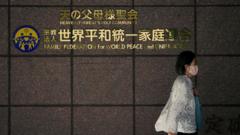
The Japanese government is currently popping champagne over the Tokyo District Court’s decision to revoke the legal status of the Unification Church. The media chorus is unified: this is justice served. It is a victory for the families destroyed by exorbitant donations and the victims of aggressive proselytizing.
They are missing the forest for the trees.
By cheering on the state-sponsored dissolution of a religious entity, the public is not protecting society. They are handing the state a loaded weapon—a precedent that, if applied consistently, would dismantle half the religious organizations operating in Japan today. This is not about the Unification Church anymore. It is about who decides which faith is "legitimate" enough to exist.
The Consensus Fallacy
The mainstream narrative relies on a comfortable, binary assumption: the Unification Church is a "cult" that deserves to be erased, while other, more "traditional" religions are stable, beneficial institutions.
This distinction is entirely artificial.
When the state uses its power to strip a religious corporation of its tax-exempt status and dissolve it based on the behavior of its followers—or the perceived harm of its doctrine—it moves the goalposts of religious freedom. If "financial exploitation" becomes the metric for state intervention, what happens when that metric is applied to the grand cathedrals demanding tithing from the poor, or the organizations that pressure adherents to eschew modern medical treatment in favor of prayer?
I have sat in boardrooms where legal teams debated the tax status of controversial non-profits. The moment the government defines the boundary of "acceptable belief," they stop being a secular referee and start being a theological arbiter. Once the state dictates that a religion has become an "enterprise of harm," they invite a bureaucratic nightmare where the definition of "harm" expands to fit the political wind.
Understanding the Legal Mechanic
To be clear, the dissolution order in Japan—based on the Religious Corporations Act—isn't a simple ban on prayer. It is a corporate execution.
The Japanese government argued that the Unification Church engaged in systematic activities that were "detrimental to public welfare." This is the legal equivalent of a blank check. In most democratic societies, the state manages religious organizations with a light touch, focusing on illegal acts (fraud, kidnapping, tax evasion) rather than the entity itself. By targeting the corporate status of the church, the Japanese court is essentially saying that the entity's very existence is the root cause of the problem.
Imagine a scenario where the state decides that a political party’s platform is fundamentally deceptive and, therefore, the party must be dissolved entirely rather than prosecuting specific members for specific crimes. You would call that authoritarian overreach. Why does that logic evaporate the moment the word "religion" enters the conversation?
The government’s reliance on the Civil Code to hold the church liable for damages caused by its followers is a double-edged sword. If this legal theory becomes the standard for corporate liability—where a parent organization is fully accountable for the erratic financial choices of every individual member—every major multinational corporation would be shuttered by Tuesday.
The Cost of State-Sanctioned Censorship
The argument against the Unification Church often centers on the "brainwashing" or "spiritual sales" tactics they employed. These are heinous. The pain of families who saw their life savings drained is real. But the mechanism of "dissolution" treats the symptoms while creating a societal disease.
By relying on the courts to act as arbiters of religious conduct, the government avoids the much harder work of strengthening consumer protection laws that apply to everyone. If the church committed fraud, charge them with fraud. If they violated tax laws, tax them.
Instead, the state took the easy path: the nuclear option.
When you empower the state to erase a religious entity, you aren't protecting the individual. You are merely changing who controls the narrative. History is replete with examples of governments starting with the "fringe" groups everyone hates, only to find that the machinery of suppression is perfectly capable of being turned against the inconvenient groups they love.
The Uncomfortable Truth About Secularism
The unspoken reality is that Japanese society has long held an uncomfortable relationship with the Unification Church because it was a foreign-born movement that successfully integrated into the political elite. The animosity isn't just about the money; it’s about the reach.
However, punishing a church for its political influence through the judicial system is a failure of democratic governance. If politicians were too close to the group, the voters should have removed them. If the group broke the law, the prosecutors should have indicted the leaders.
Dissolving the organization is a performative act of "doing something" that requires zero political courage. It allows officials to wash their hands of the systemic failures that allowed such an organization to thrive for decades.
Beyond the Cult Panic
We must move past the "cult" label, which is often used as a rhetorical shield to dismiss the rights of minority groups. Whether you find their beliefs bizarre or their practices abhorrent is irrelevant to the question of state power.
If we allow the dissolution of a religion based on "public welfare" judgments, we are setting a standard that requires the state to possess a moral compass that it rarely demonstrates. Governments are reactive, political, and often corrupt. Entrusting them with the ability to define the validity of a faith is the ultimate act of naivety.
We are currently witnessing the quiet erosion of one of the most basic principles of a free society: that the state remains neutral on the legitimacy of religious institutions. By celebrating this dissolution, the public is not cleaning up society. They are clearing the ground for a new, state-approved orthodoxy, where the right to exist is contingent upon not being too weird, too wealthy, or too politically effective.
The damage caused by the Unification Church is a tragedy. But the destruction of the boundary between the state and the spiritual institution is a disaster.
The next time the government sets its sights on an organization you actually agree with, don't look around for someone to save you. You helped build the mechanism that is coming for you.

.png?format=1500w)