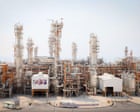
The headlines are screaming about a potential Third World War because of a single threat. Donald Trump warns that if Tehran touches Qatar, the South Pars gasfield—the crown jewel of Iranian energy—gets turned into a crater. The foreign policy establishment is clutching its pearls. The energy markets are twitching. The "experts" are busy calculating the carbon footprint of a burning gas field.
They are all missing the point.
This isn't a military strategy. It’s a hostile takeover bid disguised as a geopolitical ultimatum. If you think this is about "protecting an ally" or "deterring Iranian aggression," you’ve been reading the wrong reports. This is about the brutal, cold-blooded reality of global LNG (Liquefied Natural Gas) dominance and the dismantling of the world’s most awkward energy partnership.
The Myth of the Shared Field
Most people don’t realize that South Pars isn’t just an Iranian asset. It is the northern half of the world’s largest natural gas field. The southern half? That’s Qatar’s North Field. It is a single, continuous geological structure split by a maritime border.
The "lazy consensus" suggests that hitting South Pars would be a catastrophic loss for the global energy supply. That’s a half-truth. While it would certainly spike prices in the short term, the strategic reality is that Iran and Qatar are currently in a "drain race." They are both tapping the same reservoir.
When Trump threatens to "blow up" the Iranian side, he isn't just threatening a military strike. He is proposing a permanent solution to Iranian competition in the European and Asian gas markets. By neutralizing South Pars, the US effectively hands the keys of the entire reservoir to Qatar—a nation whose LNG infrastructure is inextricably linked to Western investment and American security guarantees.
Qatar’s Golden Handcuffs
Let’s talk about the Qatari "victimhood" narrative. The media portrays Qatar as a defenseless state caught between two giants. This is nonsense. Qatar has spent decades playing both sides with surgical precision. They host the largest US military base in the region (Al Udeid) while simultaneously co-managing their primary source of wealth with the Iranians.
It is a parasitic relationship that has reached its expiration date.
The US gas industry, specifically the massive LNG export terminals along the Gulf Coast, sees the Qatar-Iran duopoly as the primary obstacle to total market capture. If South Pars is removed from the equation, the global supply chain doesn't just "break"—it consolidates.
I have watched energy analysts overlook the mechanics of pressure maintenance for years. If the Iranian side of the field is destroyed or rendered inoperable, the pressure differential in the reservoir changes. Over time, the gas migrates. It doesn't just disappear; it moves toward the straws that are still in the ground. In this case, those straws belong to Qatar. Trump’s threat isn't just about fire and brimstone; it’s about a massive transfer of sub-surface wealth.
The Infrastructure Fallacy
Critics argue that "blowing up" a gas field is impossible or would cause an ecological disaster that the US wouldn't risk. They’re thinking about 1991 Kuwait. They’re thinking about oil fires. Gas is different.
You don't need to carpet-bomb the entire Persian Gulf. You just need to hit the processing plants and the compression stations. Iran’s energy infrastructure is aging, starved of parts by decades of sanctions, and held together by sheer willpower and black-market Chinese components.
Why the "Total War" Narrative is a Distraction
- Precision vs. Obliteration: Modern kinetic strikes don't need to "level" a field. They just need to destroy the specialized turbines and cooling units that Iran cannot replace.
- Economic Decapitation: Iran’s domestic economy is a gas-powered engine. Without South Pars, the lights go out in Tehran. Not in six months. In six days.
- The Proxy Pivot: The threat assumes Iran will strike Qatar. Iran isn't stupid. They know that hitting Qatar is hitting the West's gas tank. But by putting the threat on the table first, the US is redefining the rules of engagement. It’s no longer "don't hit our allies." It’s "if you move, we liquidate your only remaining bank account."
The LNG Hegemony
The real story here is the war for the 2030s energy market. Russia is out of the European picture for the foreseeable future. That leaves a massive vacuum. The competitors are the US and the Qatar-Iran bloc.
By threatening South Pars, Trump is signaling to European buyers that Iranian gas is not just sanctioned—it is physically insecure. No one signs a 20-year supply contract for gas that comes from a field on a target list. This effectively kills Iran’s hopes of ever building the "Friendship Pipeline" or expanding their own LNG capabilities with help from the East.
The Risk Nobody Admits
Is there a downside? Of course. The environmental impact of a massive atmospheric release of methane would be significant. But in a world where energy security has replaced climate goals as the primary driver of statecraft, that’s a secondary concern for the players involved.
The bigger risk is a miscalculation of Iranian desperation. When you tell a regime you are going to destroy their only source of income, they stop acting like a state and start acting like a cornered animal. But the "insider" truth is that the US has already gamed this out. The buildup of naval assets in the region isn't just for show; it’s a containment field.
Stop Asking if He'll Do It
People keep asking: "Would he actually pull the trigger?"
That is the wrong question. In the world of high-stakes energy diplomacy, the threat is the product. The uncertainty is the leverage. By making the destruction of South Pars a public talking point, the US has already achieved several objectives:
- Risk Premiums: It has baked a permanent "instability tax" into Iranian energy projects.
- Investment Flight: It has scared off the last few Chinese and Indian firms considering infrastructure investment in Bushehr.
- Qatari Compliance: It has reminded Doha exactly who keeps the taps flowing and the borders safe.
This isn't "crazy" foreign policy. It’s a ruthless application of economic leverage using military language. The establishment media calls it "dangerous rhetoric." I call it the first honest assessment of the Middle Eastern energy map we’ve seen in years.
The South Pars field isn't a neutral resource. It is a weapon. And for the first time, someone is pointing it back at the person holding the trigger.
Stop looking at the maps and start looking at the balance sheets. The war for the Persian Gulf isn't being fought over borders. It’s being fought over who gets to sell the last molecule of methane to a hungry world.
If you’re still waiting for a "diplomatic solution," you’re already behind the curve. The solution is being dictated by the threat of total industrial erasure.
Liquidity is the only law that matters.