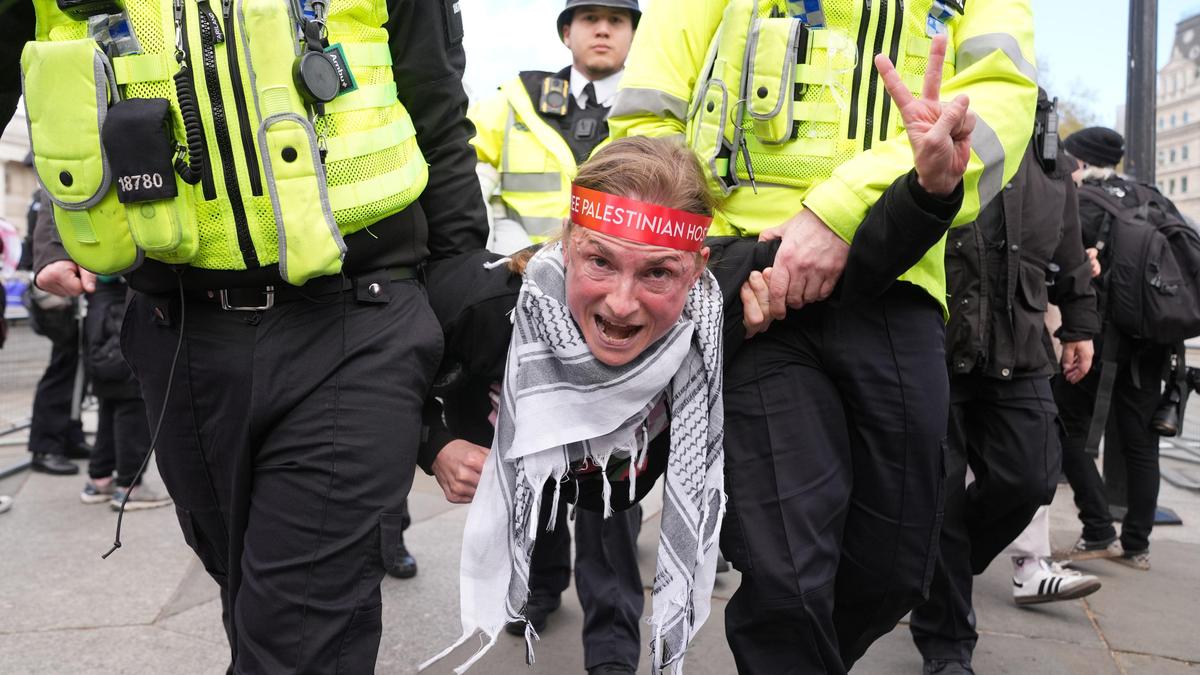
If you think the right to hold a sign in a public square is still a given in the UK, the scenes at Trafalgar Square this weekend should be your wake-up call. On Saturday, April 11, 2026, London’s Metropolitan Police arrested 523 people in a single afternoon. The "crime"? Holding pieces of cardboard that expressed support for Palestine Action, a group the government labeled a terrorist organization last summer.
This wasn't a riot. There were no smashed windows or spray-painted statues this time. Instead, the Met hauled away grandmothers in camping chairs and famous musicians like Robert Del Naja of Massive Attack. It’s a staggering escalation in how the state handles dissent, especially since the High Court recently called the ban on this group "unlawful." Honestly, it feels like the law is being used as a blunt instrument to see how much the public will take before they stop showing up.
The Numbers That Should Worry You
Let's look at the scale. 523 arrests in one day isn't a routine police operation; it's a mass clearing. The Met confirmed that every single one of those individuals was detained for showing support for a "proscribed organization" under the Terrorism Act 2000.
The demographics of the crowd tell a story the authorities probably didn't want told. Those arrested ranged in age from 18 to 87. When you're arresting an 87-year-old for holding a sign that says "I oppose genocide," you've moved past "public safety" and into the territory of "message control." The police are banking on the idea that labeling a group "terrorist" makes any association with them radioactive. But for the hundreds who sat down in the square, that label clearly didn't stick.
The Legal U-Turn Nobody Saw Coming
The most confusing—and frankly, most frustrating—part of this story is the legal limbo. In February 2026, the High Court ruled that the government’s decision to ban Palestine Action was unlawful and disproportionate. For a few weeks, the Met actually backed off. They told the public they’d stop making arrests for simple support.
Then, just days ago, they did a total 180. The force announced they’d start arresting people again because the government is appealing the court's decision. Basically, until that appeal is heard later this month, the ban technically stays on the books. The police decided to exploit that technicality to its absolute limit this weekend.
Why Palestine Action Was Banned
The group became a target after a series of high-profile "direct actions." Their playbook usually involved:
- Breaking into arms factories (specifically Elbit Systems).
- Spraying red paint to symbolize spilled blood.
- Dismantling machinery or occupying rooftops.
The tipping point for the Home Office was an incident at RAF Brize Norton in June 2025, where activists damaged two military refuelling planes. The government used this to push through a proscription order, putting a group of paint-spraying activists in the same legal category as ISIS or al-Qaeda.
The Celebrity Factor and Robert Del Naja
One of the most visible moments of the day was the arrest of Robert Del Naja. He didn't come with a mask or a tin of paint; he came with a sign. Before the police carried him away, he talked about the "trepidation" of being a touring musician facing a terrorism-related arrest.
He did it anyway. His reasoning was simple: he felt the police U-turn was "ridiculous" and that standing up in court to challenge an unlawful arrest was a risk worth taking. When people with a platform start putting their careers on the line over a placard, it suggests the government’s attempt to "de-radicalize" the movement by banning it has backfired. It’s actually galvanized people who might have stayed home a year ago.
The Human Rights Fallout
Amnesty International UK didn't hold back, calling the day a "blow to civil liberties." They pointed out the absurdity of the state criminalizing people for holding "pieces of card." It’s a valid point. If the High Court already said the ban shouldn't exist, why is the Met still filling jail cells over it?
The strategy seems to be one of exhaustion. By arresting 500 people at once, you clog the legal system, drain the resources of protest groups, and scare off the "average" person who can't afford a criminal record. But looking at the grey-haired protesters being carried off by four officers at a time, that "fear factor" doesn't seem to be working as intended.
What Happens Next for the Protesters
If you were one of the people in the square, or if you're watching from the sidelines, the next few weeks are critical. The Home Secretary’s appeal is scheduled for April 28 and 29. That's when we'll find out if the High Court's ruling holds up or if the "terrorist" label becomes permanent.
If you’re planning on attending any demonstrations in the meantime, you need to understand the current "enforcement" climate. The Met has made it clear: they aren't waiting for the final court verdict. If you carry the logo, the name, or even a sign expressing support for the group's actions, you should expect to be processed.
The legal defense for those arrested this weekend will likely hinge on the "unlawful" nature of the original ban. But a "win" in court months from now doesn't change the reality of being held in a cell today. The best move for anyone involved is to stay updated on the Defend Our Juries or Amnesty UK briefings regarding the April 28 appeal. That ruling will determine whether the UK remains a place where "offensive" speech is protected, or a place where a placard can get you a terrorism charge.