Traditional news is dying because it forgot how to talk to people. Most legacy outlets act like a professor lecturing a room full of bored students. They're stuffy, they're slow, and they're obsessed with "objectivity" to a point where they often miss the actual truth. Jack Kelly, the founder of TLDR News, realized this early on. He didn't build a media empire by copying the BBC or CNN. He built it by realizing that younger viewers don't want a suit behind a desk. They want context, speed, and a reason to care.
If you look at the numbers, the situation for mainstream media looks grim. A Reuters Institute report found that news avoidance is at an all-time high. People aren't just busy; they're actively hitting the "mute" button on world events because the delivery feels overwhelming or biased. TLDR News stepped into that gap. They don't just report what happened. They explain why it matters without the fluff.
The death of the traditional news anchor
The old guard thinks trust comes from a deep voice and a high-production studio. They're wrong. For Gen Z and Millennials, trust comes from transparency. When Jack Kelly started making videos, he wasn't trying to look like a news anchor. He looked like a guy who had done a lot of research and wanted to share it with his friends.
That shift in tone is everything. Traditional media often hides behind a "voice of God" narration. TLDR takes the opposite approach. They admit what they don't know. They show their work. If a topic is complicated, they say it’s complicated instead of oversimplifying it to fit a 30-second soundbite.
This isn't just about being "relatable." It’s a structural change in how information moves. We’ve moved from a broadcast model to a conversational one. If you aren't talking with your audience, you're just noise. Kelly’s team understands that the "TLDR" brand isn't just about being short. It’s about being efficient. You respect the viewer's time, and in return, they give you their attention.
Why objectivity is a failed experiment
Most newsrooms cling to a version of objectivity that feels fake. They present "both sides" of an issue even when one side is clearly lying. This creates a weird kind of friction for a generation that grew up with the internet. We can see through the performance.
TLDR News doesn't pretend to be a blank slate. They aim for fairness, which is different. They lay out the arguments for and against a policy, but they do it with a level of bluntness that feels refreshing. They don't use coded language. They don't use "journalese." They use the same English you use at the pub.
This approach works because it feels honest. When you stop trying to sound like an institution, you start sounding like a person. And people trust people. They don't trust faceless corporations with vague editorial boards. Kelly built his brand on his own name and face first, which created a direct line of accountability. If the video is wrong, it’s on him. That’s a level of skin in the game that a lot of big-name journalists try to avoid.
Context is the only thing that matters now
We live in an era of "headline stress." You see a notification on your phone about a coup in a country you can't find on a map, and you feel a spike of anxiety. Then you keep scrolling. Traditional news is great at telling you that something happened. It's terrible at explaining the backstory.
TLDR News succeeded by focusing on the "middle" of the story. They assume you're smart but don't have eight hours a day to read white papers. They provide the historical context that makes the current event make sense.
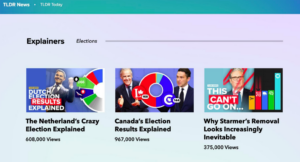
Think about the way they cover British politics or the EU. These are notoriously dry topics. Most people tune out the moment someone mentions "parliamentary procedure." But Kelly’s team breaks it down into logic puzzles. They show how Part A leads to Part B. They use simple graphics that actually mean something, rather than just being eye candy.
Managing the attention economy without selling out
The biggest trap for any new media company is the "clickbait spiral." It's tempting to use a shocking thumbnail or a terrifying headline to get views. We've all seen it. But that's a short-term play. It kills trust.
TLDR has been remarkably disciplined here. Their thumbnails are clean. Their titles are descriptive. They don't use "You won't believe what happened next." They tell you exactly what the video is about. This creates a "low-friction" relationship with the viewer. You know that if you click a TLDR video, you're going to get a 7-to-10-minute breakdown of a specific topic. No more, no less.
They also diversified early. By launching channels like TLDR News Global, TLDR News US, and TLDR News Europe, they created specialized hubs. This prevents the main channel from becoming a mess of unrelated stories. It lets the audience choose what they care about. It's a pull model, not a push model.
The problem with being too fast
There’s a tension in modern news between being first and being right. Legacy media often struggles with this. They rush to report a "breaking" story and end up having to issue corrections three hours later. Or they wait so long to verify everything that the conversation has already moved on.
Kelly seems to have found a middle ground. They aren't trying to beat Twitter (or X) to the punch. They aren't trying to be the very first person to tweet a photo of a fire. Instead, they wait a beat. They wait until there's enough information to build a narrative.
This "slow-fast" approach is better for the viewer's mental health. It turns the news from a constant stream of chaotic updates into a series of coherent lessons. It changes the role of the journalist from a reporter to a curator. In a world with too much information, the person who filters out the garbage is the most valuable person in the room.
Money and independence
You can't talk about trust without talking about who pays the bills. Most people are rightfully cynical about media ownership. If a billionaire owns the paper, you're going to wonder if the reporting on that billionaire’s friends is truly honest.
TLDR News relies heavily on direct audience support—think Patreon and sponsorships that actually fit the brand. This isn't just a business move; it's a trust move. When the audience knows they are the ones keeping the lights on, the relationship changes. The creators are beholden to the viewers, not a board of directors worried about quarterly dividends.
It also allows for a bit more experimentation. They don't have to worry about "broad appeal" in the same way a network TV show does. They can go deep on a niche topic like the intricacies of the Swiss voting system because they know their core audience loves that stuff.
Stop overthinking the algorithm
A lot of creators spend all their time trying to "hack" the YouTube algorithm. They obsess over keywords and "high-retention" editing. While TLDR clearly pays attention to these things, they don't let the tech drive the bus.
The secret is that the "algorithm" is just a mirror of human behavior. People like things that are useful. They like things that make them feel smarter. They like things that don't treat them like idiots. If you focus on providing genuine value, the views usually follow.
Kelly’s team uses a very specific visual style. It’s consistent. You know a TLDR video the moment you see a frame of it. That consistency builds a sense of stability. In a world that feels increasingly chaotic, having a reliable source that looks and sounds the same every day is a form of comfort.
How to actually build a brand people trust
If you're trying to build something in the media space today, stop looking at what the newspapers are doing. They’re stuck in 1995. Look at what's happening on YouTube, Nebula, and Substack. The future of news is decentralized, personal, and unapologetically nerdy.
Don't try to be everything to everyone. Find a specific angle. Be the person who explains the economy better than anyone else. Or the person who makes sense of international law.
Most importantly, don't be afraid to show your personality. The "professional" mask is a liability now. People want to see the gears turning. They want to know why you're interested in the story. If you aren't excited about what you're talking about, why should they be?
Next steps for the curious
Start by auditing your own news intake. Look at your social feeds and ask yourself how many of those sources you actually trust. If the answer is "not many," it's time to change who you're listening to.
Follow creators who cite their sources. If an article doesn't link to the original data or the full quote, be skeptical. Look for people like Jack Kelly who are building communities around information rather than just dumping content into the void.
Switch off the "breaking news" alerts on your phone. They’re designed to keep you addicted, not informed. Instead, set aside time each day to watch one or two deep dives. You'll find that you actually understand the world better when you aren't getting it in 280-character chunks. Trust is a two-way street. You have to be a discerning consumer, and the creators have to be honest providers. When that clicks, the "news" stops being a chore and starts being an asset.