The air inside a cockpit at night doesn't feel like the future. It feels like a pressurized sanctuary of glowing amber and cool blue light, humming with the steady vibration of engines that have become an extension of your own heartbeat. You are encased in glass and aluminum, hurtling down a strip of New York concrete at a hundred and forty miles per hour. Everything is routine. Everything is math. Until the math stops working.
On a cold January evening at John F. Kennedy International Airport, two giants of the sky nearly became a single, catastrophic headline. An American Airlines Boeing 777, bound for London, crossed a taxiway it wasn't supposed to. At that exact moment, a Delta Air Lines Boeing 737 was screaming down the adjacent runway, nose lifting, committed to flight.
They came within one thousand feet of each other.
In the world of commercial aviation, a thousand feet is the width of a razor’s edge. It is the distance between a "close call" and a national tragedy that would have redefined how we view the safety of the skies. To understand why this happened, you have to look past the radar screens and the black boxes. You have to look at the humans sitting in the seats, the weight of the radio silence, and the terrifying speed of a mistake.
The Anatomy of a Heartbeat
A pilot’s world is governed by the "sterile cockpit" rule. No idle chatter. No distractions. You are a biological computer processing a thousand data points a second. But even the best computers can experience a glitch when the interface—the communication between the ground and the air—stutters.
Air Traffic Control (ATC) is a symphony of voices. On the night of the JFK incident, the frequency was busy, a rapid-fire staccato of tail numbers and headings. The American Airlines crew was instructed to cross Runway 31L. Instead, they navigated onto Runway 4L.
Physics doesn't care about intentions. As the American 777 poked its nose into the path of the departing Delta flight, the ground radar at JFK—a system known as ASDE-X—screamed an alarm. This isn't a polite chime. It is a piercing, digital howl designed to override every other sound in the tower.
"S***! Delta 1943, cancel takeoff clearance! Delta 1943, cancel takeoff clearance!"
The voice of the controller in the recorded audio isn't just professional. It is desperate. You can hear the adrenaline spike, the sudden realization that he is watching two blips on a screen that are about to merge into one.
For the Delta pilots, this was the ultimate test of reflex. They were at "V1"—the speed of no return. In theory, once you hit V1, you are flying, no matter what. Aborting a takeoff at that speed carries its own set of lethal risks: blown tires, brake fires, or sliding off the end of the runway into the bay.
They chose the brakes.
The Weight of the Invisible
Imagine sitting in row 18B. You’ve buckled your seatbelt. You’ve turned off your phone. You’re thinking about the meeting in London or the family waiting for you at the gate. You feel the surge of the engines, that familiar press against the back of your seat as the plane gathers speed.
Then, the world tilts.
The deceleration is violent. It’s not a gentle tap of the brakes; it’s a full-system rejection of momentum. Objects fly forward. The engines roar in reverse. Outside the window, the blue and white lights of the runway blur into a streak of chaos. You don't know why you're stopping. You just know that the air has suddenly become very heavy.
The passengers on Delta 1943 didn't see the American 777. They didn't see the massive wing of the other aircraft slicing through the dark just a few hundred yards away. They were saved by a system of redundancies they didn't know existed and a controller whose eyes were glued to a primary-colored monitor.
This is the invisible stake of modern travel. We trust the system because it works 99.9% of the time. But that 0.1% is where the ghosts live. The Federal Aviation Administration (FAA) has been grappling with a surge in these "runway incursions" over the last few years. It isn't just a JFK problem; it’s a systemic strain.
The causes are deceptively simple. Fatigue. Undermanned towers. Outdated airport diagrams. A momentary lapse in "situational awareness"—a pilot's term for knowing exactly where your multi-ton metal tube is in relation to everything else on the planet.
The Silence After the Scream
The most haunting part of the JFK recordings isn't the shouting. It’s the silence that follows the aborted takeoff.
"Delta 1943, are you able to taxi?" the controller asks, his voice now eerily calm, the adrenaline receding into a cold sweat.
"Yeah, we're... we're going to need a minute," the pilot responds.
In that "minute," a thousand "what-ifs" are processed. The pilots aren't thinking about their schedules anymore. They are looking at their hands to see if they’re shaking. They are smelling the scorched rubber of the tires that just saved 153 lives. They are realizing that the margin between a normal Tuesday and a day of national mourning was exactly eighteen seconds of braking distance.
We often treat air travel as a commodity, like a bus ride with better snacks. We complain about the legroom and the price of the Wi-Fi. We forget that we are asking humans to perform miracles of coordination every sixty seconds.
The JFK incident wasn't a failure of technology. The technology worked. The radar caught the error. The radio transmitted the warning. The brakes held. It was a reminder of the fragility of the human element. We operate at the edge of our capabilities, relying on a language of short-codes and coordinates to keep the chaos at bay.
The Ghost in the Machine
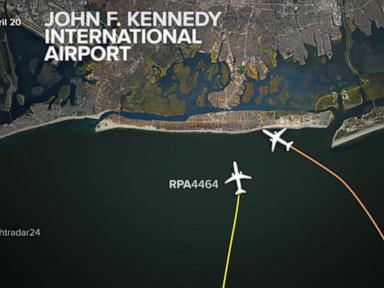
When you look at the flight paths afterward, the narrowness of the miss is sickening. The lines on the map cross with a precision that looks intentional. It looks like a choreographed dance that went wrong.
The American Airlines crew eventually made it to London, though not that night. The Delta passengers were rebooked. The planes were inspected, the tires replaced, the logs updated. On the surface, the system reset itself.
But the "invisible cost" remains. Every time this happens, a bit of the collective confidence in the "automatic" nature of flight is chipped away. We realize that the "safe" world we’ve built is actually held together by the vigilance of people who are tired, stressed, and working in a system pushed to its absolute limit.
JFK is one of the most complex pieces of real estate on earth. It is a labyrinth of intersections and competing priorities. To navigate it safely requires a level of perfection that humans aren't naturally wired for. We are wired for stories, for emotions, for distractions. We are not wired to be perfectly synchronized nodes in a global transport grid.
And yet, we try.
The Final Approach
The investigation into the JFK near-miss will produce a report hundreds of pages long. It will talk about "pilot deviation" and "operational errors." It will suggest new lighting or better training modules. It will be clinical, dry, and factual.
But the real story isn't in the report.
The real story is in the breath the Delta pilot took before he keyed the mic. It’s in the wide-eyed silence of a passenger who realized, hours later, why the plane suddenly stopped. It’s in the realization that every time we leave the ground, we are participating in a grand, precarious agreement that everything will go exactly as planned.
Next time you’re sitting on a runway, watching the rain streak across the window, listen to the silence of the cabin. Beneath that silence is a hidden world of frantic calculations and watchful eyes. We live in the gaps between the tragedies that almost happened.
A thousand feet.
It’s the length of three football fields. It’s the time it takes to blink. It’s all that stood between a routine flight and a scar on the earth that would never heal. We don't fly on wings of metal alone; we fly on the thin, vibrating thread of human attention.
And that night in New York, the thread held. Just barely.