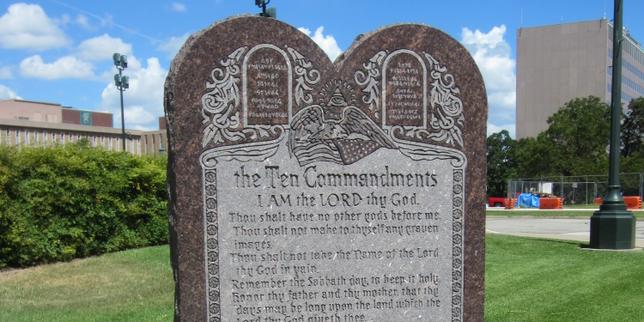
Texas just threw a theatrical brick through the window of the First Amendment, and everyone is screaming about the wrong things. The civil libertarians are hyperventilating about a "theocratic takeover." The religious right is taking a victory lap over a "moral restoration." Both sides are hallucinating.
What we are actually witnessing in the Texas legislature isn’t a spiritual awakening or a constitutional collapse. It is a masterclass in brand management and political distraction. By mandating that the Ten Commandments be displayed in every public school classroom, Texas isn’t saving souls; it is using an ancient text as a cheap aesthetic band-aid for a failing educational infrastructure.
If you think a poster on a wall changes the moral trajectory of a generation, you’ve never met a teenager.
The Myth of the Moral Vacuum
The loudest argument for this mandate is that schools have become "moral vacuums." This is the first lie we need to dismantle. A classroom isn't empty of values just because it lacks a bronze plaque. Values are transmitted through the way we grade, the way we discipline, and the way we fund those very schools.
The "lazy consensus" suggests that removing religious symbols caused a decline in student behavior. This is a classic case of post hoc ergo propter hoc—after this, therefore because of this. You want to talk about student behavior? Let’s talk about the 1:500 counselor-to-student ratios. Let’s talk about the fact that we expect teachers to be social workers, security guards, and data analysts while paying them in "Teacher of the Month" coffee mugs.
Displaying "Thou shalt not covet" in a hallway where students are judged by their zip code and the brand of their shoes is a special kind of irony. It’s not moral instruction; it’s gaslighting.
The Supreme Court’s Shift from Coercion to History
The legal "insider" secret here is that the old Lemon test—the standard used for decades to keep church and state separate—is dead. It wasn't killed by a sudden surge in piety; it was dismantled by a Supreme Court that has redefined "establishment" to mean "coercon."
In Kennedy v. Bremerton School District, the Court signaled that religious expression is fine as long as it’s "rooted in history and tradition." Texas is leaning hard into this loophole. They aren't arguing that the Commandments are divine law; they are arguing they are a historical foundation of Western law.
This is where the nuance gets interesting. By secularizing the Commandments to save them legally, the state is actually stripping them of their religious power. To win in court, the state has to argue that these aren't religious documents, but historical artifacts. They are effectively "museum-ifying" God. If I were a devout believer, I’d be insulted. The state is taking a sacred covenant and turning it into a piece of civic wallpaper, no different than a poster of the Magna Carta or a "Hang in There" kitty.
Why the Left is Losing the Argument
The opposition keeps falling into the same trap. They argue that this will "harm" non-Christian students. While that’s a valid philosophical point, it’s a losing legal and political strategy in the current climate.
The real argument isn't about the harm to the student; it's about the incompetence of the state.
We are living in an era where public school literacy rates are plummeting. In some Texas districts, less than half of the students are performing at grade level in reading. Amidst this academic emergency, the legislature has decided that the most "pivotal" use of their time is debating font sizes for "Honor thy father and thy mother."
It is a classic "look over here" tactic. If we are fighting about posters, we aren't fighting about why the state’s multi-billion dollar surplus isn't being used to fix the crumbling AC units in South Texas schools.
The Thought Experiment: The Burden of Consistency
Imagine a scenario where a Texas school board is forced to apply this "historical and traditional" standard fairly.
If we display the Ten Commandments because they influenced Western law, we must, by the same logic, display:
- The Code of Hammurabi (the actual precursor to Lex Talionis).
- The Edicts of Ashoka (for their early influence on human rights).
- The Iroquois Great Law of Peace (which arguably influenced the U.S. Constitution more than Leviticus did).
The moment you suggest this, the "traditionalist" argument falls apart. They don't want history. They want a specific, curated brand of cultural signaling. They want to mark territory. This isn't about education; it's about a suburban "dog whistle" that tells a specific demographic: "We still run this place."
The Psychological Backfire Effect
I have spent years studying how institutional mandates affect adolescent psychology. There is a well-documented phenomenon called Reactance Theory. When you tell a person—especially a teenager—how to think or what to value via a mandate, their immediate psychological impulse is to move in the opposite direction to reclaim their autonomy.
By making the Ten Commandments a mandatory state-sponsored decoration, Texas is effectively making them "uncool." They are associating these ancient ethics with the same authority figures who tell you to tuck in your shirt and get to third-period algebra on time.
If you want a kid to ignore a message, put it on a mandatory poster in a government building.
The Financial Grift
Let’s follow the money, because there is always a trail. These mandates often come with requirements for "private donations" to fund the displays. This creates a shadow economy of political action committees and religious non-profits that exist solely to funnel money into these symbolic battles.
It’s a perpetual motion machine of outrage. The legislature passes the law, the ACLU sues, the non-profits raise millions off the "attack on faith," and the lawyers on both sides buy new boats. Meanwhile, the actual classroom experience for a kid in Garland or El Paso remains exactly the same.
The Architecture of Distraction
We need to stop asking if this is "constitutional"—the current Court has already decided it probably is—and start asking if it is functional.
Does this law improve teacher retention? No.
Does it increase SAT scores? No.
Does it prevent school violence? Not even close.
It is a performance. It’s a costume drama played out in the halls of government to satisfy a base that feels the world changing too fast. It’s an attempt to freeze time by staring at a wall.
Stop Fighting the Poster, Fight the Policy
The outrage is the point. The proponents of this bill want the protests. They want the viral videos of angry parents. It validates their narrative of being "persecuted" by a secular elite.
The most contrarian thing you can do is refuse to be distracted. Treat the posters like what they are: cheap office decor. Then, turn the conversation back to the $4,000 gap in per-pupil spending between wealthy and poor districts. Turn it back to the vouchers that are designed to gut the very schools these posters are hanging in.
If the Ten Commandments are so vital to the "moral fabric" of Texas, perhaps the legislature should start with the one about not bearing false witness—specifically when they tell taxpayers that these culture war stunts are a substitute for a functioning education system.
Texas isn't becoming a theocracy. It's becoming a theme park where the rides are broken, but the signs are painted with high-definition piety.
Quit falling for the stunt. Demand a curriculum that teaches children how to think, not a wall that tells them what to fear.