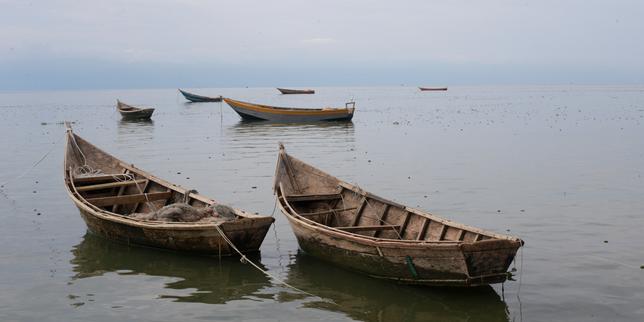
The disappearance of approximately thirty individuals following a vessel capsizing on Lake Victoria is not an isolated tragedy but the predictable output of a compromised maritime ecosystem. When a transport vessel fails in the Ugandan waters of Lake Victoria, the event is the terminal point of a causal chain involving structural overcapacity, regulatory arbitrage, and geographical volatility. To understand why these incidents recur with mathematical frequency, one must look past the immediate headlines and analyze the three specific variables that govern maritime survival in the African Great Lakes: vessel stability physics, the infrastructure gap in rapid response, and the economic incentives that prioritize volume over buoyancy.
The Physics of Instability and Overloading
The primary driver of Lake Victoria shipwrecks is a violation of basic hydrostatic principles, specifically the relationship between the center of gravity and the metacenter of the vessel. Most transport vessels operating in these corridors are modified wooden "Sesse" boats or artisanal iron-hull craft.
These vessels are frequently subjected to Static Overloading, where the total weight of passengers and cargo exceeds the displacement capacity of the hull. This reduces the freeboard—the distance between the waterline and the top of the deck—to a negligible margin. In this state, a single external force, such as a localized squall or a sudden shift in passenger distribution, causes the vessel to take on water. Once water enters the hull, the "free surface effect" takes over. The shifting weight of the internal water moves in tandem with the boat’s roll, accelerating the loss of righting leverage and leading to an irreversible capsize.
- Center of Gravity Displacement: On these vessels, cargo is often stacked high to accommodate more floor space for passengers. This raises the center of gravity, making the boat top-heavy.
- The Metacentric Height (GM) Deficit: As the center of gravity rises, the distance to the metacenter decreases. A vessel with a low or negative GM value cannot right itself after a tilt, leading to the rapid "turtling" reported by survivors of the recent Ugandan incident.
The Regulatory Vacuum and Market Realities
The Ugandan police reports often cite "overloading" and "bad weather" as the dual culprits. However, these are symptoms of a systemic failure in maritime enforcement. The enforcement of the Inland Water Transport Act faces a structural bottleneck: the ratio of patrol assets to the total surface area of Lake Victoria is insufficient for real-time monitoring.
Economic pressures create a high-risk incentive structure for boat operators. For a local transporter, the marginal cost of adding one more passenger is near zero, while the marginal revenue is 100% of the fare. Without a physical presence from the maritime police at every informal landing site, operators will continue to maximize the payload until the vessel reaches its physical breaking point. This is a classic "Tragedy of the Commons" applied to maritime safety; the short-term profit of the operator outweighs the collective risk to the passengers.
Search and Rescue Limitations as a Mortality Multiplier
The "missing" status of thirty individuals hours or days after a wreck is a function of the Golden Hour failure. In maritime disaster management, the probability of survival drops exponentially after the first sixty minutes of immersion. In the Ugandan context, several factors extend the time between the distress event and the arrival of professional rescue services.
- Communication Latency: Informal vessels rarely carry VHF radios or AIS (Automatic Identification System) transponders. Distress signals are often relayed via mobile phones, which may lose signal or be destroyed by water ingress during the initial capsize.
- Asset Distribution: Search and rescue (SAR) hardware is concentrated in major hubs like Entebbe or Jinja. If a wreck occurs near remote islands or in the middle of the lake, the transit time for a rescue boat often exceeds the survival time of a passenger without a personal flotation device (PFD).
- Hydrographic Volatility: Lake Victoria creates its own microclimate. Violent thunderstorms, known as "sudden squalls," can generate significant wave heights in minutes. These conditions not only cause the initial wreck but prevent small-scale local rescuers from reaching the site.
The PFD Deficit and Survival Probability
A critical missing component in these maritime events is the universal application of Personal Flotation Devices. In the recent incident, the high number of missing persons suggests that the majority of those on board were not wearing life jackets.
The physics of survival in Lake Victoria are brutal. Even a strong swimmer faces "cold shock response" or physical exhaustion when trying to stay afloat in choppy water while fully clothed. A PFD changes the survival equation from an active physical struggle to a passive waiting game. However, there is a significant market failure here: PFDs are often seen as an unnecessary capital expenditure by boat owners, and there is a cultural resistance among passengers who may underestimate the danger of a familiar route.
Structural Bottlenecks in Incident Reporting
The current methodology for tracking "missing" persons in Ugandan maritime accidents is prone to inaccuracy. Because these vessels often operate without official manifests, the initial count of the missing is based on anecdotal evidence from survivors or relatives. This creates a data lag that hampers the effectiveness of the search.
The lack of a centralized, digitized passenger manifest system means the police are often searching for a number rather than specific identities. This complicates the "reconciliation phase" of the disaster, where the number of recovered bodies and survivors is matched against the original total of people on board.
Operational Recommendations for Risk Mitigation
To move beyond the cycle of shipwreck and mourning, the Ugandan maritime sector requires a transition from reactive policing to structural safety engineering.
Immediate Deployment of Load-Line Enforcement
The most effective technical intervention is the mandatory marking of a "Plimsoll line" on all commercial vessels, including artisanal wooden craft. This provides a clear, visual indicator for both passengers and police. If the line is submerged, the boat is illegally loaded. This shifts the burden of proof from complex weight calculations to simple visual inspection.
The Decentralized Rescue Hub Model
Rather than relying on a few central SAR locations, the government should subsidize the equipment of "First Responder Fishers." By providing local fishing communities with basic rescue gear and fuel stipends for SAR activities, the response time can be cut from hours to minutes.
Mandatory Manifest and PFD Protocols
The state must mandate that no vessel departs a landing site without a physical manifest submitted to a local authority and a 1:1 ratio of PFDs to passengers. Enforcement must be localized at the point of departure rather than attempting to catch violators on the open water.
The disappearance of thirty people on Lake Victoria is the result of an engineered risk environment where physics, economics, and logistics have converged to ensure a high mortality rate. Until the structural causes of overloading and the latency in rescue response are addressed through hardware and localized enforcement, the lake will continue to operate as a high-entropy environment where human life is the primary casualty of systemic neglect.
The strategic priority for maritime safety in Uganda must shift to the Pre-Departure Phase. Control the loading at the shore, and the physics of the lake become irrelevant. Fail to control the shore, and no amount of search and rescue will be sufficient to overcome the math of a capsized vessel.