The kinetic disruption of the Ras Laffan industrial complex represents more than a localized industrial accident; it is a systemic shock to the global energy arbitrage model. Qatar’s North Field, the world’s most concentrated source of liquefied natural gas (LNG), functions as the primary balancing mechanism for European and Asian energy security. When a strike hits this infrastructure, the primary concern is not just the immediate loss of volume, but the cascading failure of the global "just-in-time" energy delivery system.
To understand the gravity of an attack on the world's largest LNG plant, one must analyze the facility through three distinct layers of vulnerability: the physical extraction and processing hardware, the logistical maritime bottleneck, and the financial volatility of long-term supply contracts.
The Architecture of Processing Vulnerability
The Ras Laffan complex is not a singular building but a massive integrated system of "trains"—the massive units that cool natural gas to $-162°C$ for transport. The engineering required to maintain these temperatures is extreme. A strike on these facilities targets the most difficult-to-replace components in the global energy supply chain.
The Thermal Exchange Bottleneck
The heart of an LNG plant is the Main Cryogenic Heat Exchanger (MCHE). These are often 50-meter-tall aluminum alloy towers that take years to manufacture and months to install. Unlike a standard pipeline leak, which can be patched in days, a damaged MCHE effectively decommissions a production train indefinitely.
- Lead times: Procurement for specialized cryogenic alloys and specialized welding expertise typically exceeds 18 to 24 months.
- Repair complexity: Because the process involves volatile gases under immense pressure, any structural compromise necessitates a total system purge and ultrasonic testing of every joint.
Storage and Regasification Interdependence
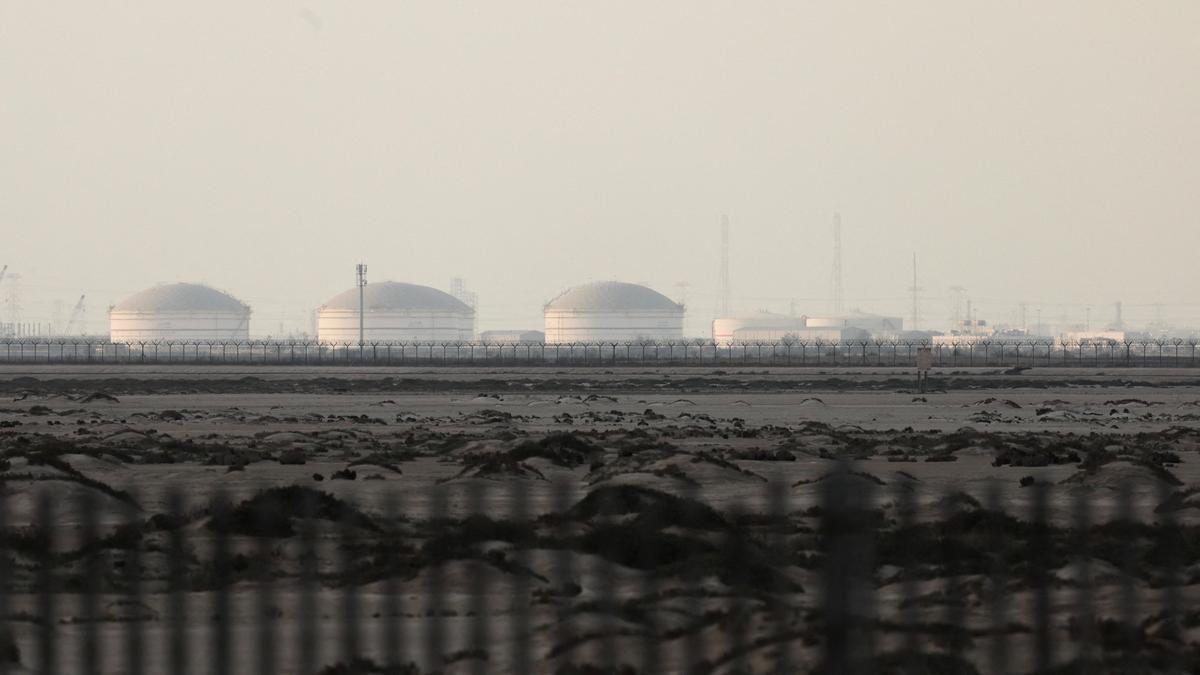
While the media focuses on the visual of fires, the structural integrity of the full-containment storage tanks is the true critical failure point. These tanks utilize a 9% nickel steel inner container and a pre-stressed concrete outer wall. If the strike causes a breach in the primary containment, the resulting "pool fire" generates thermal radiation levels that can disable neighboring electronics and safety valves even if those units were not directly hit. This creates a "cluster failure" where one hit deactivates an entire quadrant of the facility.
The Supply Chain Cost Function
The global LNG market operates on a thin margin of spare capacity. The removal of Qatari volume—which accounts for roughly 20% of global supply—immediately shifts the power dynamic from buyers to the few remaining swing producers, primarily the United States and Australia.
The Substitution Failure
Global energy markets cannot easily substitute LNG with other fuels in the short term. The cost of an outage is calculated by the formula of the "Alternative Fuel Price Gap." When LNG supply drops, utilities must switch to coal or oil-fired generation. However, the infrastructure for this switch has been dismantled in many parts of the EU to meet decarbonization targets.
- Supply Inelasticity: LNG production cannot be "ramped up" quickly. A plant is either on or off.
- The Premium of Uncertainty: Even if the damage is moderate, the market prices in a "security premium." This reflects the probability of a follow-up strike, driving up insurance premiums for every vessel entering the Persian Gulf.
Maritime Risk and the Strait of Hormuz
Every molecule of gas produced at Ras Laffan must pass through the Strait of Hormuz. A strike on the plant signals that the production source is no longer a "safe zone," which fundamentally changes the risk profile for shipowners.
- War Risk Surcharges: Insurers typically increase premiums by 500% to 1,000% following a kinetic event in the Gulf.
- Charter Rates: As the available pool of "willing" vessels shrinks, the daily charter rate for an LNG carrier—already often exceeding $100,000—skyrockets, further bloating the landed cost of gas in Tokyo or Berlin.
Strategic Implications of Kinetic Energy Warfare
Modern warfare has shifted from targeting military assets to targeting the economic "circulatory system." By hitting a node like Ras Laffan, an adversary is not just attacking Qatar; they are attacking the industrial output of every nation dependent on that gas.
The European Vulnerability Map
Since the decoupling from Russian pipeline gas, Europe has become disproportionately reliant on Qatari LNG. This creates a strategic paradox:
- Storage vs. Flow: Europe’s gas storage levels might be high (e.g., 90%), but storage only provides a buffer for 2 to 3 months of winter demand.
- The Refill Crisis: If Ras Laffan is offline during the summer "refill" season, Europe enters the following winter with a structural deficit that cannot be solved by conservation alone.
The Geopolitical Leverage Shift
An attack of this magnitude forces a realignment of security priorities. Nations that previously remained neutral in Middle Eastern conflicts find themselves forced to intervene to protect their own energy inflation rates. This "externalization of risk" is a calculated move by the aggressor to bring global pressure onto the target nation to concede on unrelated diplomatic fronts.
Technical Recovery and Systemic Resilience
The path to recovery for a damaged LNG mega-complex follows a rigid sequence of technical milestones. There are no shortcuts in cryogenic engineering.
- Safety Purge and Stabilization: The first 72 hours are dedicated to preventing secondary explosions by venting pressurized gases, a process that itself creates a massive environmental and financial loss.
- Metallurgical Assessment: Engineers must determine if the intense heat of the strike altered the crystalline structure of the aluminum and stainless steel components. If the metal has been "tempered" by the fire, it can no longer hold the pressures required for liquefaction.
- Control System Reconstruction: Modern LNG plants are managed by thousands of sensors and fiber-optic loops. Even if the tanks are intact, a destroyed control room renders the plant a "dumb" asset that cannot be safely operated.
The reality of 21st-century energy security is that it is built on a foundation of extreme centralization. We have traded the geopolitical risk of pipelines for the technical and kinetic risk of massive, concentrated liquefaction hubs. When one hub fails, the "global" market reverts to a series of isolated, high-priced islands.
The strategic play for energy importers is no longer just "diversification of source," but "diversification of transit and technology." This necessitates a shift toward smaller, modular Floating LNG (FLNG) units which, while less efficient than the massive trains at Ras Laffan, offer a decentralized target profile that is significantly harder to disable with a single strike. Investors and policy makers must now price "resilience" higher than "scale" in the energy infrastructure calculus.
Any organization holding long-term contracts tied to North Field production must immediately trigger force majeure contingency plans, diversifying into the spot market for US Gulf Coast volumes, despite the higher Henry Hub-linked pricing. The window for low-cost hedging on energy volatility has closed; the new baseline assumes that energy infrastructure is now a front-line military target.