Neukgu didn't just escape a zoo. He walked straight into the middle of a national identity crisis. For nine days, this two-year-old male wolf turned the city of Daejeon upside down, dodging drones and SWAT teams like a four-legged fugitive. While the government scrambled and schools closed their doors, the internet did something else entirely. It started rooting for the wolf.
On April 17, 2026, the hunt finally ended. Rescuers cornered Neukgu near the Anyeong Interchange, shot him with a tranquilizer dart, and hauled his sleeping 30kg body back to the O-World zoo. He’s safe. He’s healthy. But the saga of his "nine days of freedom" says more about us than it does about him.
The great escape from O-World
It all started on April 8. Neukgu, whose name literally translates to "wolf" in Korean, decided he’d had enough of his enclosure. He didn't wait for a gate to be left open. He dug his way out. By the time keepers realized he was gone, Neukgu was already miles away, navigating the rugged hills and urban fringes of central South Korea.
Daejeon officials didn't take it lightly. They deployed over 100 personnel, thermal imaging drones, and police units. They even shut down a nearby elementary school because, let's face it, a wild predator near a playground is a PR nightmare. But Neukgu was smart. He eluded capture multiple times, once jumping over a four-meter retaining wall right in front of a search party.
Why everyone was so obsessed
You have to understand the history here to get why this wasn't just another "animal on the loose" story. In 2018, a puma named Bori escaped from this same zoo. The authorities shot and killed her within hours. The public backlash was savage. People felt the city was too quick to pull the trigger on a confused animal that had nowhere to go.
With Neukgu, the vibe was different. People were genuinely worried he’d meet the same fate. Even President Lee Jae Myung had to weigh in on social media, urging everyone to bring the wolf back alive. It became a test of whether South Korea could handle a wild animal with compassion instead of just firepower.
Then there was the meme culture. Within a week, a "Neukgu" cryptocurrency popped up on decentralized exchanges. People started calling him an "honorary ambassador." There's something deeply relatable about a creature that just wants to break out of its cage and run, even if it has no idea where it’s going.
The fishing hook mystery
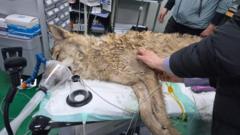
When the vets finally got their hands on Neukgu on Friday morning, they found something weird. His vitals were fine—heart rate normal, temperature stable—but an endoscopy revealed a fishing hook in his stomach.
It tells you everything about how Neukgu survived. He wasn't hunting deer in the mountains; he was scavenging. He likely ate a discarded fish or some bait near one of the local reservoirs. It’s a reminder that even when these animals "escape" to the wild, they’re still living in a world built and trashed by humans. The hook was removed successfully, and honestly, the wolf looked better fed than most expected.
The problem with rewilding dreams
Neukgu isn't just a random zoo animal. He's part of a high-stakes breeding program to restore the Korean wolf. This subspecies is technically extinct in the wild on the Korean Peninsula. Decades of habitat loss and systematic culling during the colonial era wiped them out.
The dream is to one day have these wolves roaming the mountains again. But Neukgu’s nine-day trek proved how hard that's going to be. South Korea is dense. The mountains are crisscrossed with highways and hiking trails. When Neukgu was spotted "in the wild," he was actually trotting along the side of a road, illuminated by car headlights. There is no true "wild" left for a wolf to go back to.
What happens now
Daejeon Mayor Lee Jang-woo apologized for the "public anxiety" and promised to fix the zoo’s security. But the conversation shouldn't stop at bigger fences.
If you’re following this story, don't just look at the cute photos of a sleeping wolf. Look at the reality of conservation in 2026. We want these animals to exist, but we don't have the space for them to actually be animals. Neukgu is back in his enclosure now. The city is relieved. But for nine days, he reminded everyone that "extinct" species still have a drive to survive that no zoo can fully contain.
If you want to support actual habitat restoration, look into organizations like the Korea Federation for Environmental Movements (KFEM). Don't just buy a meme coin. Demand that "animal welfare" means more than just a stronger cage and a successful tranquilizer shot.