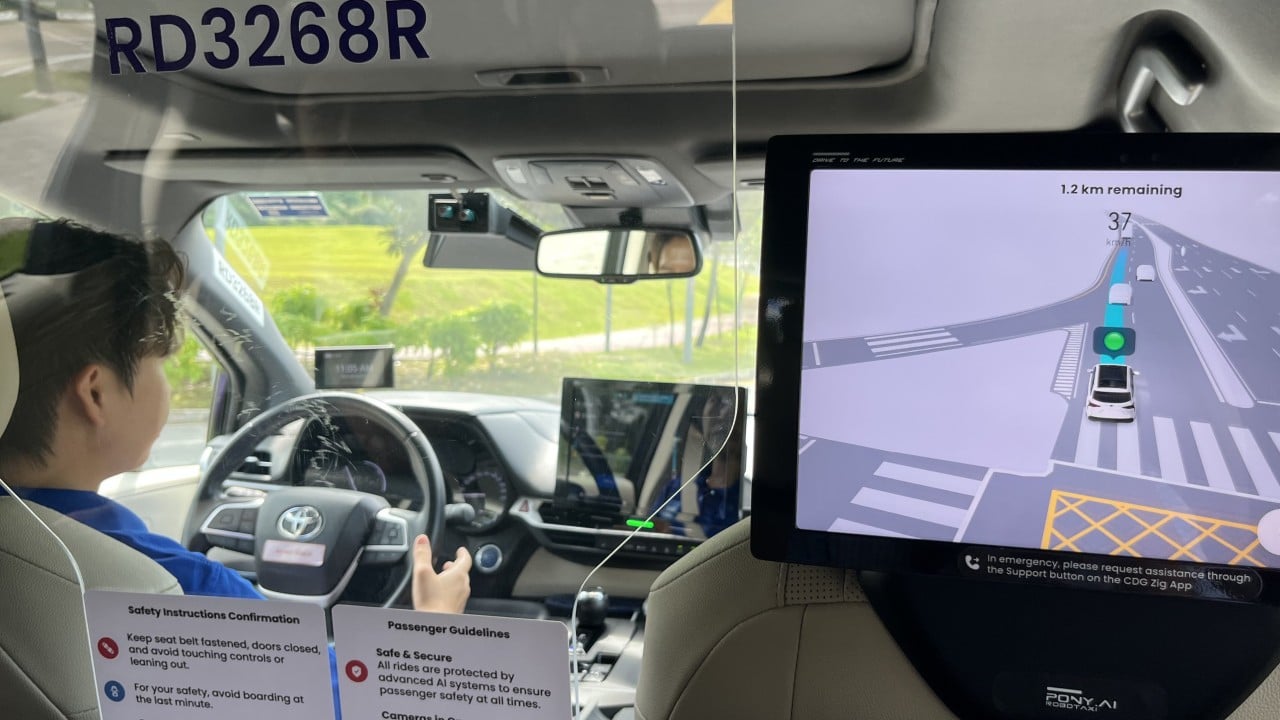
The headlines are breathless. Singapore is welcoming Chinese autonomous vehicle titans like WeRide and Pony.ai with open arms. The narrative is cozy: a tiny, tech-forward city-state partners with the world’s most aggressive AI hardware makers to solve urban mobility once and for all. It sounds efficient. It sounds like progress.
It is actually a strategic trap.
Singapore’s current obsession with importing Chinese "Level 4" autonomy isn't a leap into the future. It’s an expensive outsourcing of sovereign infrastructure to companies that are playing a different game entirely. We are witnessing the birth of a digital glass floor—transparent, shiny, and ready to shatter the moment the subsidy tap runs dry or the geopolitical winds shift.
The Geography Fallacy
The "lazy consensus" among tech journalists is that Singapore is the perfect "living lab" because it is flat, well-mapped, and highly regulated. This is exactly why it’s a terrible test bed.
If you can make a robotaxi work in the pristine, sensor-drenched streets of Queenstown or the One-North district, you haven't proven the technology works. You’ve only proven that you can build a very expensive horizontal elevator. Real autonomy—the kind that actually scales and generates profit—needs to survive the chaos of Jakarta, the snow of Oslo, or the unpredictable sprawl of Houston.
By hyper-optimizing for Singapore’s "goldilocks" environment, Chinese AV firms are essentially building bespoke toys. I have watched firms burn through $500 million in venture capital just to master a three-square-mile geofence. The moment the vehicle encounters a rogue delivery rider on a sidewalk or a monsoon that disrupts LiDAR returns, the system defaults to a "remote operator" in a dark room. That isn't autonomy. It’s a glorified video game with $200,000 stakes.
The LiDAR Crutch and the Data Trap
The industry is currently split between the "vision-only" camp (Tesla) and the "sensor-fusion" camp (the Chinese giants). Singapore is betting heavily on the latter.
The problem? Sensor-fusion, while safer in the short term, is an economic dead end for a mass-market robotaxi fleet. When you stack $50,000 worth of LiDAR, RADAR, and ultrasonic sensors on top of a vehicle, you aren't building a taxi. You are building a research laboratory on wheels.
- The Maintenance Gap: These sensors require calibration that no standard mechanic can perform.
- The Obsolescence Cycle: In two years, the current generation of sensors will be paperweights.
- The Power Draw: Running the compute stack required to process those gigabytes of data per second eats into the electric range, making the "green" argument for AVs a mathematical lie.
More importantly, the Chinese leaders aren't in Singapore to solve Singapore’s traffic. They are there for the data. Singapore is providing the world’s most expensive training gym. The city is paying for the privilege of having its citizens' movement patterns harvested to refine algorithms that will eventually be sold back to the rest of the world. Singapore isn't the partner; it's the product.
The Myth of the "Seamless" Integration
Every press release mentions how "seamlessly" these taxis will fit into the existing public transport network. This is a fundamental misunderstanding of urban flow.
Adding 5,000 robotaxis to a city doesn't reduce congestion. It creates "zombie miles." These are the miles driven by empty cars circling blocks while waiting for a fare because parking is too expensive or unavailable. In a land-scarce environment like Singapore, the last thing you want is a fleet of empty AI shells taking up road capacity.
If Singapore truly wanted to disrupt mobility, it wouldn't be chasing the four-wheeled passenger car. It would be automating the "first-mile, last-mile" heavy lifting through high-capacity, modular pods that don't mimic the 100-year-old form factor of a sedan. But pods aren't sexy. Pods don't get you a partnership with WeRide.
The Geopolitical Blind Spot
Let’s be blunt about the elephant in the room: security.
An autonomous vehicle is a rolling surveillance platform. It is equipped with 360-degree high-definition cameras, microphones, and high-precision mapping sensors. Handing the keys to the city’s mobility data to foreign entities—regardless of which country they hail from—is a massive risk.
We have seen how the "Internet of Things" became the "Botnet of Things." Now, imagine an "Internet of Moving Things" where the firmware is managed from an office 2,000 miles away. If a software update can brick a smartphone, a "bug" can paralyze a city’s arterial roads.
The False Promise of Lower Costs
"People Also Ask" if robotaxis will make transport cheaper. The answer is: maybe in 2040.
Right now, the cost per mile for a human-driven ride-hail in Singapore is heavily subsidized by the "gig economy" model. Humans are cheap; they maintain their own vehicles, they pay for their own insurance, and they don't require a $100-an-hour site reliability engineer to monitor their every turn.
A robotaxi fleet requires:
- Temperature-controlled docking stations.
- High-bandwidth 5G/6G coverage across every inch of the route.
- A massive backend server farm to process edge cases.
- Cleaning crews (because humans are messy, and sensors hate smudges).
When you add up the Total Cost of Ownership (TCO), the human driver is actually the most efficient "hardware" on the market. Replacing a $30,000 human-driven car with a $250,000 AI-driven car and claiming it’s a "cost-saving measure" is the kind of creative accounting that only exists in Silicon Valley or Shenzhen.
Why the "Safety First" Argument Is Flawed
The go-to defense for robotaxis is safety. "Robots don't get tired; robots don't drink."
True. But robots also don't have "common sense." A human driver knows that a ball rolling into the street is usually followed by a child. A human driver can interpret a traffic warden’s hand signals. Current Level 4 systems struggle with "theory of mind"—the ability to predict what other humans will do based on social cues.
By forcing robotaxis into the ecosystem, we aren't making the roads safer; we are forcing humans to drive more like robots. We are sanitizing our streets to accommodate the limitations of the AI, rather than making the AI smart enough to handle the streets.
The Solution Nobody Wants to Hear
If Singapore wants to lead the world in mobility, it should stop trying to be a customer for Chinese AV tech and start being its regulator-in-chief.
Stop funding the deployment of cars. Start funding the development of a Universal Autonomy Language. We need a standardized, open-source protocol that allows vehicles from different manufacturers to talk to each other and to the city's infrastructure.
Instead of five different companies mapping the same street with five different proprietary formats, the city should own the "Base Map." Force the tech companies to plug into a government-owned "Digital Twin" of the city.
This shifts the power balance. It makes the AV companies utility providers rather than data overlords. But this requires a level of technical assertiveness that most governments, even Singapore’s, are too timid to exercise. They would rather take the photo-op with the shiny new car.
The Real Winner Isn't Who You Think
The winner of the Singapore robotaxi race won't be WeRide, and it won't be the Singaporean commuter.
It will be the real estate developers.
The moment you truly automate transport, "distance" becomes a commodity. If you can sleep or work in a car, a 90-minute commute is no longer a deterrent. This will trigger a massive shift in land value, hollowing out the central business districts and driving up prices in the fringes.
But we aren't talking about that. We’re talking about how cool the LiDAR "spinning bucket" looks on top of a crossover SUV.
Singapore is currently playing the role of the enthusiastic beta tester for a product that isn't designed to serve its long-term interests. It is buying into a vision of "autonomy" that is actually a new form of dependency.
Stop celebrating the arrival of foreign AV leaders as a win. Start asking why we are building a city that serves the sensors, rather than a technology that serves the city. The drive toward robotaxis isn't a race to the future; it’s a race to see who can hand over their infrastructure the fastest.
Turn off the autopilot. It’s time to steer.