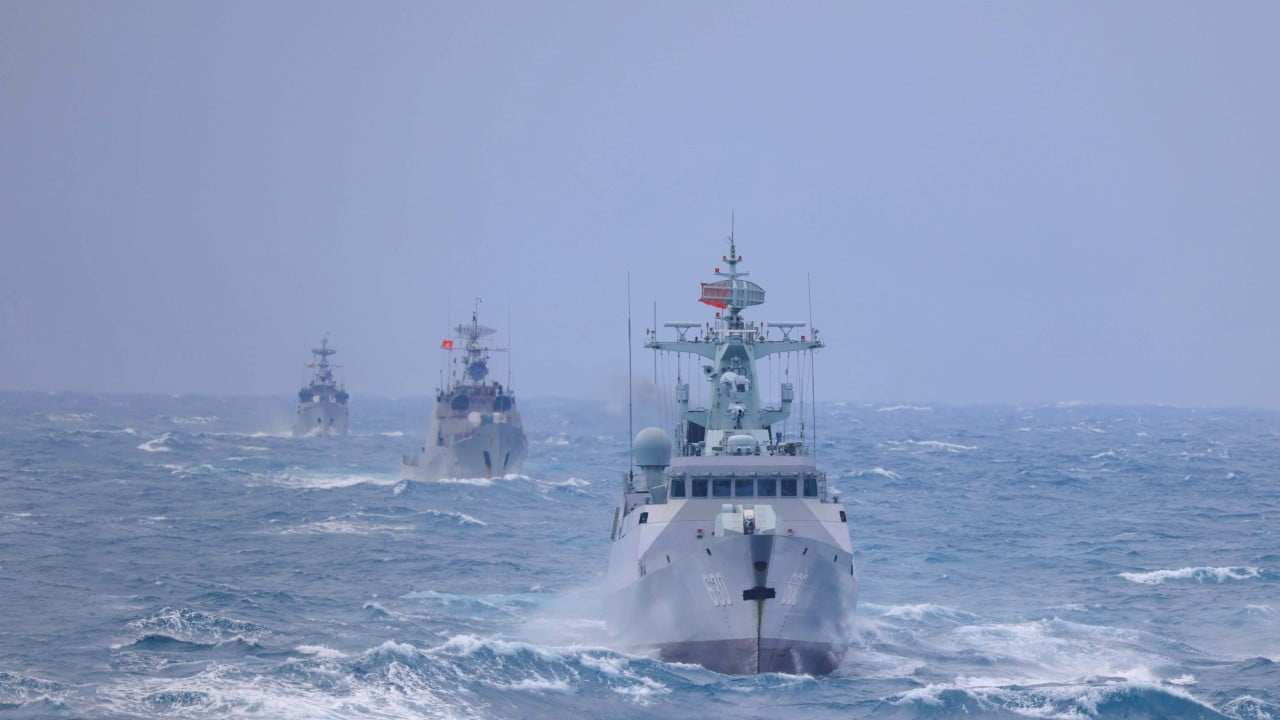
The sea does not care about sovereignty. To the sailor standing on the deck of a Type 054A frigate or a Vietnamese Gepard-class corvette, the Gulf of Tonkin is not a map of dashed lines and disputed claims. It is a physical weight. It is the smell of brine so thick it sticks to the back of your throat and the relentless, rhythmic thrum of diesel engines vibrating through the soles of your boots.
For decades, this stretch of water has been a theater of high-stakes poker played with gray hulls and radar locks. But the game just changed.
When China and Vietnam recently agreed to upgrade their joint naval patrols to include live-fire drills, the diplomatic cables focused on "stability" and "cooperation." To the uninitiated, it sounds like bureaucratic housekeeping. To the men and women peering through binoculars across those turquoise waves, it is a tectonic shift in the friction of the South China Sea.
The Sound of Certainty
Imagine a young lieutenant on a Vietnamese patrol craft. Let’s call him Minh. For years, Minh’s interactions with the People’s Liberation Army Navy (PLAN) followed a predictable, if tense, choreography. They would shadow each other. They would broadcast stern warnings over the radio in broken English or Mandarin. They would play a maritime version of "I’m not touching you," testing boundaries without ever quite crossing the line into kinetic energy.
Now, imagine the sound of a 76mm naval gun clearing its throat.
Live-fire drills are the ultimate expression of military intimacy. You do not hand a loaded weapon to someone you intend to fight tomorrow unless you are trying to prove—loudly—that you can trust them today. By agreeing to pull the trigger in each other’s presence, Hanoi and Beijing are attempting to bridge a gap that history has spent centuries widening.
This isn't just about practicing aim. It is about the data.
When ships exercise together at this level, they share more than just coordinates. They share "frequencies." They see how the other’s radar suites track a target. They hear the specific acoustic signature of the other’s engines under duress. This is a level of transparency that was unthinkable even five years ago. It is a calculated gamble: that by revealing their teeth, they might actually stop biting each other.
The Ghost in the Machine
The geopolitical reality is that Vietnam is caught in a vice of its own making. On one side is the historical trauma of Chinese expansionism; on the other is the economic necessity of the "Two Corridors, One Belt" initiative.
Consider the sheer scale of the hardware involved. China isn't just sending old cutters to these drills. They are deploying sophisticated platforms equipped with phased-array radars and vertical launch systems (VLS). For Vietnam, participating in these drills is a way to "de-risk" the neighborhood. If you are worried about a giant in your backyard, the safest place to be is often right next to his elbow, where he has to watch his own swing.
But the invisible stakes are found in the software.
In modern naval warfare, the winner isn't the one with the biggest gun; it’s the one with the best "Common Operating Picture." By integrating their patrol schedules and firing arcs, these two nations are effectively trying to create a shared digital map of the Gulf of Tonkin. They are attempting to eliminate the "fog of war" that leads to accidental collisions or frantic, heat-of-the-moment escalations.
A Dance on a Knife's Edge
We often treat international relations like a game of Risk, moving plastic pieces across a board. The reality is much more fragile.
There is a specific kind of silence that happens on a bridge right before a joint maneuver. The captain watches the distance-to-target indicator. The helmsman feels the pull of the current. There is a profound vulnerability in allowing a foreign power’s warship to operate within striking distance while your own sensors are focused on a practice target.
Vietnam’s "Four Noes" policy—no military alliances, no foreign bases, no joining one country against another, and no using force—is being tested here. This isn't an alliance. It’s a pressure valve.
Critics in Washington or Tokyo might see this as Hanoi drifting into Beijing’s orbit. That misses the nuance of the Vietnamese psyche. Hanoi is a master of "Bamboo Diplomacy": roots that are deep and firm, but a trunk that bends with the strongest wind to avoid snapping. By engaging in live-fire drills with the PLAN, Vietnam isn't surrendering. They are insulating. They are making themselves "legible" to the Chinese military to ensure that a misunderstanding doesn't turn into a tragedy.
The Weight of the Water
The Gulf of Tonkin is a graveyard of miscalculations. It is where the sparks of the Vietnam War were fanned into a conflagration. Today, it is a vital artery for global trade, a nursery for regional fisheries, and a potential flashpoint for a third World War.
When the smoke from the practice rounds clears, the underlying tensions remain. The Paracel and Spratly Islands are still there, jagged reminders of overlapping claims that no amount of joint patrolling can erase.
But for a moment, the focus isn't on the maps. It’s on the signal.
The decision to move from "patrolling" to "firing" is a signal to the rest of the world that these two neighbors are tired of the uncertainty. They are choosing a scripted tension over an unscripted disaster. It is a cold, pragmatic realization that in the crowded waters of the 21st century, the only thing more dangerous than your enemy is an enemy who doesn't know what you’re about to do.
Minh, our hypothetical lieutenant, stares out at the gray silhouette of the Chinese frigate on the horizon. For the first time, he isn't just wondering if they will fire. He knows exactly when they will, at what, and why.
There is no peace in the Gulf of Tonkin. There is only the carefully maintained absence of war. And sometimes, the loudest way to keep the quiet is to make a little noise together.
The shells hit the water, sending plumes of white spray into the humid air. The radar screens flicker, recording the splash, the trajectory, and the intent. On both ships, the crews exhale. The guns are hot, the sensors are full, and for today, the line has been held—not by force, but by the terrifying, necessary act of looking each other in the eye while pulling the trigger.


