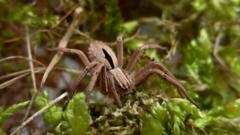
Conservation is rarely a matter of simple altruism. It is a gritty, high-stakes calculation involving land rights, hydrological engineering, and the brutal reality of dwindling budgets. The recent surge in funding for the Great Fen project—specifically targeting the recovery of the Fen Raft Spider (Dolomedes plantarius)—is not just a feel-good story about a rare arachnid. It is a litmus test for whether humans can successfully manufacture a wilderness that has not existed for centuries.
The Fen Raft Spider is a giant of its kind, a semi-aquatic predator capable of sitting on the water's surface to hunt small fish and tadpoles. By the mid-20th century, it was nearly extinct in Britain, reduced to a handful of isolated pockets. The current funding boost aims to expand these populations through aggressive habitat restoration and "translocation," a polite term for moving animals into newly built environments. But beneath the celebratory headlines lies a complex debate about ecological authenticity and the long-term cost of keeping a "lost" species on life support.
Engineering a Survival Zone
Nature does not return on its own. When we talk about "protecting" the Fen Raft Spider, we are actually talking about massive civil engineering. The East Anglian fens were drained centuries ago for agriculture, turning a vast wetland into some of the most productive—and dry—farmland in the world. To bring the spider back, conservationists must effectively break the drainage systems that farmers have relied on for generations.
This requires more than just a few biologists with nets. It involves:
- Acquiring high-value agricultural land to convert back into marsh.
- Rerouting water flows to ensure year-round dampness without flooding neighboring commercial properties.
- Strict monitoring of water quality, as the spiders are hyper-sensitive to the nitrogen runoff common in modern farming.
The funding is being used to scale these physical interventions. The goal is to create a "corridor" of wet habitat. Without these artificial links, the spider populations remain islands. Small, isolated groups face the "extinction vortex," where a lack of genetic diversity or a single bad season can wipe them out entirely.
The Cost of the Charismatic Microfauna
Why this spider? Why now? In the world of conservation, money follows the "charismatic." Usually, this means pandas or tigers. The Fen Raft Spider, with its impressive leg span and unique hunting behavior, serves as a "flagship species." It is easier to secure a million-pound grant for a "giant lost spider" than it is for a rare species of bog moss or a specific type of aquatic silt.
Critics of this approach point out a hard truth: we are picking winners. By focusing heavily on the Fen Raft Spider, the funding naturally prioritizes the specific type of standing water and vegetation it prefers. This isn't necessarily a bad thing, as many other species hitch a ride on these improvements. However, it creates a managed version of nature that is dependent on human intervention.
If the pumps stop or the funding dries up in a decade, these "protected" habitats could vanish faster than they were built. We are not just saving a spider; we are committing to a permanent mortgage on the landscape.
The Translocation Gamble
Moving a species from its home to a new site is an invasive process. It is the ecological equivalent of an organ transplant. Success is never guaranteed. In the early days of Fen Raft Spider recovery, the success rate was shaky. Spiders were raised in test tubes, fed by hand with tweezers, and then released into the wild.
The new phase of funding moves away from this "boutique" conservation. The focus has shifted to large-scale releases. Yet, the data on long-term survival in these new sites is still being gathered. There is a risk that we are creating "sink populations"—groups that look healthy for a few years but cannot actually sustain themselves without a constant influx of new spiders from laboratories.
The Human Conflict Beneath the Surface
You cannot flood land without making enemies. The expansion of the Great Fen and similar projects often puts conservationists at odds with local heritage and the economy. For the people who live in these areas, the "lost" wilderness isn't something to be recovered; it’s something their ancestors spent 400 years conquering.
There is a quiet tension between the drive for biodiversity and the need for food security. Every acre of fenland restored is an acre of peat-rich soil taken out of cereal production. As global supply chains become more volatile, the argument for keeping every inch of British soil under the plow grows louder. The spider is caught in the middle of a much larger fight about what the British countryside is actually for.
Is it a museum for the species we almost killed, or is it a factory for the food we need?
The Hydraulic Reality
The survival of the Fen Raft Spider depends entirely on water levels. Not just "wet," but specifically managed depths that allow the spider to hunt and breed while keeping its nursery webs safe from rising floods. This level of precision requires a sophisticated network of sluices and dams.
We have replaced a natural ecosystem with a technological ecosystem.
Managing these water levels becomes increasingly difficult as climate patterns shift. Heavier winter rains followed by prolonged summer droughts make the "static" management of the 20th century obsolete. The current funding must account for this volatility. If the project fails to build climate resilience into the very soil, the Fen Raft Spider will remain a temporary guest in its own home.
The Myth of the Lost Species
The term "lost" is a powerful marketing tool, but it is scientifically imprecise. The Fen Raft Spider was never truly lost; we knew exactly where it was. It was squeezed. We pushed it into the margins until there was nowhere left to go. Bringing it back isn't a discovery; it’s a reparations project.
The real test of this funding boost won't be the number of spiders counted next spring. It will be whether these populations can survive a decade of neglect. True success in conservation is the moment you can walk away and the species doesn't notice you're gone.
We are nowhere near that point with the Fen Raft Spider. For now, we are simply paying the interest on an ecological debt that we may never fully clear. The spider is back, but it is living on a life-support system powered by grants and diesel pumps.
Stop looking at the spider and start looking at the water levels. The moment those gauges drop, the entire project collapses, regardless of how much money is in the bank.