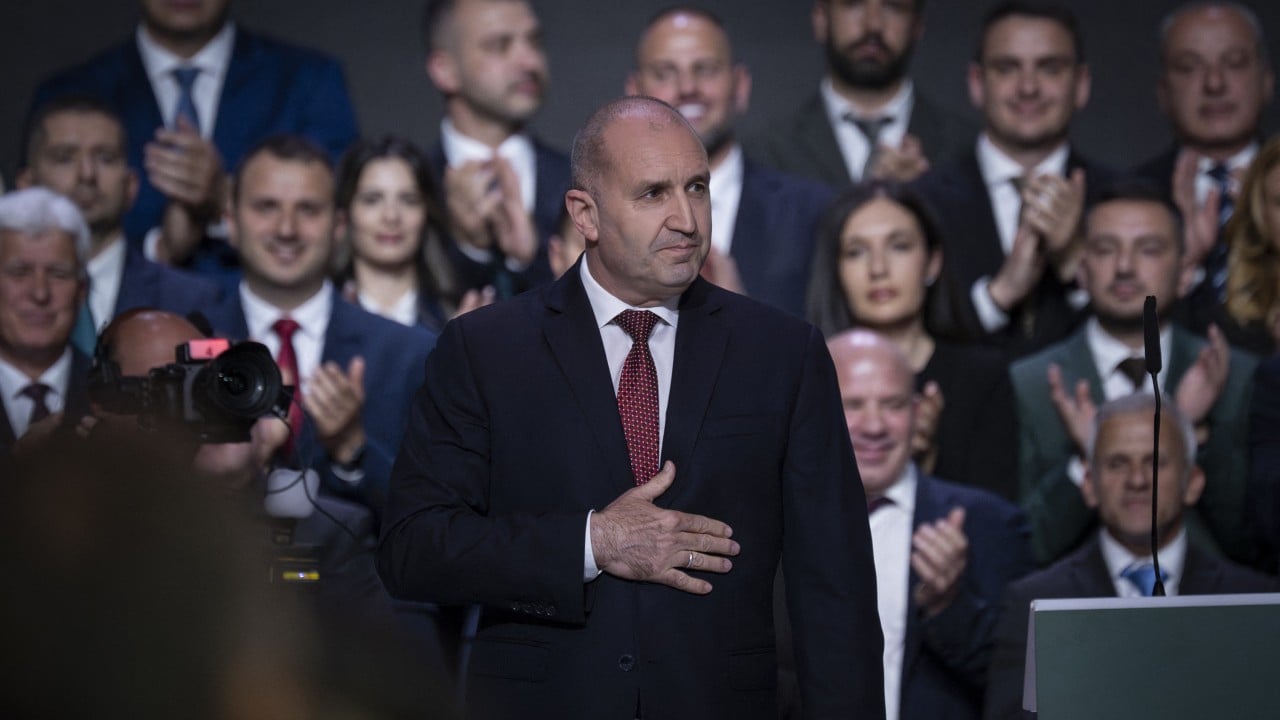
Bulgaria has finally broken its five-year fever of political paralysis, but the cure may be more volatile than the disease. On April 19, 2026, Rumen Radev, the former fighter pilot who traded his ceremonial presidency for the grit of party politics, secured a crushing parliamentary majority. His Progressive Bulgaria (PB) coalition captured nearly 45% of the vote, an outcome that effectively vaporized the traditional establishment. While the Kremlin greets this victory with a smile and Brussels offers a wary handshake, the reality on the ground in Sofia is not about a sudden shift toward Moscow. It is about a desperate electorate choosing a strongman they know over a chaotic system that failed to provide even the most basic stability.
For half a decade, Bulgaria was the "sick man" of the European Union’s democratic process. Seven elections passed without producing a functional government. The result was a vacuum filled by caretaker cabinets and an economy stuck in neutral. Radev’s victory is less an ideological endorsement of Russia and more a blunt-force rejection of the gridlock. He promised to dismantle the "oligarchic model," a phrase that resonates in a country where corruption is not just a bug but a feature of the state. By winning 131 of the 240 seats, Radev now holds the kind of concentrated power Bulgaria hasn't seen in nearly thirty years.
The Pragmatism of a MIG Pilot
Radev’s political identity is built on a calculated ambiguity. To the West, he speaks of the "European path" and the benefits of the eurozone, which Bulgaria finally joined earlier this year. To the East, he signals a "pragmatic" return to Russian energy and a refusal to send arms to Kyiv. This isn't a man who is confused about his loyalties; it is a man who understands that Bulgaria’s geographical and economic reality is a balancing act.
He has famously stated that "Crimea is Russian," a comment he defends as simple realism. During the campaign, he hammered the previous caretaker government for signing a security pact with Ukraine, labeling it a risk to national security. This rhetoric isn't just for show. It taps into a deep-seated historical affinity for Russia that persists in Bulgarian society, even as the country remains a NATO member. Radev knows that a significant portion of his voters want lower gas prices and a quiet life, not a front-row seat in a continental war.
Breaking the Establishment
The scale of the defeat for the old guard is staggering. Boyko Borissov’s GERB party, which dominated the country for over a decade, was relegated to a mere 13.4%. The reformist PP-DB coalition, once the darlings of the urban elite and Western diplomats, fared no better at 12.6%.
What happened? The establishment parties spent five years fighting over the spoils of a shrinking state while the average Bulgarian watched their purchasing power evaporate. Radev didn't need a complex platform. He simply needed to be the only person in the room who looked capable of making a decision and sticking to it. He campaigned on a "victory of morality," a vague but potent slogan in a nation tired of seeing the same faces in different coalition configurations.
The Death of the Far Right Fringe
One of the most overlooked aspects of this election is the near-total collapse of the ultranationalist party, Revival. They were once the primary vehicle for pro-Russian sentiment in Bulgaria. By adopting a more "pragmatic" and less unhinged version of their rhetoric, Radev effectively cannibalized their base. Revival barely scraped past the 4% threshold. Radev has professionalized the populist impulse, making it palatable for the middle class while keeping the anger of the periphery focused on the "corrupt elite."
The Brussels Dilemma
The European Union is currently in a state of quiet panic. Just a week ago, Hungary’s Viktor Orbán was finally ousted, leading many to believe the EU’s "troublemaker" era was ending. Now, they face Radev.
However, Radev is not Orbán—at least not yet. Bulgaria is smaller, more dependent on EU structural funds, and its banking system is now deeply integrated into the eurozone. Radev cannot afford a full-scale break with Brussels. Instead, he is likely to play the role of the "skeptic within." He will likely use his majority to drag his feet on sanctions, demand carve-outs for energy imports, and push back against EU environmental regulations that he claims hurt Bulgarian industry.
The Kremlin’s endorsement of his victory, voiced by Dmitry Peskov, was immediate. Moscow sees an opportunity to wedge a crack in the EU’s unified front on Ukraine. If Radev follows through on his promise to resume "pragmatic dialogue" with Russia, Sofia could become the primary conduit for Russian influence in the Balkans.
The Capture Risk
The most significant danger isn't actually foreign policy; it’s internal. Bulgaria’s judiciary and regulatory bodies are hollowed out. In the past, the fragmented parliament acted as a messy form of checks and balances—nobody could control everything because nobody could agree on anything.
Radev now has a clear path. With an absolute majority, he can appoint his own people to key positions in the prosecutor’s office and the anti-corruption agencies. While he claims this is to "clean up" the system, history in Eastern Europe suggests that such cleanups often end with the new leader simply replacing the old oligarchs with their own.
He lacks the 160-seat supermajority required for fundamental constitutional changes to the judiciary. This means he might still have to negotiate with the PP-DB if he truly wants to reform the courts. Whether those negotiations will be a genuine effort to fix the rule of law or a cynical exercise in power-sharing is the question that will define his first year as Prime Minister.
The Energy Gambit
Watch the pipelines. Bulgaria’s energy security is the lever Radev will use to demonstrate his "pragmatism." He has already hinted at renegotiating terms with Gazprom and securing the "free flow" of oil. This is a direct challenge to the EU’s strategy of decoupling from Russian energy. If Sofia manages to secure cheaper energy than its neighbors by playing both sides, it will create a template that other cash-strapped European nations might be tempted to follow.
The Bulgarian electorate has handed Radev a mandate to be a disruptor. They didn't vote for him to be a loyal soldier of the European Commission or a puppet of the Kremlin. They voted for him to stop the bleeding. In the eyes of a Bulgarian pensioner struggling with heating costs or a young professional tired of the "endless election" cycle, Radev’s perceived strength is a feature, not a bug.
The fighter pilot has the controls. Whether he is flying toward a stable European future or performing a dangerous maneuver that ends in a crash remains to be seen. The only certainty is that the era of Bulgarian indecision is over. The era of the Radev majority has begun, and the ripples will be felt from the Black Sea to the Berlaymont.
Demand for results will be immediate. Radev has no coalition partners to blame for failures and no president to hide behind. He has the house, the gavel, and the keys. Now he has to govern.