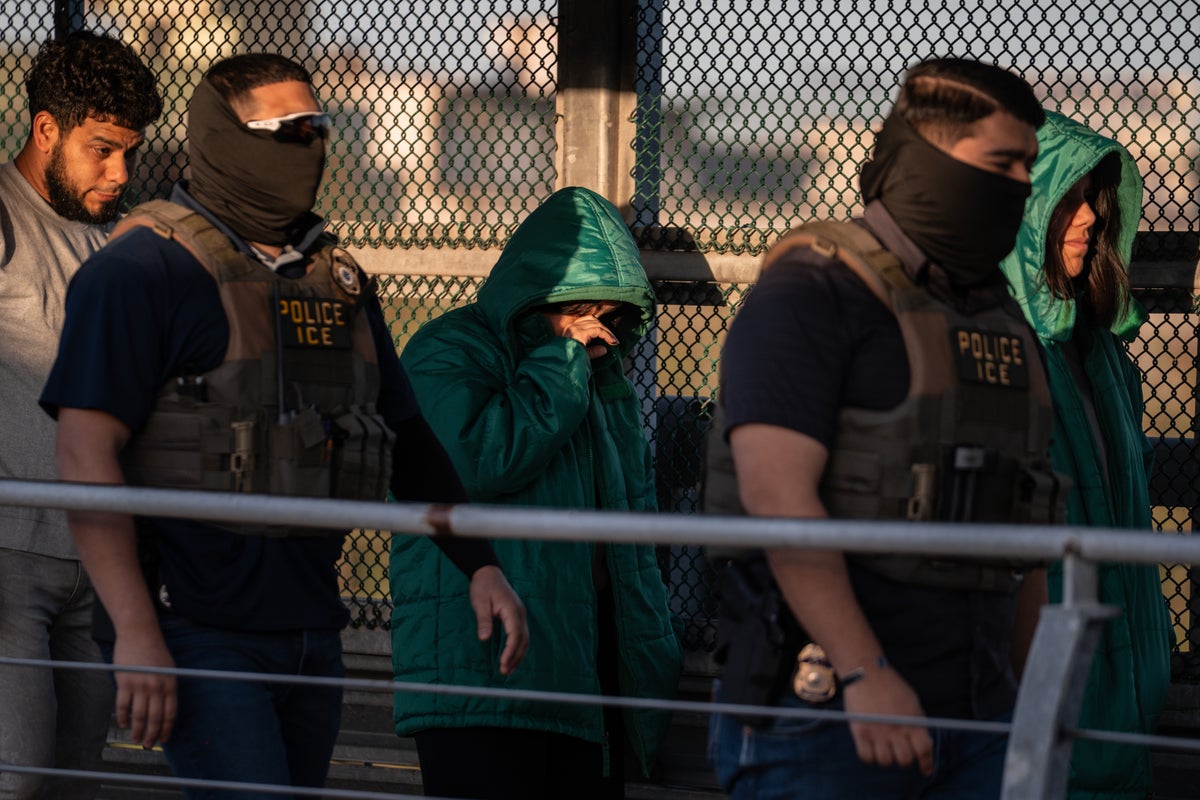
The coffee in the Styrofoam cup is always cold by the time the sun hits the dashboard of a white transport van in Georgia. For the men inside, the dawn doesn't signal a new day so much as the end of a specific kind of life. They aren't in Los Angeles. They isn't in Chicago. They aren't in any of the "sanctuary" hubs that dominate the nightly news cycles and the heated rhetoric of campaign podiums. They are in a place like Irwin County, surrounded by pines and the heavy, humid silence of the American South.
Every day, more than 1,000 people are arrested by Immigration and Customs Enforcement (ICE). It is a staggering number, a four-digit heartbeat of a system operating at a scale that is difficult to visualize until you see it as a line of people shuffling toward a processing center. But the story we are told about these arrests—the one involving high-profile raids in "liberal" cities and dramatic standoffs with local mayors—is largely a shadow play. Don't forget to check out our previous post on this related article.
The real movement is happening in the silence. It is happening in the places where the cameras rarely go.
The Geography of the Invisible
If you look at the data, a strange map emerges. You might expect the heat map of arrests to glow brightest over the sprawling metropolitan "sanctuary" zones that the administration frequently targets in its speeches. Instead, the heat is elsewhere. It’s in the Field Offices of Atlanta, Phoenix, and Salt Lake City. It is in the interior, where the infrastructure of enforcement is less about televised "surges" and more about the steady, grinding machinery of local cooperation and courthouse pickups. If you want more about the background of this, NBC News provides an in-depth breakdown.
Consider a hypothetical man named Elias. Elias doesn't live in a skyscraper-shadowed neighborhood in Manhattan. He lives in a small town outside of Charlotte. He has lived there for twelve years. He fixes HVAC systems. One Tuesday morning, he is pulled over for a broken taillight. In a high-profile sanctuary city, that interaction might end with a fix-it ticket and a warning. But in the quiet interior, the local jail has an agreement with federal authorities. By Wednesday morning, Elias is no longer a father or a mechanic. He is a statistic in the daily 1,000.
The administration’s rhetoric often focuses on "Operation Sentinel" or "Safe Cities" initiatives—manpower surges sent into places like New York or San Francisco to prove a point about law and order. Yet, the numbers show these surges are often more about optics than output. While the news crews are filming a single raid in a Brooklyn apartment complex, hundreds of arrests are being processed through the 287(g) programs in rural counties across the Sun Belt.
The Mechanics of the Surge
To understand why the "targeted" cities aren't the primary source of arrests, you have to understand the friction of the law. In a city like Seattle, ICE agents often work without the help of local police. They cannot enter jails to check the status of inmates. They cannot ask a beat cop to hold a suspect until a federal agent arrives. This creates a "friction" that slows the process down.
In the interior, that friction is lubricated by policy.
In places like Gwinnett County, Georgia, or parts of Texas, the handoff between local law and federal enforcement is often a well-oiled machine. When the administration announces a "surge" in a sanctuary city, it is often an attempt to overcome that friction with sheer force. But it is an expensive, inefficient way to work. It requires flying in elite teams, booking hotel rooms, and navigating a hostile public.
Meanwhile, the daily arrests—the 1,000-plus souls—are being gathered where the resistance is lowest. This creates a disconnect between what we see on the news and what is actually happening to the demographics of the country. We watch the drama of the "surge," but we miss the reality of the "steady state."
The steady state is a 4:00 AM knock in a suburb where the neighbors don't speak the same language. It is the sudden absence of a cook in a diner who has been there for a decade. It is the realization that the system doesn't need a "surge" to be effective; it just needs a quiet county jail and a willing sheriff.
The Human Cost of Efficiency
Statistics have a way of numbing the soul. One thousand arrests a day sounds like a logistical achievement to some and a tragedy to others, but it remains a number. To feel the weight of it, you have to look at the "collateral" arrests.
These are the people who weren't the targets. Suppose ICE agents go to an apartment complex looking for a specific individual with a criminal record. While they are there, they encounter three other people. They check their papers. They find no criminal history, but they find no legal status either. Under current mandates, these people are arrested "at-large."
In the high-profile surges, these collateral arrests are common, but they are even more prevalent in the interior operations where the "net" is cast wider. The administration has shifted away from the previous era's focus on "priority" targets—those with serious criminal convictions—to a broader "no exemptions" policy.
This means the 1,000 arrests a day are increasingly made up of people whose only crime is being here. It is the grandmother who overstayed a visa twenty years ago. It is the construction worker who has paid into Social Security for a decade using a number that isn't his.
The logic of the system is now one of volume. When the goal is to hit a certain threshold of removals, the nuance of a person’s life—their American children, their community ties, their lack of a rap sheet—becomes a rounding error. The machine is hungry. It needs its 1,000 units a day to justify the budget, the rhetoric, and the political promises.
The Architecture of the Interior
Why does it feel like two different Americas are living side-by-side? Because they are. There is the America of the "Sanctuary," where the battle is fought in press conferences and courtrooms over the limits of federal power. And there is the America of the "Interior," where the battle was lost years ago, and the federal government operates with nearly total local support.
The irony is that the high-profile surges often fail to produce the massive numbers the administration boasts about. When ICE announces a raid in Los Angeles, people go into hiding. Word spreads on WhatsApp. The streets go quiet. The "surge" becomes a game of hide-and-seek that the government often loses.
But in the interior, there is no place to hide. There are no safe havens. The workplace, the road, and the home are all within the reach of the seamless handoff between the local deputy and the federal agent.
This is why the majority of arrests aren't happening where the President says he is focusing his energy. He is focusing his rhetoric on the cities that defy him, but he is getting his results from the places that already obey. It is a classic magician's trick: watch the right hand (the high-profile surge) while the left hand (the daily interior arrests) does the real work.
The Echo in the Room
Walking through an immigration detention center is an exercise in sensory deprivation. The light is fluorescent and unwavering. The sound is a constant low hum of ventilation and the occasional jangle of keys. There is a specific smell—a mix of industrial floor cleaner and stale air—that sticks to your clothes long after you leave.
In these rooms, the politics of "surges" and "sanctuaries" feel incredibly distant. The people sitting on the plastic benches don't care about the headlines in the New York Times or the tweets from the White House. They are wondering who will pick up their kids from school. They are wondering if the car they left on the side of the road has been towed yet.
They are the 1,000.
If the current trend continues, we are looking at a future where the American interior is systematically purged of a specific class of people, not because they are "bad hombres," but because they are the easiest to catch. The "surge" is a distraction. The "daily average" is the reality.
The cold coffee in Georgia, the white van in Arizona, the hushed courthouse in Utah—this is where the law meets the bone. It isn't a war of "sanctuary" versus "sovereignty" played out on a debate stage. It is a quiet harvest, happening every single morning, one person at a time, until the thousand is reached.
The van doors slam shut. The engine turns over. The sun finally clears the trees, but for those inside, it is already night.
Would you like me to generate a detailed breakdown of the specific 287(g) agreements by state to show where this cooperation is most active?