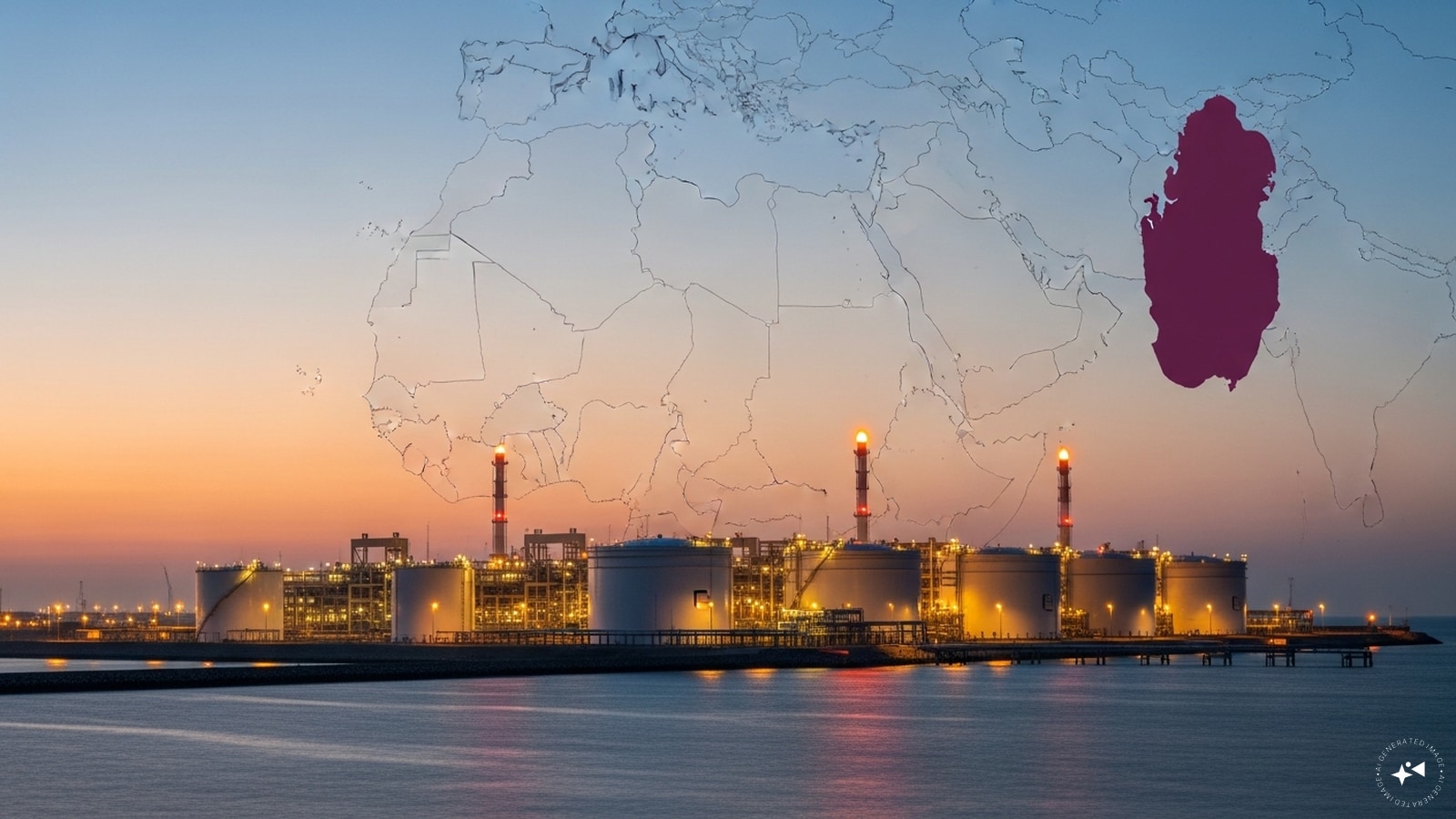
The mainstream financial press is currently hyperventilating over headlines claiming QatarEnergy has "halted" LNG production because of the Israel-Iran escalation. It is a textbook example of lazy journalism meeting a fundamental misunderstanding of energy logistics. If you’re selling your energy positions or bracing for a global blackout based on these reports, you aren't just wrong—you’re being played.
Qatar didn't stop producing gas. They didn't even stop liquefying it. They paused transit through the Bab el-Mandeb strait. There is a massive, tectonic difference between a production shutdown and a logistical reroute, yet the market treats them as the same catastrophe. This isn't a supply crisis; it's a shipping delay, and a predictable one at that.
The Production vs. Transit Fallacy
Most "experts" sitting in glass towers in London or New York see a headline about a pause and immediately model a supply shock. Here is the reality from someone who has watched these cargo flows for two decades: Qatar’s North Field is still pumping. The liquefaction trains at Ras Laffan are still humming at capacity.
When QatarEnergy "halts" shipments through the Red Sea, the gas doesn't evaporate. It just takes the long way around the Cape of Good Hope.
Yes, adding 15 to 20 days to a voyage increases the "ton-mile" demand. Yes, it ties up hull capacity. But it does not remove the molecules from the global balance sheet. The "halt" narrative implies a physical shortage that simply does not exist. We are looking at a plumbing problem, not a dry well.
Why the Red Sea is a Distraction
The obsession with the Bab el-Mandeb ignores the actual geography of Qatari dominance. Look at the data: Qatar’s primary customers aren't in Europe; they are in Asia.
- China, Japan, South Korea, and India take the lion's share of Qatari LNG.
- The route to these markets travels East, through the Strait of Hormuz, completely bypassing the Red Sea and the Houthi threat.
- Only about 5% to 8% of global LNG trade typically moves through the Suez Canal.
By screaming about a Red Sea "halt," the media is focuses on a rounding error while ignoring the steady, massive flow of energy to the East. The "escalating conflict" is a tragedy, but as an economic catalyst for an LNG collapse, it’s a paper tiger.
The Myth of the "Fragile" Supply Chain
I’ve seen traders lose fortunes betting on the fragility of the Qatari supply chain. They underestimate the redundancy built into these systems. Qatar is currently mid-swing in its North Field East (NFE) and North Field South (NFS) expansion projects, aiming to boost capacity from 77 million tons per annum (mtpa) to 126 mtpa by 2027.
Do you honestly think a state-owned entity investing tens of billions of dollars in infrastructure hasn't priced in regional volatility? Qatar operates with a "buffer and bypass" mentality. If the Red Sea is hot, they swap cargoes.
The Swap Mechanism (A Thought Experiment):
Imagine Qatar has a cargo designated for the UK (via the Red Sea) and a US-based provider (like Cheniere) has a cargo designated for Tokyo. Instead of both ships traveling 40 days and risking missile fire, they execute a paper swap. Qatar delivers to Tokyo; Cheniere delivers to the UK. The physical gas moves less, the risk disappears, and the "halt" becomes a footnote. This happens every day in the shadows of the OTC markets, while retail investors are panicking over CNN tickers.
The Real Threat Nobody is Talking About
If you want to actually worry about something, stop looking at the Houthis and start looking at the Strait of Hormuz.
The Red Sea is a choice; the Strait of Hormuz is a requirement. Every single drop of Qatari LNG must pass through that 21-mile-wide neck of water controlled by Iranian proximity. If Iran decides to turn the lights off, they won't do it in the Red Sea. They will do it at the mouth of the Persian Gulf.
But here is the contrarian kicker: Iran won't do it.
Iran’s own economy, though sanctioned, relies on the relative stability of Gulf shipping for its "shadow fleet" oil exports. Closing Hormuz is the "nuclear option" of trade—it ruins the aggressor as much as the victim. The current "escalation" is a calibrated dance of kinetic signaling, not an all-out effort to commit economic suicide. QatarEnergy knows this. Their "halt" is a temporary safety protocol, not a white flag.
Stop Asking "When Will Prices Drop?"
The premise of the question is flawed because it assumes the Red Sea "halt" is what’s keeping prices up. It isn't. Prices are being sustained by a combination of European storage anxiety and the structural shift away from Russian pipeline gas.
If the Red Sea cleared tomorrow, you might see a $0.50 move in JKM or TTF futures, but the underlying tightness remains. You are being told to watch the magician’s left hand (the Israel-Iran conflict) while the right hand (long-term structural deficits) is doing the actual work.
The Professional’s Checklist for This "Crisis"
- Ignore the "Halt" Headlines: Check the actual AIS (Automatic Identification System) data for tankers leaving Ras Laffan. If ships are moving East, the revenue is flowing.
- Monitor the Cape of Good Hope: Watch for an uptick in bunkering activity in South Africa. That’s where the real logistical cost is being absorbed.
- Watch the Swap Spreads: If the spread between Atlantic and Pacific basins narrows, it means the big players are already swapping cargoes to bypass the conflict zone.
The Volatility Trap
Market makers love the "war in the Middle East" narrative because it spikes volatility, which generates fees. They want you to believe that a missile in the Yemen desert can freeze the global energy transition. It can’t.
Qatar is the most efficient gas machine on the planet. They have the lowest extraction costs, the newest fleet, and the most strategic depth. A few rerouted tankers isn't a collapse; it's an operational pivot.
The "conflict" is the noise. The production capacity is the signal. While the amateurs are reading about "production halts," the professionals are watching the liquefaction trains. As long as the smoke is coming out of the stacks in Ras Laffan, the world has gas. Everything else is just expensive theater.
Stop trading the headlines. Start trading the physics of the flow. If the gas is being cooled to -162°C, it’s going to find a buyer, and it’s going to find a way to get there—even if it has to take the scenic route.
Bet on the molecules, not the maps.