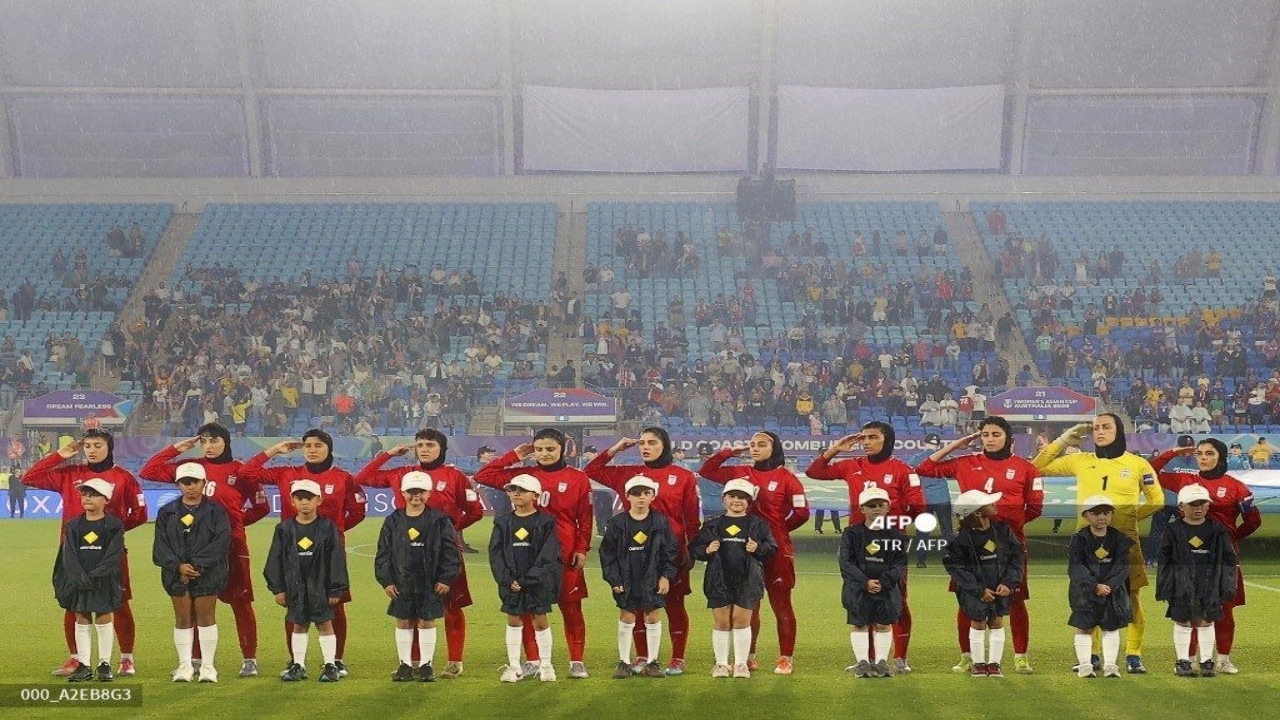
The grass under a footballer’s cleats is supposed to be a stage. For five women from Iran, it became a minefield.
When the news broke that Australia had granted humanitarian visas to five members of the Iranian women’s national football team, the headlines read like a dry administrative update. They spoke of "visa subclasses," "processing times," and "diplomatic protocols." But those cold terms fail to capture the smell of fear in a locker room or the weight of a jersey that feels more like a shroud than a uniform.
To understand why a world-class athlete would trade her national colors for the status of a refugee, you have to look past the scoreboard.
The Pitch That Doubled as a Prison
Imagine a young woman named Zahra. This is a composite character, a vessel for the collective experiences of female athletes living under the shadow of the Islamic Republic’s morality laws. Zahra has spent her life perfecting a bicycle kick, but she must do it while ensuring her headscarf doesn't slip. If a strand of hair escapes during a header, the consequence isn't a yellow card from a referee. It is a summons from a committee.
In Iran, women’s sports are not merely about physical excellence. They are a constant, exhausting negotiation with the state. The athletes are monitored. Their social media accounts are scrubbed. Their travel is restricted by the whims of male guardians.
When the "Woman, Life, Freedom" protests ignited following the death of Mahsa Amini, the stadium changed. It was no longer just a place to play. It became a choice. Do you stay silent and keep your career? Or do you show solidarity with the women dying in the streets and lose everything?
The five women who arrived in Australia didn't just choose a new country. They chose to stop breathing through a straw.
The Invisible Stakes of the Beautiful Game
The Australian government’s decision to provide these visas wasn't just a charitable act. It was a recognition of a specific type of peril. These athletes are symbols. When a female athlete performs on a global stage, she represents a version of Iranian womanhood that the regime finds inherently threatening: powerful, visible, and autonomous.
The risk for these players increased exponentially when they began to use their platforms—however subtly—to signal support for human rights. In the eyes of their home government, a goal scored by a "disobedient" woman is an act of sedition.
Consider the mechanics of the escape. These aren't people moving for better wages or a Mediterranean climate. They are leaving behind parents, childhood bedrooms, and the very soil they represented on the international stage.
The move to Australia involves a total dismantling of identity. One day, you are a national hero with your name on the back of a jersey. The next, you are a file number in a Canberra processing center. The "humanitarian" label is heavy. It carries the trauma of what was left behind.
Why Australia Became the Destination
Australia has a complicated relationship with its border policies, but in this instance, the intersection of sport and human rights created a rare moment of alignment. The country has a deep-seated cultural reverence for the "fair go," particularly in the sporting arena.
By granting these visas, the Australian government acknowledged that for these five women, returning home was no longer a viable option. The threat of detention, the "confession" videos forced upon activists, and the permanent ban from the sport they love were not hypothetical fears. They were the guaranteed itinerary of a return flight to Tehran.
The Australian football community, particularly the Matildas, has long been a vocal advocate for equality. The presence of these Iranian players on Australian soil provides a stark contrast. In Sydney or Melbourne, they can train without a government handler watching their every move. They can post a photo of a victory meal without fearing the morality police will knock on their door the next morning.
The Weight of the New Jersey
Life in a new country is not a cinematic montage of success. It is a grueling process of re-learning how to exist.
For these five players, the challenge is twofold. They must process the survivor’s guilt of leaving teammates behind in Iran, and they must find a way to rebuild a professional career in a foreign league where they are unknown quantities.
The transition is psychological. For years, their bodies were battlegrounds for state ideology. Now, their bodies belong to them again. That kind of freedom is terrifying. It is loud. It is overwhelming.
The statistics on refugee integration often ignore the specific grief of the elite athlete. An athlete’s window of peak performance is tiny. Every month spent in visa limbo, every week spent away from a high-performance training environment, is a permanent loss of potential.
The Game Goes On
The departure of these five women is a devastating blow to the Iranian national team, but it is a louder statement than any trophy could ever be. It tells the world that the spirit of the game cannot be contained by theocratic mandates.
When they eventually step onto a pitch in Australia—whether for a local club or a professional side—the stakes will be different. There will be no secret police in the stands. There will be no fear of a "morality" violation for showing a wrist or a neck.
They will just be footballers.
But as they run, they will carry the ghosts of the women who couldn't leave. They will carry the memory of the stadiums in Iran where women were banned from even watching the game for decades.
The roar of an Australian crowd is a different frequency than the silence of a monitored stadium in Tehran. It is the sound of a person finally being allowed to take up space.
The grass is still green. The ball is still round. But for these five, the air they breathe while they run is finally, agonizingly clear.
Would you like me to look into the specific clubs in Australia that have offered training spots to these athletes?