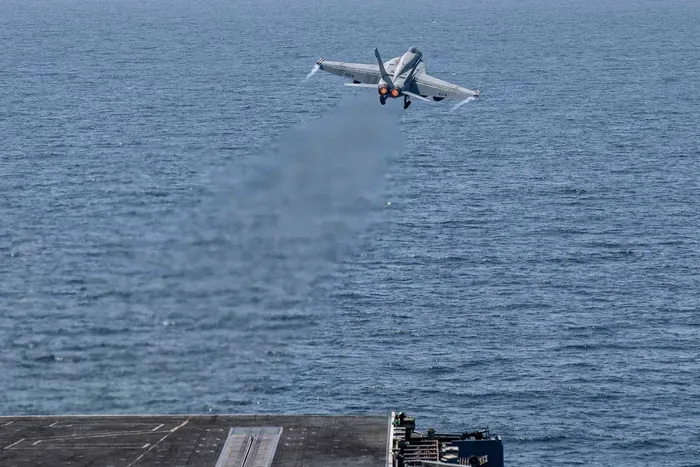
The return of the USS Gerald R. Ford (CVN-78) to Souda Bay, Crete, represents more than a routine logistical stop; it is a recalibration of the United States’ primary instrument of maritime dominance in the Eastern Mediterranean. While social media cycles frequently generate speculative friction—such as unverified claims of "deliberate fires" or localized combat damage—the operational reality of a Carrier Strike Group (CSG) is governed by the rigid mathematics of nuclear-powered endurance, sortie generation rates, and the geopolitical signaling of "presence." To analyze the Ford’s movements accurately, one must look past the informational noise and evaluate the three structural pillars of modern naval hegemony: technical readiness, theater-wide deterrence, and the logistical constraints of the Aegean-Levantine corridor.
The Technical Threshold of the CVN-78 Platform
The Gerald R. Ford is not merely a replacement for the Nimitz-class; it is a fundamental shift in the physics of naval aviation. The transition from steam-powered catapults to the Electromagnetic Aircraft Launch System (EMALS) and the implementation of the Advanced Arresting Gear (AAG) define the ship’s primary value proposition: a 33% increase in Sortie Generation Rate (SGR).
- Electromagnetic Precision: EMALS allows for a more granular control over the launch stroke, reducing stress on airframes. This translates to lower maintenance requirements for the F/A-18E/F Super Hornet fleet and the E-2D Advanced Hawkeye, effectively extending the operational life of the air wing during high-tempo deployments.
- Weaponry Throughput: The use of Advanced Weapons Elevators (AWE), which utilize linear motors rather than cables, facilitates a faster flow of ordnance from magazines to the flight deck. This removes the traditional bottleneck found in Nimitz-class ships, where ammunition movement often lagged behind the refueling cycle.
Allegations of internal fires or systemic failures often ignore the redundant architecture of a nuclear-powered vessel. The Ford utilizes two A1B nuclear reactors, providing roughly three times the electrical generation capacity of its predecessors. This power surplus is designed specifically to handle the "surge" requirements of electromagnetic systems and future directed-energy weapons. Any localized electrical incident—common in the shakedown phases of new ship classes—is mitigated by a decentralized power grid that prevents the "cascade failure" scenarios frequently hypothesized in speculative reporting.
The Strategic Geometry of Souda Bay
The choice of Crete as a focal point for the CSG is dictated by the geographic constraints of the Eastern Mediterranean. Souda Bay is the only deep-water port in the region capable of supporting an aircraft carrier alongside a pier while offering the security infrastructure of a NATO installation. The "Crete Pivot" serves three distinct strategic functions that no other facility in the region can replicate.
- The Signal of Persistence: Remaining in the vicinity of the Levant for an extended duration requires a "hub and spoke" logistics model. By docking at Crete, the Ford maintains a high-readiness posture while allowing for the rapid intake of supplies via the Naval Support Activity (NSA) Souda Bay. This reduces the reliance on T-AKE (Dry Cargo/Ammunition) and T-AO (Fleet Replenishment Oiler) ships, which are vulnerable targets in a contested maritime environment.
- ISR Integration: The carrier does not operate in a vacuum. Its presence in the Aegean integrates the ship’s organic sensors with land-based intelligence, surveillance, and reconnaissance (ISR) assets stationed in Greece and Cyprus. This creates a multi-layered "Common Operational Picture" that extends from the North African coast to the Iranian periphery.
- Escalation Management: The movement of a carrier is the most legible form of military diplomacy. By moving to Crete rather than maintaining a station directly off the coast of Israel or Lebanon, the U.S. Navy executes a "controlled withdrawal of proximity" without a "withdrawal of capability." It signals a de-escalatory intent to regional actors like Hezbollah while keeping the air wing within a two-hour flight time of any potential flashpoint.
Countering the Information Attrition Model
The "deliberate fire" narrative surfacing in non-traditional media outlets is an example of informational attrition. In modern hybrid warfare, the objective is not to sink the carrier—a task requiring a saturation attack of anti-ship ballistic missiles (ASBMs) that few nations possess—but to sink the reputation of the carrier’s invincibility.
Data-driven analysis of the Ford’s maintenance logs and official communications suggests that the ship has met or exceeded its required "Reliability, Availability, and Maintainability" (RAM) benchmarks for its first full deployment. The friction points observed are almost entirely related to the maturation of the dual-band radar and the software integration of the AAG. There is no empirical evidence of catastrophic internal sabotage or combat-related damage. The "fire" reports likely stem from misinterpretations of routine "hot refueling" exercises or smoke signatures from the ship’s auxiliary diesel generators, which are used during specific maneuvering sequences or pier-side transitions.
The Cost Function of Extended Deployment
The primary risk to the Ford is not a singular kinetic event, but the "Readiness Debt" incurred by unplanned deployment extensions. The CSG-12, led by the Ford, has seen its mission pushed beyond the standard six-month window. This creates a compounding effect on the crew and the machinery:
- Human Capital Depletion: Extended sea time without a predictable return date leads to a decline in retention rates for highly specialized nuclear and aviation technicians.
- Maintenance Deferral: Every day the carrier remains at sea is a day that "depot-level" maintenance is postponed. This creates a backlog that will eventually require a longer-than-usual Planned Incremental Availability (PIA) period upon return to Norfolk.
- Economic Burn Rate: Operating a CSG costs approximately $6 million to $8 million per day. An extended stay in the Mediterranean, while strategically necessary, consumes the Navy’s Operations and Maintenance (O&M) budget, potentially starving other theaters, such as the Indo-Pacific, of necessary resources.
The Ford’s deployment is a stress test of the "Dynamic Force Employment" (DFE) concept, which aims to make naval movements less predictable to adversaries. However, DFE relies on the assumption that the fleet is large enough to rotate assets seamlessly. With the Nimitz-class aging and the Ford-class still in the early stages of procurement, the U.S. Navy is operating at a "capacity deficit" that forces the Ford to stay on station longer than intended.
Tactical Realities of the Levantine Basin
The Mediterranean is an increasingly crowded "acoustic environment." Russian Kilo-class submarines operating out of Tartus, Syria, and the proliferation of Iranian-designed drone technology among non-state actors have transformed the basin into a high-threat zone. The Ford’s defense-in-depth relies on the Aegis Combat System equipped on its escorting destroyers and cruisers.
The primary threat is no longer a traditional fleet engagement, but "asymmetric saturation." This involves the use of low-cost loitering munitions to overwhelm the radar processing capabilities of the strike group. The Ford’s move to Crete provides a geographic buffer, forcing any potential drone swarm to travel over longer distances, thereby increasing the "Detection to Engagement" window for the ship’s E-2D Hawkeye early-warning aircraft.
Strategic Play
The Gerald R. Ford’s presence in Crete is the definitive anchor of U.S. policy in the Middle East. To maintain this advantage, the Navy must prioritize the following vector: transition from "presence-based" deterrence to "capability-based" deterrence. This requires the immediate integration of unmanned aerial tankers (MQ-25 Stingray) to extend the carrier’s strike range, allowing it to operate from even further offshore—beyond the reach of regional land-based missile systems—without sacrificing its ability to project power over the Iranian or Levantine interior. The Ford's return to Crete is not a retreat; it is the logistical pause required to sustain a long-term siege of regional instability.