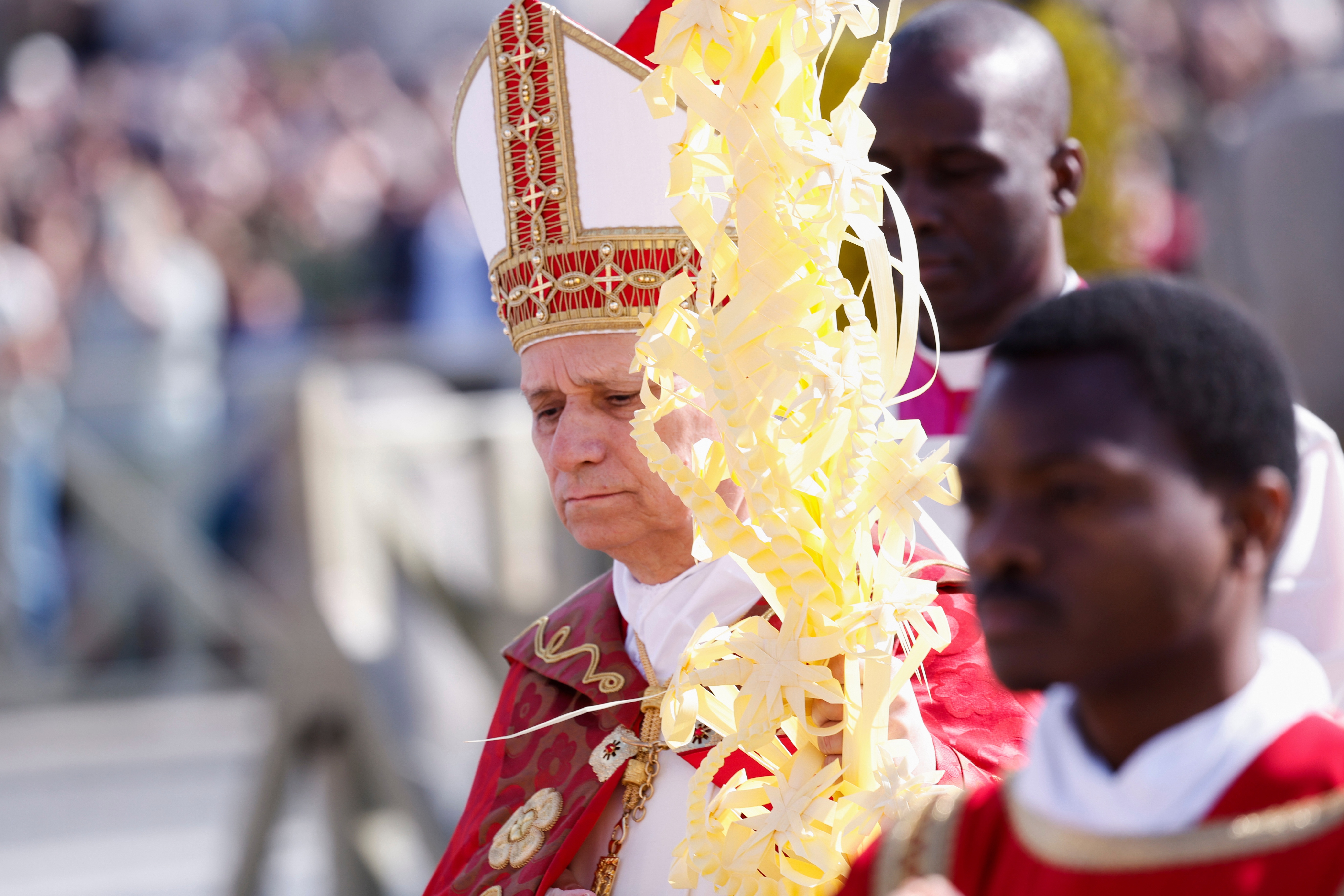
God doesn't take sides in our border disputes or resource grabs. That's the blunt reality Pope Leo XIV dropped on the world during his Palm Sunday Mass at St. Peter’s Square. He didn't use the typical, flowery diplomatic language we’ve come to expect from the Vatican. Instead, he took a sledgehammer to the ancient, dangerous idea that any war can be "holy" or "justified" by divine will.
If you've followed the papacy over the last decade, you know the shift has been coming. But this message was different. It wasn't just a plea for peace. It was a theological correction of centuries of bad history. The Pope made it clear that using the name of the Creator to wrap a flag around a missile is nothing short of blasphemy. He’s calling out a specific brand of religious nationalism that’s currently tearing through Eastern Europe and the Middle East.
The Death of the Just War Theory
For a long time, the Catholic Church leaned on the "Just War" theory. It’s an old framework, dating back to St. Augustine and Thomas Aquinas, meant to figure out when picking up a sword might actually be the right thing to do. Pope Leo XIV basically just retired it. He argued that in a world of nuclear stockpiles and drone strikes, the conditions for a "just" conflict simply don't exist anymore.
Modern warfare is too messy. It’s too indiscriminate. When a "smart bomb" levels an apartment complex, there’s nothing just about it. The Pope’s Palm Sunday message pointed out that the civilian cost of today’s conflicts makes the old theories obsolete. He’s pushing the Church toward a stance of total non-violence, which is a massive pivot from the medieval Crusades-era logic that some fringe groups still try to use today.
Why Religious Leaders Keep Getting It Wrong
We see it every day on the news. Religious leaders in various countries stand behind their presidents and prime ministers, blessing tanks and sanctifying invasions. Pope Leo XIV didn't name names, but he didn't have to. Everyone knew who he was talking about. He’s tired of faith being used as a recruitment tool for the military-industrial complex.
The problem is that religion is a powerful motivator. It’s easy to convince people to die for a cause if you tell them God wants it. The Pope called this a "perversion" of faith. He’s right. When you look at the statistics of modern displacement—over 120 million people forced from their homes worldwide—you see the human cost of these "holy" justifications. There is no divine mandate for a refugee camp.
Palm Sunday as a Political Statement
Palm Sunday commemorates Jesus entering Jerusalem on a donkey. It’s a humble image. It’s the opposite of a general riding a warhorse. Pope Leo XIV used this contrast to drive his point home. He told the massive crowd that you can't follow the Prince of Peace while cheering for the destruction of your neighbor.
This wasn't just a religious sermon. It was a high-level geopolitical critique. By rejecting the idea that God justifies war, the Pope is stripping away the moral cover that many leaders rely on. He’s saying that if you want to go to war, own it as a human failure. Don't drag the Almighty into your mess.
Breaking the Cycle of Retribution
The hardest part of the Pope’s message is the call to stop the "eye for an eye" mentality. It’s human nature to want revenge. When a country gets attacked, the immediate response is to hit back harder. But Leo XIV argues that this only creates a self-sustaining loop of violence that lasts for generations.
Look at the conflicts in the Sahel or the ongoing carnage in Ukraine. These aren't just military battles; they're deep-seated cycles of trauma. The Pope’s argument is that until we stop claiming God is on our side of the trench, we’ll never find a way out. He’s asking for a radical kind of empathy that most politicians find completely impractical. Honestly, it is impractical. But that’s his point. Peace isn't about practical politics; it’s about a fundamental shift in how we value human life.
The Global Reaction and What Happens Next
The reaction to the speech was split exactly where you’d expect. Human rights organizations and peace activists are hailing it as a landmark moment. Meanwhile, hardline nationalists are calling it "naive" and "dangerously out of touch." Some conservative factions within the Church are even whispering about heresy, clinging to those old Augustinian doctrines.
But Leo XIV doesn't seem to care about the internal politics. He’s looking at the big picture. He’s seeing a world on the brink of wider conflict and he’s trying to pull it back. This wasn't a one-off speech; it’s the new official line of the Vatican. Expect to see this reflected in future encyclicals and diplomatic efforts.
If you’re looking to understand how this impacts the world, start by watching how the Church handles its relationships with countries currently at war. The Vatican has often acted as a mediator. Now, that mediation comes with a very specific condition: the total rejection of religious justification for violence. If a leader wants the Pope's help, they have to stop claiming God wants the war to continue.
You should pay attention to how your local religious and community leaders discuss global conflict. The next time you hear someone suggest that a war is "necessary" or "blessed," remember the Palm Sunday message. Challenge the idea that violence can be holy. Support organizations that focus on de-escalation rather than those that fund the weaponry. Real peace starts when we stop pretending our weapons have divine approval.