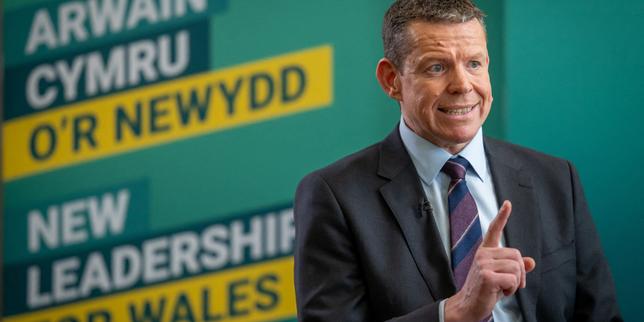
The historical ceiling for Welsh nationalism is currently being tested by a fundamental realignment of the electoral math in Wales. For decades, Plaid Cymru (The Party of Wales) functioned as a regional pressure group rather than a definitive governing alternative to Welsh Labour. However, the 2024-2026 political cycle reveals a structural decay in the "Labour Hegemony Model" that has defined Cardiff Bay since the inception of devolution in 1999. The possibility of Plaid Cymru finishing first in a national ballot is not a product of sudden ideological conversion among the Welsh electorate; it is the result of three specific systemic failures within the incumbent administration and a strategic pivot in nationalist messaging from cultural preservation to economic utility.
The Three Pillars of Nationalist Expansion
To understand why Plaid Cymru is currently positioned to challenge for the top spot, one must deconstruct their growth into three distinct operational channels:
- The Post-Industrial Pivot: Historically, Plaid Cymru’s strength was concentrated in the "Y Fro Gymraeg" (the Welsh-speaking heartlands of the north and west). Their current strategy targets the "Valleys" and the M4 corridor—areas that are English-speaking and traditionally loyal to Labour. This shift requires a transition from identity politics to "bread-and-butter" economic interventionism.
- The Competency Gap: Welsh Labour’s twenty-five-year tenure has created a record of vulnerability. Specifically, performance metrics in the Welsh NHS and educational attainment under the PISA (Programme for International Student Assessment) rankings provide a statistical cudgel for the opposition. When an incumbent has governed for a quarter-century, "change" becomes a powerful, if vague, brand.
- The Westminster Decoupling: The 2024 UK General Election demonstrated that a Labour government in London removes the "Shield of Opposition" from Labour in Cardiff. Previously, Welsh Labour could blame "Tory Austerity" for local failures. With a Labour-led Treasury, the fiscal accountability for Wales’s budget falls squarely on the Welsh Government, creating a friction point that Plaid Cymru is positioned to exploit.
The Cost Function of Devolutionary Stagnation
The Welsh economy operates under a specific set of constraints known as the "Barnett Formula," which dictates the block grant from the UK government. The core logic of the nationalist surge rests on the argument that the current devolved settlement has reached its point of diminishing returns.
Plaid Cymru’s economic framework posits that Wales is currently in a "Dependency Trap." The mechanics of this trap are defined by:
- Low Productivity: GVA (Gross Value Added) per head in Wales remains the lowest in the UK.
- Infrastructure Deficit: The lack of a North-South rail link and the underfunding of the core road network creates an internal trade barrier.
- Demographic Imbalance: An aging population combined with the "brain drain" of young professionals to Bristol, Birmingham, and London creates a shrinking tax base.
Nationalist strategy has evolved to frame independence not as a romantic goal, but as a technical solution to these specific fiscal bottlenecks. By arguing for full control over the Crown Estate and taxation powers, they are attempting to move the debate from "Is Wales a nation?" to "Is Wales a viable economic unit?"
The Electoral Calculus: First-Past-The-Post vs. Proportional Representation
The specific timing of the "nationalist hope" is linked to the reform of the Senedd (Welsh Parliament) voting system. The transition to a more proportional system changes the incentive structure for voters.
In a First-Past-The-Post (FPTP) system, as used in UK General Elections, Plaid Cymru is often sidelined by tactical voting designed to keep the Conservatives out. In the Senedd’s new electoral framework, the "wasted vote" logic disappears. This structural change lowers the barrier to entry for voters who are dissatisfied with Labour but were previously afraid that a vote for Plaid would inadvertently help the right-wing opposition.
The growth of the nationalist vote is also a function of the fragmentation of the "Unionist" vote. The Welsh Conservatives have struggled to find a coherent post-Brexit identity, while Reform UK has begun to siphon off traditional working-class Labour voters. Plaid Cymru gains not necessarily by increasing their raw numbers in every district, but by remaining stable while the Unionist bloc fractures into three competing factions.
The Logistical Constraints of the Independent Movement
While the polling trajectory is favorable for Plaid Cymru, several hard constraints limit their ceiling. These are the variables that the "hope" narrative often ignores:
- The Fiscal Gap: Estimates of the Welsh fiscal deficit vary, but the gap between tax raised in Wales and public spending is significant. Plaid Cymru’s counter-argument—that this deficit is a byproduct of being in the UK, not a reason to stay—remains an unproven hypothesis that many centrist voters find risky.
- The Identity Ceiling: There is a consistent 15–20% gap between people who would vote for Plaid Cymru and people who support full independence. This "Soft Nationalist" or "Devo-Max" cohort wants more powers but fears a total break. If Plaid pushes too hard on a "referendum now" platform, they risk alienating the very voters they need to finish first.
- Media Marginalization: Wales lacks a robust domestic media ecosystem compared to Scotland. Most Welsh citizens consume UK-wide news based in London, which rarely covers Senedd politics with the depth required to sustain a long-term shift in political consciousness.
Strategic Divergence: Plaid Cymru vs. the SNP
A common analytical error is treating Welsh nationalism as a carbon copy of the Scottish National Party (SNP). The dynamics are fundamentally different. The SNP achieved dominance by becoming a "catch-all" party that replaced Labour entirely. In Wales, the linguistic divide (Welsh speakers vs. English speakers) creates a natural friction that the SNP did not have to navigate.
Plaid Cymru’s path to the top is more likely to resemble a "Coalition Lead" than a "Majority Sweep." They do not need to win 50% of the vote to come first; they need to exploit Labour’s voter fatigue while keeping the Welsh Conservatives at bay in the rural belts.
The causal link between Plaid's potential success and Labour's failure is direct: every percentage point Labour loses over the "20mph speed limit" controversy or NHS waiting lists is a point that doesn't necessarily go to the right, but often "parks" itself with Plaid Cymru as a protest.
The Bottleneck of Governance
The primary risk for the nationalist movement is the "Coalition Trap." Plaid Cymru has previously entered into "Co-operation Agreements" with Labour. While this gave them a seat at the table and allowed them to implement policies like Universal Free School Meals, it also blurred their identity as an opposition party.
To finish first, Plaid Cymru must pivot from being a "junior partner" to being a "disruptive alternative." This requires a aggressive stance on:
- Energy Sovereignty: Asserting that Welsh water and wind resources are being exported without sufficient financial return to the Welsh Treasury.
- Health Reform: Proposing a radical decentralization of the Welsh NHS to break the bureaucratic inertia that has characterized the last decade.
- The Steel Crisis: Using the decline of the Port Talbot steelworks as a case study for the perceived "indifference" of both London and the Cardiff Labour establishment.
The probability of Plaid Cymru finishing first depends on their ability to weaponize the "Economic Competency" variable over the "Cultural Identity" variable. If the election is about the Welsh language, they remain a minority party. If the election is about the failure of the Welsh economy under twenty-five years of single-party rule, the path to the top is statistically open.
The final strategic move for the nationalist leadership is to target the "economic center." They must convince the Welsh business community—which has historically been Unionist—that a Plaid-led government would be more agile and responsive to local market needs than a Welsh Labour government that is increasingly seen as being out of ideas. The battle for the first-place finish will not be won in the Gwynedd mountains, but in the office parks of Newport and the suburbs of Cardiff.


