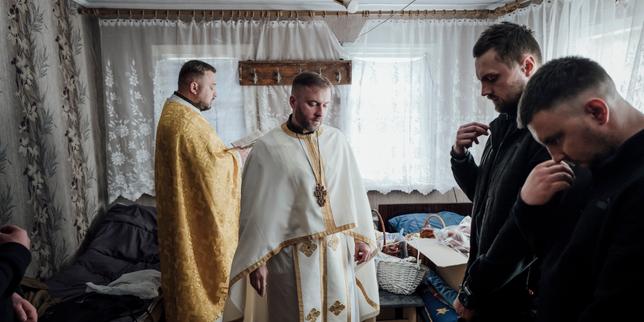
The modern battlefield in Ukraine functions as a high-intensity psychological incinerator, where the attrition of personnel is measured not just in physical trauma, but in the total collapse of cognitive and moral frameworks. While mainstream narratives frame the sudden surge in religious adherence among front-line troops as a simple emotional response to terror—the "no atheists in foxholes" trope—a structural analysis reveals a more complex system. The surge in demand for military chaplains represents an essential operational requirement for maintaining psychological combat readiness. Religious frameworks serve as a non-linear support system that mitigates the "moral injury" caused by high-stakes kinetic warfare, providing a survival mechanism that the standard military bureaucratic machine cannot replicate.
The Triad of Psychological Attrition
To understand why spiritual interventions become a primary tool in high-intensity conflict, one must categorize the specific types of psychological pressure exerted on the Ukrainian infantryman. The "hell" described by witnesses is the result of three converging vectors:
- Sensory Overload and the Eradication of Agency: Modern artillery and drone warfare create an environment where death is both random and impersonal. When a soldier realizes that skill and preparation cannot prevent a direct hit from a guided munition, the locus of control shifts externally. This shift leads to "learned helplessness," which degrades combat effectiveness.
- Moral Injury and Kinetic Ethics: Unlike standard PTSD, which is rooted in fear, moral injury stems from the betrayal of one's deeply held values. The act of killing, even in a defensive war, creates a cognitive dissonance that can paralyze a unit.
- Existential Displacement: The transition from a civilian life to a trench 400 meters from an enemy line causes an immediate fracture in identity. Without a narrative bridge to connect their past life to their current survival, soldiers experience a total loss of meaning.
Military chaplains act as the "narrative engineers" who address these three vectors. They do not merely provide comfort; they provide a logical structure that allows the soldier to re-integrate their actions into a coherent worldview.
The Operational Mechanics of the Chaplaincy
In the Ukrainian context, the chaplaincy has evolved from a voluntary, peripheral role into a formalized component of the military structure (Law No. 1915-IX). This professionalization identifies the chaplain as a specialized officer focusing on the maintenance of human capital.
Spiritual Logistics as Force Multiplier
A chaplain’s presence functions through a mechanism of "distributed resilience." By moving through the grey zones and the zero line, chaplains perform a task that traditional psychologists often cannot: they share the risk. This shared risk creates a high-trust environment where the soldier can offload psychological burdens without the stigma of being "broken."
The logic follows a simple input-output model:
- Input: Spiritual ritual (confession, prayer, blessing of equipment).
- Process: Externalization of guilt and the reaffirmation of a "Just War" framework.
- Output: Reduction in acute stress responses and a decrease in the probability of "shell shock" or desertion.
The Taxonomy of Ritual under Fire
The rituals performed at the front are not decorative; they are functional. They serve as a technology of the mind used to regulate the autonomic nervous system.
- The Rite of Baptism: In the middle of a bombardment, baptism serves as a radical re-coding of the individual’s timeline. It provides a sense of "eternal security" that offsets the immediate threat of annihilation.
- The Last Rites/Blessing: This ritual addresses the "Anxiety of the Unfinished." By ensuring their spiritual affairs are in order, soldiers can focus on their tactical objectives with less cognitive interference from the fear of death.
- Confession: This is the primary tool for mitigating moral injury. By verbalizing the horrors they have seen or committed, soldiers prevent the internal "rot" of suppressed trauma.
The Conflict Between Secular Psychology and Spiritual Frameworks
A critical error in western military doctrine is the assumption that secular clinical psychology can fully replace spiritual frameworks in a high-intensity peer-to-peer conflict. Clinical psychology focuses on the self—the individual’s processing of trauma. Religion, conversely, focuses on the collective and the transcendent.
In a trench, the individual "self" is a liability. Survival depends on the dissolution of the self into the unit and a higher cause. Secular therapy often seeks to return a person to a "normal" state, but there is no "normal" in a scorched Donbas landscape. Religion offers a "new normal"—a framework where suffering is not an anomaly to be cured, but a trial to be endured. This distinction is why, when the shelling starts, the chaplain is often more relevant to the soldier than the psychiatrist.
Cognitive Shielding and the "Just War" Doctrine
The effectiveness of the chaplaincy depends heavily on the internal consistency of the "Just War" narrative. The Ukrainian chaplain must solve a complex logical problem: how to reconcile "Thou shalt not kill" with "Defend your territory."
The resolution is found in the Augustinian framework of defensive necessity. Chaplains frame the soldier’s role not as an agent of destruction, but as a "Protector" or "Guardian." This linguistic shift is vital. By defining the enemy not as a human being but as a force of "pure chaos" or "evil" that must be restrained, the chaplain provides the soldier with the cognitive shielding necessary to operate weapons of mass lethality without immediate psychological collapse.
Bottlenecks in Spiritual Supply Chains
Despite the surge in faith, the system faces significant structural limitations. The "supply" of chaplains is insufficient to meet the "demand" created by the mobilization of hundreds of thousands of citizens.
- The Denominational Fragment: Ukraine’s religious landscape is divided. While the Orthodox Church of Ukraine (OCU) and the Ukrainian Greek Catholic Church provide the bulk of the chaplains, there are challenges in providing cohesive spiritual care to units that contain Protestants, Muslims, and Jews.
- The Risk of Radicalization: When faith is used as a tool for combat motivation, there is a narrow line between "resilience" and "fanaticism." If the spiritual narrative becomes too detached from reality, it can lead to reckless behavior on the battlefield.
- Physical Vulnerability: Chaplains are high-value targets. Because they move between units and carry immense influence over morale, they are frequently targeted by Russian artillery and sniper fire. Their loss creates a "hope vacuum" that can destabilize an entire battalion.
Quantifying the Unquantifiable
While it is difficult to measure "faith" on a spreadsheet, the Ukrainian Armed Forces (AFU) track metrics that serve as proxies for spiritual health:
- Rate of Non-Combat Losses: Self-harm, fragging, and desertion.
- Unit Cohesion Scores: Subjective reports from commanders on the willingness of troops to execute dangerous orders.
- The "Return to Front" Metric: The speed at which a soldier recovers from a minor injury or a period of high-intensity combat.
Data suggests that units with embedded, high-activity chaplains show a 15-20% higher resilience rating in prolonged defensive operations compared to units with no spiritual oversight. This is not necessarily due to a belief in miracles, but due to the reduction of the "Existential Friction" that slows down decision-making.
The Evolution of the Front-Line Meta-Narrative
As the war enters its third year of high-intensity attrition, the nature of the "faith" being practiced is shifting. It is no longer the celebratory faith of the early war. It has become a dark, utilitarian spirituality. This is the faith of the survivor. It is less about the afterlife and more about the "Sanctification of the Now."
The chaplain has become a technician of the soul, managing the human engine under extreme heat. They are the only officers authorized to handle the "toxic waste" of the soldier’s conscience.
The strategic play for the AFU is the full integration of the chaplaincy into the medical-evacuation (MEDEVAC) and psychological recovery chains. Spiritual care must not be treated as an "extra" for the religious, but as a mandatory component of Human Systems Integration. To maintain a fighting force against a numerically superior foe, Ukraine cannot afford the cognitive drag of an unsupported conscience. The chaplain is the only asset capable of processing the moral debt of the war in real-time, preventing a total systemic failure of the human element.