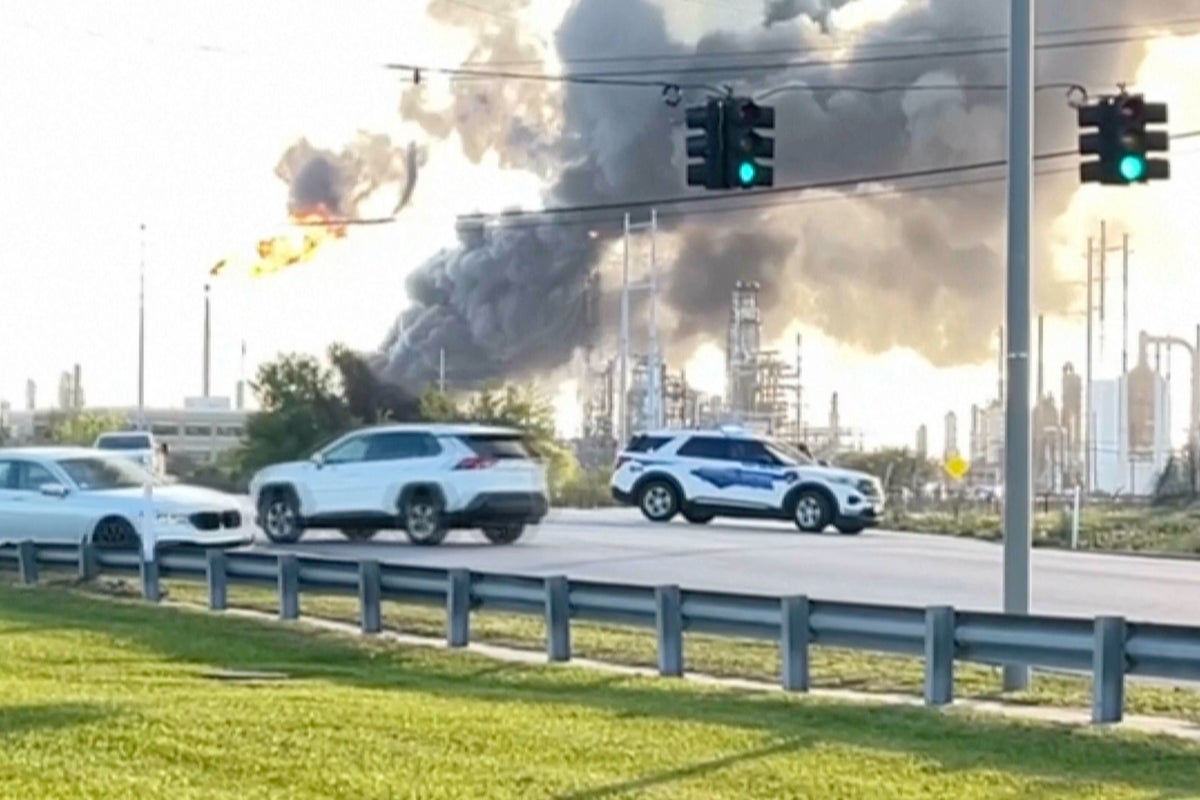
The failure of a high-pressure distillation unit or a localized thermal runaway within a catalytic cracking circuit does not merely create a fire; it triggers a systemic shock to the North American energy supply chain. When an explosion occurs at a Texas Gulf Coast refinery, the immediate visual chaos—smoke plumes and shelter-in-place orders—masks a far more rigid sequence of economic and mechanical interdependencies. Understanding this event requires moving past the "accident" narrative to analyze the three specific vectors of failure: kinetic containment loss, regulatory friction, and downstream supply-chain inelasticity.
The Kinetic Failure Mechanism
Refineries are not monolithic structures but integrated thermodynamic systems designed to operate at narrow margins of temperature and pressure. An explosion of this magnitude generally originates from one of two primary mechanical breaches.
- Loss of Primary Containment (LOPC): This occurs when the physical integrity of piping, pressure vessels, or storage tanks is compromised. In the context of Texas refineries, many of which process heavy sour crudes, "Sulfidic Corrosion" is a persistent threat. If high-temperature hydrocarbons breach a pipe wall, the auto-ignition temperature is often exceeded instantly upon contact with oxygen.
- Vapor Cloud Explosion (VCE) Dynamics: When a leak occurs without immediate ignition, a flammable plume accumulates. The "huge fire" reported by local media is often the secondary result of a VCE, where the overpressure wave causes structural damage to surrounding units, rupturing further lines and feeding a continuous fire loop.
The "shelter-in-place" directive issued to local residents is a standard operational mitigation for the release of Hydrogen Sulfide ($H_2S$) or Sulfur Dioxide ($SO_2$). $H_2S$ is a byproduct of the desulfurization process; even at low concentrations (100 ppm), it is immediately dangerous to life or health (IDLH). The decision to shelter rather than evacuate is based on a calculated risk threshold: moving a population through a potential gas plume is statistically more dangerous than utilizing the "envelope" of a residential structure to filter out peak concentrations.
The Three Pillars of Refinery Post-Crisis Recovery
Following the initial suppression of a fire, the facility enters a period of "forced outage" that follows a predictable, though costly, structural path.
Infrastructure Integrity Assessment
Engineers must conduct non-destructive testing (NDT) on all steel structures exposed to temperatures exceeding 538°C (1,000°F). At these levels, structural steel loses approximately 50% of its yield strength. Even if a unit looks intact, the molecular grain structure of the metal may have shifted, making it prone to brittle fracture during the next startup cycle.
Regulatory and Forensic Friction
The Chemical Safety Board (CSB) and OSHA typically freeze the site. This creates a "recovery bottleneck" where the opportunity cost of idle capital exceeds the direct cost of the physical damage. A Tier 1 process safety event triggers an exhaustive Root Cause Analysis (RCA). If the investigation reveals a "culture of normalization of deviance"—where small leaks were ignored—the refinery faces not just fines, but the potential revocation of its "Social License to Operate," leading to increased insurance premiums that can shift the facility's position on the global cost curve.
Inventory and Feedstock Re-routing
Refineries operate on "just-in-time" crude delivery. An explosion halts the intake of hundreds of thousands of barrels per day. This creates a localized glut of crude oil in the Permian-to-Coast pipelines, forcing storage at hubs like Cushing, Oklahoma. Simultaneously, it creates an immediate deficit in the supply of Tier 3 gasoline and ultra-low sulfur diesel (ULSD).
The Cost Function of Downstream Disruption
The impact on the consumer is dictated by the "Crack Spread," which is the pricing difference between a barrel of crude oil and the petroleum products extracted from it. When a major Texas refinery—representing a significant percentage of the U.S. Gulf Coast (PADD 3) refining capacity—goes offline, the crack spread widens.
This is not a linear relationship. Because the U.S. pipeline infrastructure (such as the Colonial Pipeline) operates at near-peak capacity, a disruption in Texas causes a "bullwhip effect" in the Northeast.
- PADD 1 Vulnerability: The U.S. East Coast relies heavily on Gulf Coast output. A 14-day outage at a major refinery can deplete local inventories to "tank bottoms," the level at which fuel can no longer be pumped due to sediment.
- Logistical Inelasticity: You cannot simply "truck in" the volume lost from a refinery explosion. A single mid-sized refinery produces enough gasoline daily to fill approximately 1,200 tanker trucks. The logistical friction of replacing a refinery’s output via sea or rail is insurmountable in the short term.
Structural Hazards of the "Restart" Phase
The most dangerous period for a refinery is not during steady-state operation, but during "Turnaround" and "Startup." Statistics from the American Petroleum Institute (API) suggest that a disproportionate number of LOPC events occur when a unit is being brought back online.
Thermal expansion is the primary culprit. As cold equipment is introduced to high-temperature feedstocks, metal components expand at different rates. If the "heat-up" schedule is rushed to capitalize on high market prices caused by the shortage, the risk of flange leaks and gasket failures increases exponentially. This creates a "Perverse Incentive Loop": the higher the fuel prices climb due to the accident, the more pressure management feels to restart quickly, thereby increasing the probability of a secondary event.
Quantifying the Community Risk Profile
The "locals told to shelter" narrative often ignores the long-term environmental health externalities. While the immediate threat is fire and acute gas exposure, the secondary threat is the deposition of particulate matter and unburned hydrocarbons.
| Factor | Immediate Impact | Long-term Consequence |
|---|---|---|
| Nitrogen Oxides ($NO_x$) | Respiratory irritation | Ozone formation and smog |
| Benzene Release | Dizziness, acute toxicity | Carcinogenic risk in groundwater |
| Carbon Soot | Physical occlusion of airways | Soil contamination and crop damage |
Modern refining complexes utilize "Fenceline Monitoring" to track these emissions in real-time. However, during an explosion, these sensors are often overwhelmed or destroyed, leaving a data gap that complicates future litigation and health assessments.
The Strategic Path Forward for Infrastructure Resilience
To mitigate the systemic volatility highlighted by this event, the industry must move toward "High Reliability Organizing" (HRO). This involves three tactical shifts in asset management:
- Digital Twin Integration: Maintaining a real-time virtual model of the refinery that uses IoT sensors to predict metal fatigue before a breach occurs. This moves maintenance from "reactive" to "prescriptive."
- Decentralized Power Systems: Ensuring that the refinery’s safety systems (automated fire monitors and emergency shutdown valves) are on a localized microgrid. Many explosions escalate because a loss of external power prevents operators from closing critical valves.
- Automated Isolation: Implementing "Triple Offset Butterfly Valves" with fail-safe actuators that trigger based on pressure-drop gradients rather than manual intervention.
The Texas refinery explosion is a reminder that in high-hazard industries, "safety" is not a static state but a continuous, capital-intensive struggle against the laws of thermodynamics. Any strategy that prioritizes short-term throughput over the rigorous inspection of "dead-leg" piping is mathematically certain to encounter a catastrophic failure.
Identify the specific units affected by the blast—if the fluid catalytic cracker (FCC) or the hydrocracker is offline, expect a minimum 30-day upward pressure on regional gasoline futures. If the damage is limited to atmospheric distillation, the recovery window may shorten to 10 days, provided the metallurgical integrity of the supporting bypass structures is verified by third-party inspectors. Owners of midstream assets should immediately evaluate storage capacity at the terminal level to capture the inevitable crude surplus caused by the refining bottleneck.
Would you like me to analyze the specific impact of this refinery outage on RBOB (Reformulated Blendstock for Oxygenate Blending) futures and regional spot pricing?