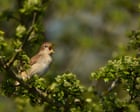
The marginal recovery of the UK nightingale (Luscinia megarhynchos) population is not a victory of conservation sentiment but a fragile stabilization within a shrinking ecological niche. Current monitoring data suggests a plateauing of the long-term decline, yet this trend is deceptive. To understand the viability of the species, we must look past raw census numbers and analyze the specific structural requirements of their habitat—a transient stage of vegetation known as scrub—which operates under a strict decay function. The nightingale is a biological indicator of the failure to manage successional habitats at scale.
The Successional Bottleneck Logic
The primary driver of nightingale distribution is the availability of "middle-succession" scrub. Unlike ancient woodland or permanent grassland, this habitat is chronologically unstable. Without active intervention or specific grazing pressures, scrub naturally transitions into closed-canopy woodland within 10 to 15 years.
This creates a Successional Bottleneck. For a nightingale population to remain stable in a specific region, new scrub must be created at a rate that equals or exceeds the rate at which existing scrub matures into forest. The recent "cautious welcome" of population figures ignores the reality that much of the currently occupied habitat is approaching its biological expiration date.
The nightingale’s niche is defined by three non-negotiable structural variables:
- Basal Density: The presence of dense, thorny thickets (often blackthorn or hawthorn) near the ground to provide nesting cover from terrestrial predators.
- Litter Layer Depth: A thick accumulation of leaf litter that supports a high biomass of invertebrate prey, specifically beetles and ants.
- Thermal Buffering: A microclimate maintained by the dense vegetation that protects nests from the increasingly volatile temperature swings seen in UK springs.
When a site "shades out," the canopy closes, the basal density thins, and the ground-level microclimate shifts. At this point, the site becomes an ecological sink for nightingales, even if the surrounding landscape appears green.
The Spatial Variance of Breeding Success
The UK population is currently retreated into a high-density "core" in the South and Southeast of England. This geographic contraction introduces Stochastic Risk. When a species is concentrated in a limited geographic area, it becomes hypersensitive to localized shocks—such as a single drought year in the UK or a catastrophic weather event along the migration route through the Mediterranean and Sahara.
Analysis of breeding success reveals a divide between traditional managed reserves and "unintentional" habitats. The most significant population gains are often found in areas where human land-use has been abandoned or paused, such as:
- Disused mineral extraction sites.
- Brownfield land awaiting development.
- Margin areas of large infrastructure projects.
The irony of nightingale conservation is that formal "Protection" (designating a site as a SSSI or Nature Reserve) often leads to habitat stagnation. Static protection prevents the very disturbance—clearing, burning, or heavy grazing—required to reset the successional clock.
Migration Energetics and the African Wintering Grounds
While UK habitat is the focal point of domestic policy, the nightingale’s survival is a function of its entire life cycle across the Afro-Palearctic migration system. The bird spends only three months in the UK. The remaining nine months are a high-stakes energy management exercise.
The "Cost of Transit" is increasing. Desertification in the Sahel region forces birds to make longer non-stop flights over inhospitable terrain. To survive this, a nightingale must achieve a specific Fuel Load Index before departure. If the UK spring is cold or dry, reducing invertebrate availability, the birds cannot accumulate the necessary fat reserves. This leads to high "carry-over effects," where birds that survive the flight arrive in Africa in poor condition, reducing their overwinter survival rate and their subsequent reproductive fitness when they return to the UK the following year.
The slight increase in UK numbers may reflect a period of favorable winds or localized rainfall in the sub-Saharan wintering belt rather than a fundamental improvement in UK land management. We are viewing a pulse in a failing system, not a shift in the system's trajectory.
The Logic of Re-Wilding vs. Active Management
There is a tension between the "Re-wilding" movement and the specific requirements of the nightingale. Proponents of re-wilding argue for the reintroduction of large herbivores (pigs, cattle, ponies) to create a mosaic of habitats. From a data-driven perspective, this is the only scalable way to generate the "Scrub-Mosaic" the nightingale requires.
Manual intervention—where rangers cut back scrub by hand—is economically unviable at the landscape scale. It relies on volunteer labor and precarious grant funding. In contrast, Bovid-Driven Disturbance creates a self-sustaining cycle of habitat renewal.
- Cattle create paths through dense thickets, maintaining the "edge" habitat nightingales prefer.
- Pigs disturb the soil, promoting the germination of thorny scrub species.
- The resulting habitat is heterogeneous, meaning it contains scrub at various ages, ensuring that as one patch matures out of the nightingale's preference, another is just entering it.
Quantifying the Noise Pollution Variable
A secondary, often overlooked constraint on nightingale expansion is the Acoustic Competition found in the modern British landscape. Nightingales rely on complex, high-frequency song to defend territories and attract mates. Research into avian bioacoustics suggests that anthropocentric noise—specifically from motorways and flight paths—overlaps with the nightingale’s frequency range.
In high-noise environments, male nightingales must sing louder or at higher pitches, which increases their metabolic expenditure. There is evidence that females perceive these altered songs as lower quality, leading to lower pairing success in habitats near major transport hubs. Therefore, even structurally perfect scrub may remain unoccupied if it falls within a high-decibel zone. This effectively removes thousands of hectares of potential habitat from the "available" column in conservation models.
Strategic Priority: The Creation of "Moving Targets"
The current conservation strategy of holding onto specific "Hotspots" is logically flawed because it fights the second law of thermodynamics—it tries to keep a dynamic system static.
The strategic shift must move toward Rotational Land-Use Frameworks. This involves:
- Successional Zoning: Implementing 20-year cycles across clusters of landholdings where scrub is allowed to develop on one parcel while being aggressively cleared on another.
- Infrastructure Mitigation Reform: Shifting the focus of "Biodiversity Net Gain" from tree planting (which creates woodland) to scrub creation. Trees are the default for carbon sequestration credits, but they are a death knell for nightingale-grade scrub. Policy must be adjusted to value "Early Successional Habitat" as highly as "Ancient Woodland."
- Cross-Border Data Integration: Establishing a real-time tracking network that links UK breeding success with satellite-derived vegetation indices in the Sahel. This would allow conservationists to predict "crash years" before they happen and focus resources on supplemental feeding or predator control during low-survival cycles.
The nightingale is currently surviving in the gaps of our industrial landscape. To move from a "cautious welcome" of slight increases to a genuine population recovery, the UK must institutionalize habitat disturbance. The goal is not to preserve the scrub we have, but to build a system that is constantly, intentionally losing and recreating it.