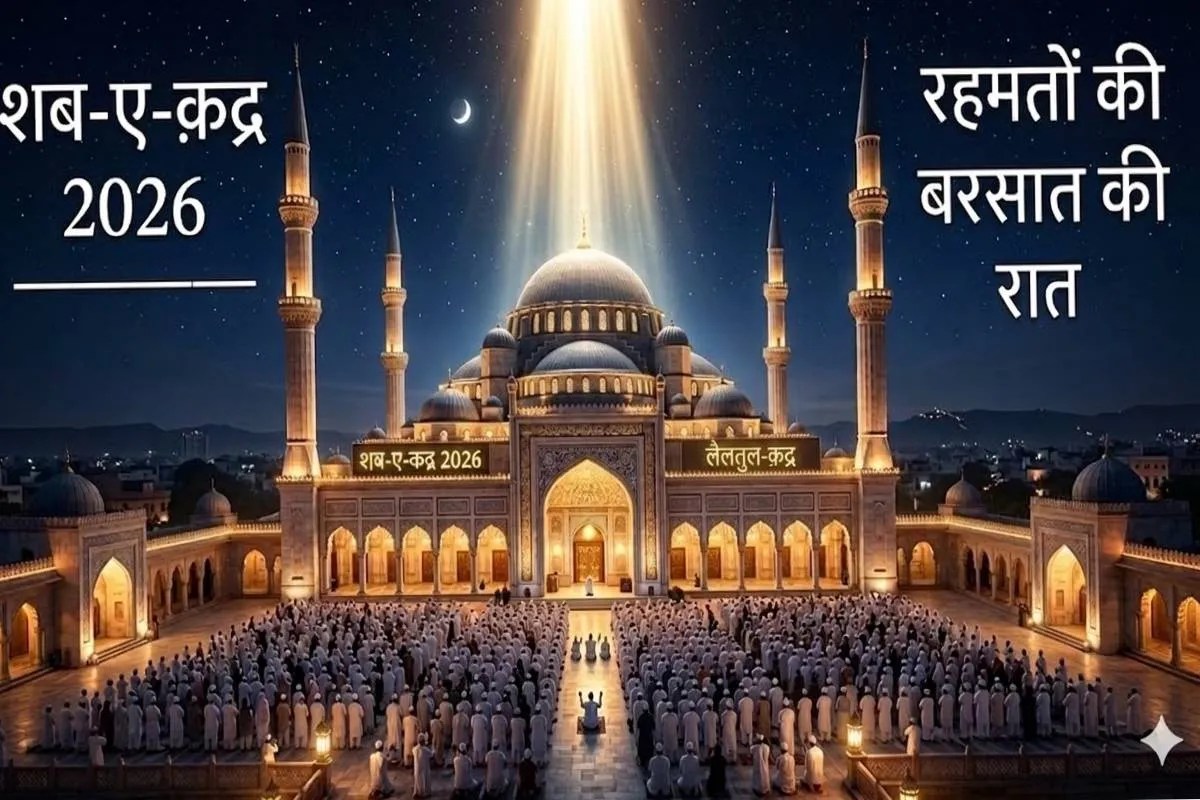
Shab-e-Qadr, or the Night of Decree, stands as the most significant event on the Islamic calendar, occurring during the final ten nights of Ramadan. In 2026, this search for spiritual alignment reaches its peak as millions of observers sequester themselves in mosques and private homes. It is not merely a night of prayer; it is a temporal window where Muslims believe the Quran was first sent down and where the destiny of the following year is written.
The weight of this night rests on a specific mathematical promise found in the 97th chapter of the Quran. It is described as "better than a thousand months." This isn't poetic flair. It is a literal calculation for the believer. A single night of devotion is credited as eighty-three years and four months of continuous worship—effectively a lifetime of piety compressed into several hours of darkness.
The Hunt for the Hidden Date
There is a deliberate mystery at the heart of Shab-e-Qadr. Unlike Eid or the start of Ramadan, the exact date is not fixed. The Prophet Muhammad traditionally pointed toward the odd-numbered nights of the final third of the month: the 21st, 23rd, 25th, 27th, or 29th.
This ambiguity serves a psychological purpose. If the date were known with absolute certainty, the human tendency toward efficiency would likely lead many to ignore the rest of the month and focus solely on that twenty-four-hour window. By hiding the exact moment, the faith mandates a ten-day marathon of consistency. It forces a period of sustained introspection rather than a one-off performance.
In 2026, the global observation begins to intensify following the 20th day of Ramadan. Astronomically, this falls in late March. For the devout, the search involves looking for physical signs described in ancient texts: a sun that rises without blinding rays the following morning, a night that is neither too hot nor too cold, and a peculiar sense of calm in the atmosphere. Whether these signs are literal or metaphorical matters less than the heightened state of awareness they demand from the observer.
The Mechanism of Itikaf
To understand the "how" of this night, one must look at the practice of Itikaf. This involves a total withdrawal from worldly affairs. Men usually congregate in mosques, while women often designate a specific corner of their homes, vowing not to leave or engage in idle talk, business, or social media.
This is an intentional severance from the noise of the modern world. In an era where the attention economy deconstructs our focus every few seconds, the practice of Itikaf is a radical act of reclaiming one's mental and spiritual autonomy. It is the ultimate "deep work" of the soul. You are not just praying; you are auditing your life. You are reviewing the errors of the past year and presenting a roadmap for the version of yourself you intend to become.
The ritual involves several layers of engagement:
- Recitation: Completing or reviewing the Quran to reconnect with the foundational text.
- Dua: Specific, personal supplications. This is the "request" phase, where the individual asks for health, forgiveness, and specific life changes.
- Salatul Tasbih: A specialized prayer of glorification that is long, repetitive, and designed to induce a meditative state.
- Charity: Many wait for these odd nights to give their Zakat (obligatory alms), believing the reward for their generosity is multiplied by the same "thousand-month" factor.
The Economic and Social Friction
While the spiritual narrative is one of peace, the logistical reality of Shab-e-Qadr creates a unique friction in the secular world. In 2026, as in every year, the surge in nocturnal activity places a massive strain on urban infrastructure in Muslim-majority regions and high-density neighborhoods globally.
Markets stay open until dawn. Electricity grids face peak loads at 3:00 AM as families prepare Suhoor (the pre-dawn meal). Public transport systems must pivot to accommodate the massive influx of people moving toward central mosques.
There is also the matter of the workplace. The tension between a grueling spiritual schedule and the demands of an 8:00 AM start time is a recurring struggle for the modern Muslim professional. Many use their annual leave for these final ten days. Those who cannot often find themselves operating in a state of sleep-deprived clarity, a physical sacrifice that is viewed as part of the purification process. The fatigue is not a bug; it is a feature of the discipline.
The Doctrine of Forgiveness
The primary objective of the night is the erasure of past sins. The theological premise is straightforward: whoever stands in prayer on Shab-e-Qadr with sincere faith and hoping for a reward will have all their previous sins forgiven.
This offers a profound psychological reset. In a culture that rarely forgets a mistake and where digital footprints make "starting over" nearly impossible, the concept of a total spiritual wipe is immensely powerful. It provides the believer with the agency to move forward without the paralysis of past guilt.
However, there is a catch that is often overlooked in casual descriptions of the night. Islamic tradition suggests that even on this night of total mercy, forgiveness may be withheld from those who harbor malice, those who have severed ties with their kin, or those who have not rectified the wrongs they committed against other human beings. You can ask God for forgiveness for your own shortcomings, but if you have cheated a neighbor or slandered a friend, the "Night of Power" requires you to fix that human connection first. The vertical relationship with the divine is inextricably linked to the horizontal relationship with the community.
The Visual and Atmospheric Shift
Walking through a city on the 27th night of Ramadan provides a sensory experience unlike any other. The air is thick with the scent of oud and rose water. The low hum of thousands of voices murmuring in unison creates a physical vibration in the streets surrounding major prayer centers.
It is a rare moment of communal synchronicity. In a fragmented world, seeing millions of people focused on a single, invisible goal—the pursuit of a hidden night—is a testament to the enduring power of ritual.
As the sun begins to rise on the morning after an odd-numbered night, the tension breaks. There is a collective exhale. Whether or not the "signs" were met, the effort itself is the reward. The believer emerges from the mosque or the prayer mat not just tired, but recalibrated.
If you are looking to understand the resilience of the Islamic faith, do not look at the festivals or the public displays. Look at the quiet intensity of these final ten nights. Look at the person sitting in a corner of a mosque at 4:00 AM, exhausted, weeping, and asking for a better year. That is where the real work happens.
Make sure your schedule for the final week of Ramadan is cleared of non-essential meetings to allow for the physical recovery these nights demand.