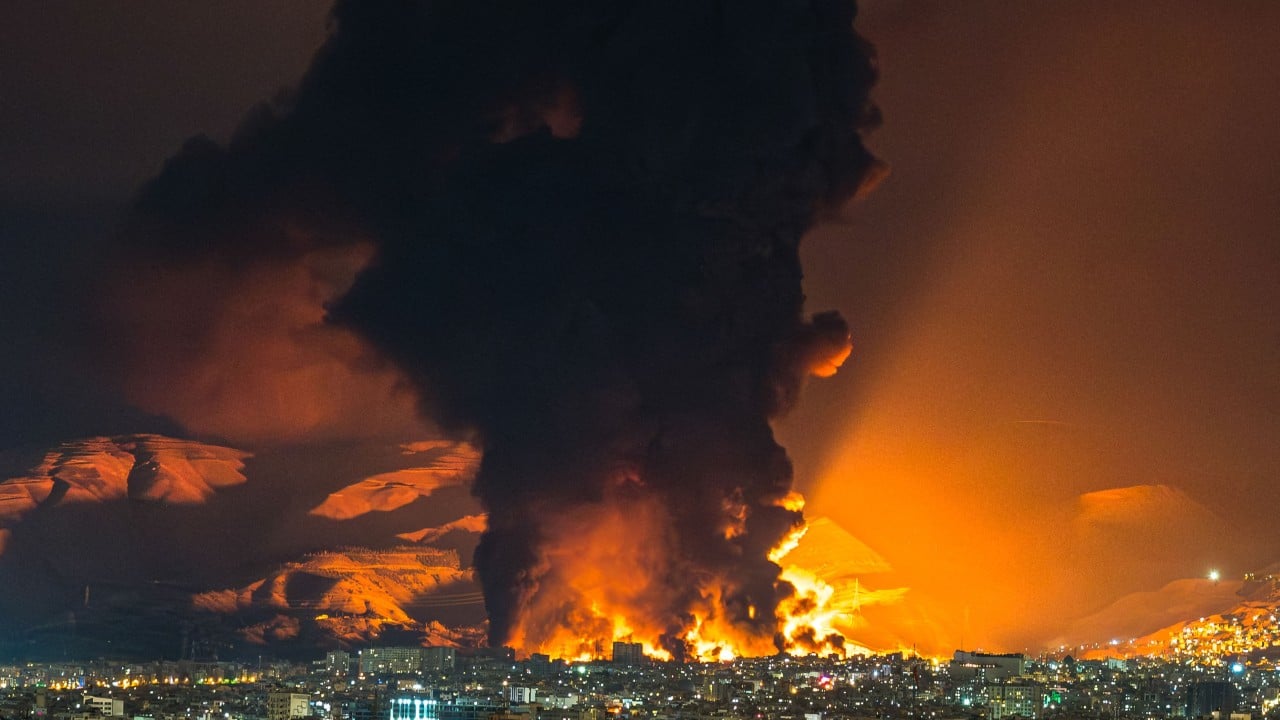
The coffee in your mug is a miracle of logistics. You don’t think about the bean’s journey from a high-altitude farm in Ethiopia, through the jagged, narrow Strait of Hormuz, and into your kitchen. You just want to wake up. But as you stir in the cream, a world away, a single spark in the Persian Gulf is threatening to turn that morning ritual into a luxury of the past.
We have been here before. History doesn't just repeat; it echoes. In 1973, it was the Yom Kippur War. In 1979, the Iranian Revolution. We remember the grainy footage of cars stretched for blocks at gas stations and the grim faces of presidents telling us to turn down the thermostat. We call those the "oil shocks." They were seismic. They rewrote the global economy. Yet, the shadow currently stretching across the Middle East suggests that those two crises were merely dress rehearsals.
A full-scale conflict involving Iran wouldn't just be a localized war. It would be a heart attack for the global energy system.
The Narrow Gate
Imagine a hallway. It is thin, cramped, and serves as the only exit for a massive building housing thousands of people. Now, imagine someone slamming the door and twisting the lock. That is the Strait of Hormuz.
At its narrowest point, the shipping lanes are only two miles wide. Through this tiny throat of water passes roughly 21 million barrels of oil every single day. That is one-fifth of the world’s total consumption. It isn’t just oil, either. A massive portion of the world’s liquefied natural gas (LNG), the stuff that heats homes in Berlin and powers factories in Tokyo, flows through this same precarious gap.
If Iran decided to choke that point, the "shock" wouldn't be a gradual rise in prices. It would be an overnight evaporation of supply. We are talking about a scenario where the global market loses a chunk of its lifeblood in the time it takes for a news cycle to break. Unlike the 1970s, the world is now more interconnected, more "just-in-time," and more fragile.
The Hypothetical Case of Elias and the Logistics Chain
Consider Elias. He’s a long-haul trucker in Nebraska. He doesn't follow Middle Eastern geopolitics. He cares about the price of diesel and the mortgage on his three-bedroom ranch.
In a standard geopolitical skirmish, the price of oil might tick up five dollars. Elias feels it at the pump, grumbles, and moves on. But if a war with Iran shuts down the Strait, we aren't looking at a five-dollar increase. Analysts at major financial institutions have whispered about oil hitting $150 or even $200 a barrel.
At $200 a barrel, Elias’s business model dies. The cost of transporting a crate of oranges from Florida to New York doubles. The cost of the plastic packaging those oranges sit in—derived from petroleum—triples. Suddenly, the "inflation" we’ve been battling feels like a fond memory.
This is the "invisible stake." It isn't just about the military maneuvering of destroyers and drones. It is about the fact that our entire modern existence is built on the assumption of cheap, flowable energy. When that flow stops, the modern world stops with it.
The Ghost of 1973
To understand the scale of the threat, we have to look at what happened when the taps were turned off before. In 1973, the OAPEC nations declared an embargo. The price of oil quadrupled. It didn't just make driving expensive; it caused a global recession that lasted years. It broke the back of the post-war economic boom.
The 1979 shock was even worse for the psyche. Long lines. Fistfights at pumps. The realization that a superpower could be brought to its knees by a change in government five thousand miles away.
Today, the situation is more volatile. In the 70s, the Soviet Union was a stable, if rival, energy producer. Today, Russia is sanctioned and mired in its own war. China, the world's largest importer of oil, is no longer a sleeping giant but a hungry one. If Iranian oil—and the oil of its neighbors—is pulled from the board, there is no "Plan B" waiting in the wings.
The U.S. Strategic Petroleum Reserve is at its lowest level in decades. We have used our safety net to cushion the blows of the last few years. If the big one hits now, we are hitting the concrete without a mat.
The Dominoes in the Desert
A conflict with Iran is rarely just about Iran. It’s a regional wildfire.
Iran has spent decades building a "Ring of Fire" around the Middle East. If a direct war begins, it isn't just the Strait of Hormuz that closes. You have the Bab al-Mandab strait at the mouth of the Red Sea, where Houthi rebels already prove they can disrupt global shipping with relatively inexpensive drones.
Think about the vulnerability of the infrastructure. The giant desalination plants in Saudi Arabia and the United Arab Emirates provide the water that keeps those desert cities alive. They run on power. They are within range of Iranian missiles. If the power goes out, the water stops. If the water stops, you have a humanitarian catastrophe that makes current refugee crises look like a ripple in a pond.
The sheer density of the world’s energy infrastructure in such a small, volatile geographic area is a design flaw in our civilization. We have put all our eggs in a basket that sits on a tectonic fault line.
The Myth of Energy Independence
You will hear politicians talk about "energy independence." It’s a comforting phrase. It suggests that because we produce more oil and gas at home, we are immune to the chaos abroad.
It is a lie.
Oil is a global commodity. Even if every drop of oil used in America was drilled in Texas, the price is set on a global stage. If the world loses 20% of its supply because Hormuz is mined or blocked, the price of Texas tea goes up just as fast as the price of Brent Crude. Traders in London and Singapore don’t care where the oil comes from; they only care that there isn't enough of it.
Your local gas station doesn't have a "Made in the USA" discount when the world is on fire.
The Psychological Toll
Beyond the spreadsheets and the shipping lanes lies the most dangerous element of all: panic.
Energy is the foundation of trust in a society. When you flip a switch, the light comes on. When you turn the key, the engine starts. When those fundamental expectations are violated, the social contract begins to fray. We saw it in the 70s—the sudden rise in crime, the loss of faith in institutions, the sense that the future was shrinking.
A war with Iran would be a psychological body blow. It would signal that the era of easy globalization is over. It would force a radical, painful restructuring of how we live, move, and eat.
The Cost of Silence
We often treat these geopolitical tensions as "background noise"—something that happens to people in uniforms on the other side of a screen. But the geography of the Middle East is the geography of your bank account. The security of a few miles of water in the Persian Gulf is the security of your retirement fund, your job, and the price of the bread on your table.
The 1970s shocks were a warning we chose to forget. We built bigger cars, longer supply chains, and more complex dependencies. We doubled down on a system that relies on total stability in the most unstable region on earth.
Right now, the tension is a low hum. It’s a series of headlines we scroll past. But the tension is building, the pressure in the pipe is rising, and the ghosts of the 70s are standing at the door, waiting to see if we’ve learned anything at all.
Somewhere in the darkness of the Gulf, a tanker is moving. Its wake is the only sound in the night. For now, the oil flows. For now, the lights stay on. But the hand is on the valve, and the grip is tightening.
Would you like me to analyze the specific economic sectors most at risk if the Strait of Hormuz were to close for more than thirty days?