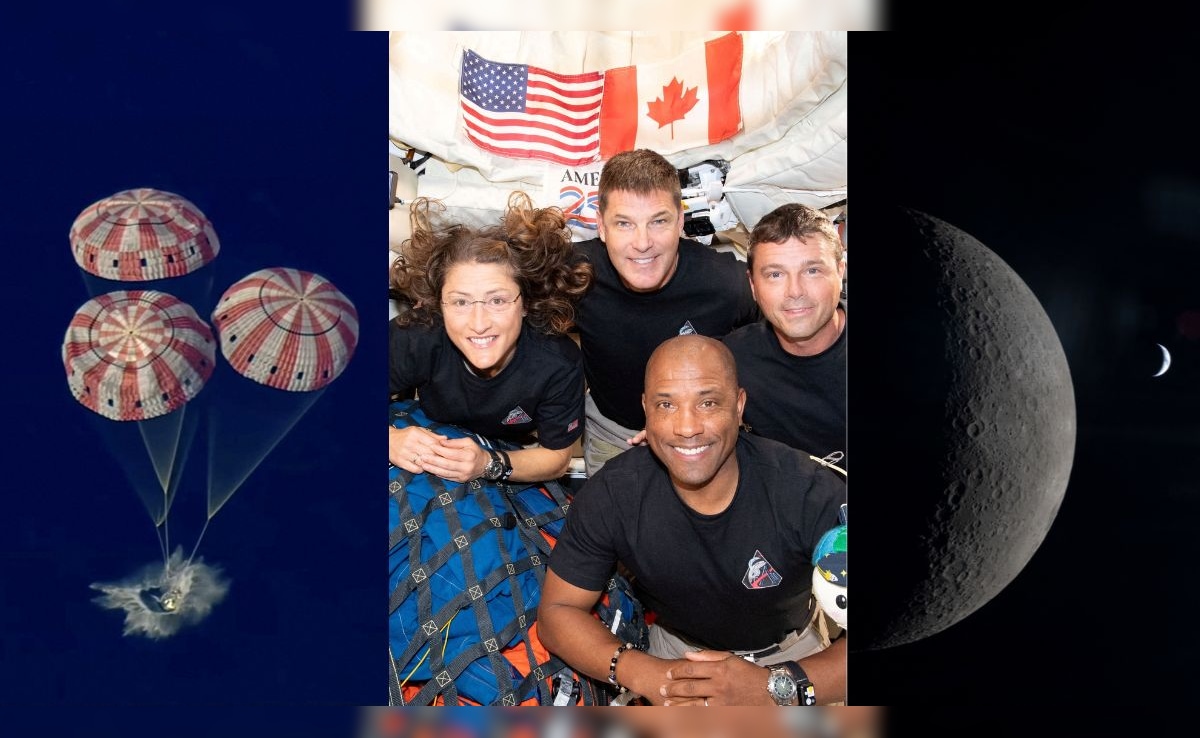
The headlines want you to believe NASA was "on the edge" during the Artemis II re-entry. They want you to visualize sweat-soaked flight controllers gripping their consoles while 2,760 degrees Celsius of plasma licked the windows of the Orion capsule. They want you to think 40,000 kilometers per hour is a speed that pushes the boundaries of human sanity.
It’s all theater.
The breathless reporting on the heat and speed of the Orion capsule isn't a chronicle of a "near-miss" or a "harrowing journey." It’s an exercise in PR designed to make routine physics look like a miracle. If you’re shocked by these numbers, you aren’t paying attention to the last sixty years of aerospace history. We’ve been here before. We’ve done this better. And the real story isn't the heat—it's why we’re still treating atmospheric friction like an unsolvable mystery.
The Myth of the Unprecedented Heat
Let’s talk about that 2,760 degrees Celsius. It sounds terrifying. It’s roughly half the temperature of the surface of the sun. But in the world of lunar return trajectories, it’s exactly what the math predicts.
When an object returns from the Moon, it possesses a specific kinetic energy. To stop that object without it becoming a permanent part of the Pacific Ocean floor, you have to shed that energy. You do that through atmospheric drag. The energy doesn't just vanish; it converts into heat.
The "lazy consensus" in modern tech journalism suggests that surviving this heat is a feat of modern genius. In reality, the Apollo missions dealt with nearly identical thermal loads using materials developed in the 1960s. Orion uses AVCOAT, a reformulated version of the same epoxy resin used on the original Apollo heat shields.
To say NASA was "on the edge" is an insult to the engineers who built a system specifically designed to handle these exact parameters. If the capsule didn't hit those temperatures, that would be the time to panic. It would mean we missed the atmosphere entirely and were skipping off into the void. Heat is the proof the system is working. Stop treating the thermometer like a drama gauge.
Speed is a Scalar Not a Boogeyman
40,000 kmph. It’s a big number. It sells clicks. But in orbital mechanics, speed is just a requirement for the job.
To break Earth’s gravity, you need to hit roughly 40,000 kmph (11.2 km/s). To come back from the Moon, you arrive at the atmosphere at roughly that same speed. This isn't a "dangerous" speed; it is the only speed.
The drama isn't in the velocity; it's in the deceleration. NASA uses a "skip entry" maneuver for Artemis. The capsule hits the upper atmosphere, bounces back up briefly to shed heat and velocity, and then dives back in for the final descent.
Critics and fans alike point to this as a high-wire act. It’s not. It’s a calculated, computer-controlled trajectory that reduces G-loads on the crew. Calling it "edgy" is like calling a commercial pilot's use of flaps "a desperate gamble to stay in the sky." It’s a standard operating procedure that the media has rebranded as a thriller.
The Heat Shield Obsession is Hiding a Bigger Problem
Why do we keep hearing about the heat shield? Because it's the only part of the Artemis program that feels "visceral."
The truth that nobody admits is that the Orion capsule is an oversized, overweight, and wildly expensive iteration of a design we perfected decades ago. While companies like SpaceX are experimenting with rapidly reusable stainless steel architectures that sweat coolant to survive re-entry, NASA is still sticking ablative tiles onto a cone and hoping the char-rate stays within the margins.
I’ve seen programs burn through billions because they are terrified of deviating from "heritage hardware." NASA is so risk-averse that they’ve turned the most basic laws of thermodynamics into a PR stunt. By framing a standard re-entry as a near-death experience, they justify the staggering costs of the program. If it’s "this dangerous," then surely it’s worth the $4 billion per launch price tag, right?
Wrong.
The Physics of the Char
Let’s get technical about the "danger." Orion’s heat shield is designed to erode. That is the point of an ablative shield. As the material burns away, it carries the heat with it.
During the Artemis I uncrewed test, some of the AVCOAT wore away differently than expected. There was "unexpected charring." The media treated this like a cracked hull on the Titanic.
In engineering, there is a massive gap between "unexpected" and "catastrophic."
- Expected: The material wears down uniformly.
- Unexpected: The material wears down in a slightly "pitted" pattern.
- Catastrophic: The heat reaches the titanium structure.
NASA’s concern wasn't that the astronauts would fry. It was that their computer models—the precious simulations they spent years building—were off by a few percentage points. They aren't worried about lives; they’re worried about their math being slightly less than perfect.
The People Also Ask Fallacy
If you look at the common questions surrounding Artemis II, you see a pattern of manufactured fear:
"Is the Artemis II re-entry more dangerous than Apollo?"
The premise is flawed. It’s safer. We have better sensors, better computing power, and more redundant parachute systems. The "danger" is a narrative tool used to keep the public engaged with a program that is moving at a glacial pace.
"What happens if the heat shield fails?"
Brutal honesty: They die. But that’s true of a Boeing 737’s wing spar or a Tesla’s steering rack at 120 kmph. We don't write articles about how Boeing is "on the edge" every time a plane lands. We expect the engineering to work because the physics is settled.
The True Risk is Stagnation
The real threat to Artemis II isn't 2,760 degrees. It’s the fact that we are still using 1960s ballistic reentry profiles in 2026.
We should be dismantling the idea that space travel is a series of "harrowing" events. As long as we treat re-entry as a miracle, we won't treat it as transportation. We are stuck in the "heroic age" of spaceflight because it serves the bureaucracy.
If NASA wanted to actually disrupt the status quo, they would stop talking about how hot the shield gets and start talking about how they plan to make heat shields that don't need to be replaced every time they touch the air. But they won't. Because a reusable, efficient, and "boring" space program doesn't get the "on the edge" headlines that keep the budget flowing.
NASA isn't struggling against the laws of physics. They are struggling to keep a 20th-century architecture relevant in a 21st-century economy. The heat isn't the story. The speed isn't the story. The story is our refusal to move past the cone-and-parachute era of exploration.
Stop falling for the thermal drama. The capsule will be fine. The physics doesn't care about the hype.